
Table of Contents
Every year, archaeologists pull objects out of the ground that force us to rethink everything we thought we knew about the past. Some discoveries confirm long-held theories, while others throw established narratives into chaos. Here are some of the most revealing archaeological discoveries from recent years, each one a piece in the puzzle of human history.
Stone Age Goddess Figurine: The Tumba Madžari Great Mother
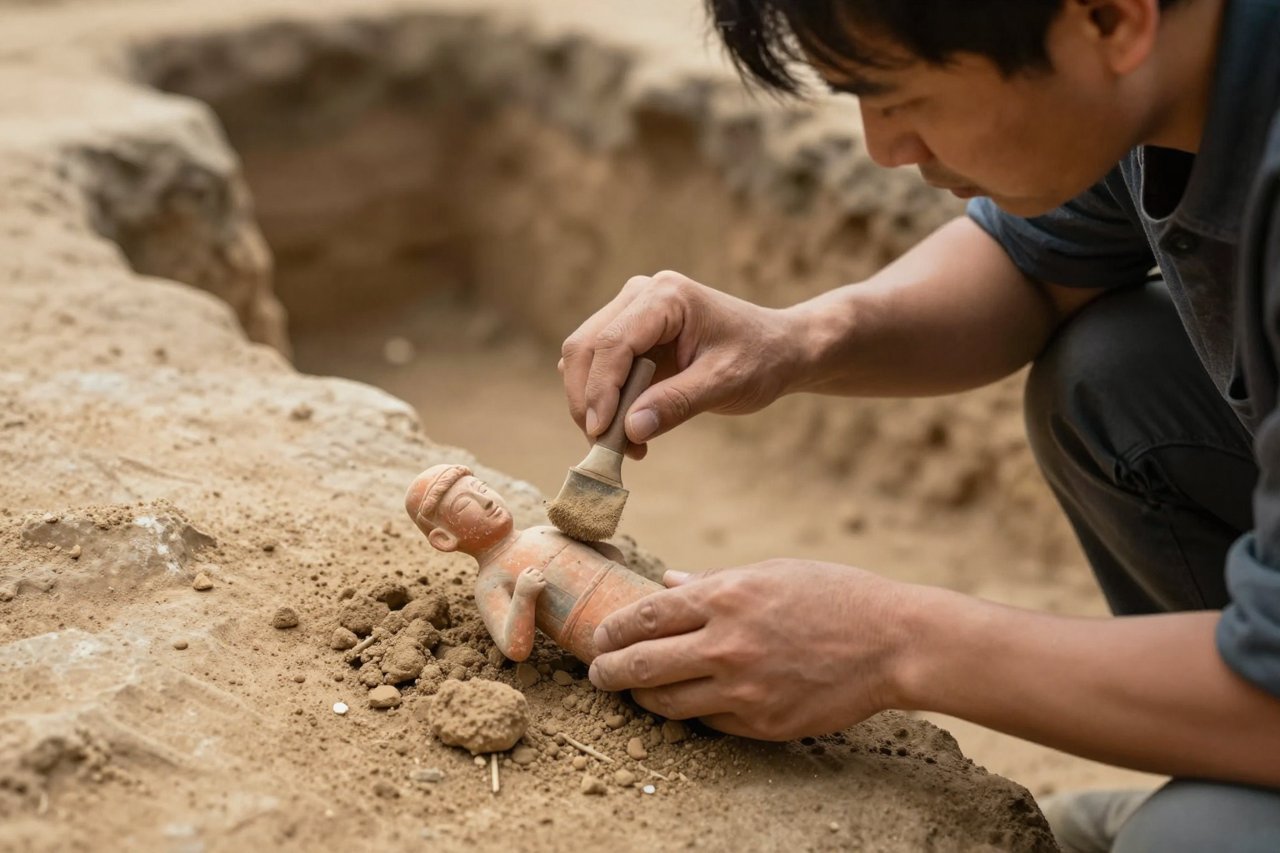
In North Macedonia, a remarkable discovery has shed light on the spiritual life of Neolithic people. The Tumba Madžari Great Mother is a boxy goddess figurine designed to protect Stone Age houses 7,800 years ago. Found at the Tumba Madžari archaeological site near Skopje, this terracotta figure stands about 10 centimeters tall and depicts a stylized female form with exaggerated hips and a flat, rectangular body. Archaeologists believe it was placed in a special niche or altar within homes to ward off evil spirits and ensure fertility. The figurine is one of the oldest known representations of a mother goddess in the Balkans, offering a rare glimpse into the rituals and beliefs of early farming communities.
DNA Analysis Reveals Elite Families Ruled Scythian Society
The Scythians were nomadic warriors who dominated the Eurasian steppes around 2,500 years ago, but their social structure has long been a mystery. Recent DNA analysis reveals that elite families ruled nomadic Scythian society, overturning the idea that they were a loose confederation of equal tribes. By sequencing genomes from 31 Scythian burial mounds in the Black Sea region, researchers found that high-status individuals were closely related, often within a single lineage. One burial contained a father and his two sons, all adorned with gold and weapons. This suggests that power was hereditary, with family dynasties controlling trade routes and military campaigns. The study also showed that Scythian women could attain elite status, as some female burials contained weapons and jewelry similar to men.
How DNA Analysis Is Changing Archaeology
Ancient DNA (aDNA) has become a game-changer in archaeology. Unlike traditional methods that rely on artifacts and texts, DNA can reveal kinship, migration patterns, and even disease. In the case of the Scythians, it proved that nomadic societies could be just as hierarchical as settled civilizations. For more on how genetics is revolutionizing the field, check out the 7 Most Recent Shocking Archaeological Discoveries, which includes several aDNA breakthroughs.

New Archaeological Study Challenges the Paleo Diet
The Paleo diet has been hugely popular among health enthusiasts who claim it mimics what our ancestors ate during the Stone Age. But a new archaeological study challenges the Paleo diet by showing that ancient humans had a far more varied and plant-heavy diet than previously thought. Researchers analyzed carbon isotopes in tooth enamel from Neanderthals and early Homo sapiens in Europe and found that they consumed large amounts of grains, legumes, and even tubers. In fact, some individuals derived up to 50% of their protein from plant sources. The study also found evidence of cooking and processing techniques that made plant foods more digestible. So much for the all-meat caveman stereotype.
Ancient Corn in Mexican Cuisine: A 9,000-Year-Old Legacy
Corn is a staple of Mexican cuisine today, but its domestication began thousands of years ago. Understanding and Eating Your Way Through Corn in Mexican Cuisine is not just a culinary journey—it’s an archaeological one. The earliest evidence of domesticated corn comes from Mexico’s Balsas River valley, where tiny cobs dating back 9,000 years were found. These early cobs were only a few centimeters long and had just a handful of kernels. Over millennia, indigenous farmers selectively bred corn into the large, productive crop we know today. The process also involved nixtamalization, a technique that uses lime to treat corn, making its nutrients more bioavailable. This discovery highlights how archaeological findings can enrich our understanding of modern food traditions.
Recent Shocks: 5 Archaeology News That Have Amazed the World
Not all breakthroughs come from planned excavations. Sometimes, they emerge from chance finds or re-examinations of old collections. The 5 Archaeology news that have amazed the world include a hidden Mayan city discovered in Mexico using LiDAR, a Viking ship burial in Norway that contained the remains of a high-ranking woman, and a 3,000-year-old Egyptian mummy that still had its brain intact. These stories remind us that the ground still holds countless secrets.
LiDAR: Revealing Lost Cities from the Air
LiDAR technology uses laser pulses to map the ground beneath dense forest canopies. In Central America, it has uncovered entire cities that were invisible to archaeologists on foot. One survey in Guatemala revealed over 60,000 structures, including palaces, causeways, and irrigation systems, all built by the Maya. This method is now being used in Cambodia, the Amazon, and even Europe to find hidden archaeological landscapes.
The Future of Archaeological Discoveries
As technology advances, so does our ability to uncover the past. DNA analysis, LiDAR, and other non-invasive techniques are allowing archaeologists to explore without destroying sites. Meanwhile, public interest in archaeology has never been higher, fueled by news of spectacular finds. But the real excitement lies in the mundane objects—a broken pot, a discarded tool—that tell the stories of everyday life. Every discovery, big or small, adds a new line to the human story.


