
Table of Contents
You’ll probably buy the wrong foundation at least twice before you find one you repurchase on purpose. That’s not a personal failing. The category is built to trip you up: forty-plus shades under fluorescent light, testers that have been open since March, and a counter assistant working towards a sales target.
The frustrating part is that nearly all of these mistakes are avoidable, and they cost the same whether the bottle is cheap or expensive. Here are the ones that come up again and again, plus what to do instead.
The jawline test is only half the test
Swiping one shade along your jaw and nodding at the mirror is how most people choose a foundation, and it’s how most people end up with a bottle that’s half a shade too pink or two shades too light. Your jaw sees less sun than your cheeks, your neck is often a different depth entirely, and store lighting runs cool, which pushes warm shades towards grey.
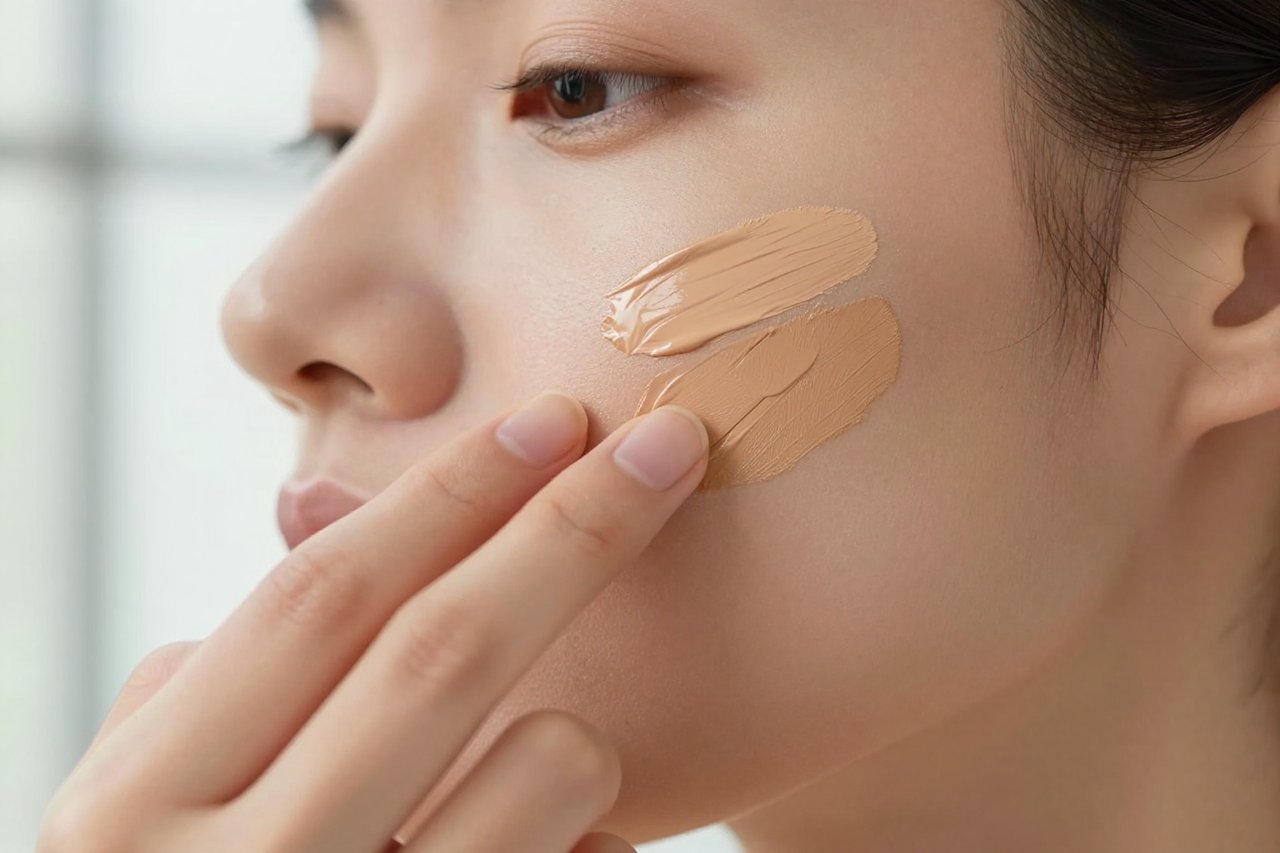
What works better: three stripes, side by side, on the cheek. Blend the edges lightly. Then leave the shop, walk into natural daylight, and look in a compact mirror after about three minutes. That’s when oxidation kicks in and the shade settles. The one that disappears into your skin is your match. The one that looks slightly off at 11am will look loudly wrong by 4pm.

If you want a repeatable system rather than trial and error, a step-by-step method for finding your shade is worth reading before you spend again, because most people repeat the same mistake with every purchase.
Swatching the back of your hand is close to useless
Hands are typically one to two shades deeper than faces and far more textured, because they take more sun and more washing. A shade that vanishes on your hand can sit chalky and flat on your face. Test strips belong on the face or, at a push, the inner wrist.
Two more testing mistakes worth naming:
- Trying shades on bare, freshly exfoliated skin. Foundation behaves differently over your actual morning routine, so test over moisturiser and SPF, or you’ll buy a formula that separates by lunchtime.
- Trusting the counter lighting. Ask to step outside with a mirror. Any assistant who won’t let you do that isn’t selling you the best foundation for your face, they’re selling you a bottle.
More coverage doesn’t fix more problems
Full coverage is the default goal for a lot of people, and it’s the wrong one for most. Thick pigment doesn’t hide texture; it settles into it. Pores, fine lines around the eyes and any flaking from retinol or cold weather all read sharper under a heavy base, because the formula pools in the dips and sits on top of the bumps.
Medium coverage that you build only where you need it, a touch extra over redness or a spot, looks more like skin and wears longer through the day. If you need a genuinely full-coverage moment for an event, use a denser formula once, in a thin layer, and skip powder everywhere except the T-zone.
You can blame the primer, not just the foundation
Pilling, patchiness and foundation that slides off by lunch are often a pairing problem. Silicone-based primers and water-based foundations don’t mix; the foundation beads up on top of the slip layer. Same story with a rich, oil-heavy moisturiser under a matte, alcohol-forward formula.
The rule of thumb: match the base of your primer to the base of your foundation, and give each layer 60 seconds to settle before the next one. The best foundation for you is the one that fits your skin, not the one with the loudest campaign, and that includes how it behaves next to everything else you’re already using.
Skin type is not a marketing category
An oily complexion and a dehydrated one need different things, and shopping for the wrong one is the most expensive habit in the category. Matte, oil-free formulas genuinely hold better through a long day on an oily T-zone. On dry or dehydrated skin the same formula turns tight and flaky within an hour.
If shine through the day is your main complaint, it’s worth comparing specific formulas rather than categories, which is how these foundations for oily skin are grouped. And if you’re torn between cushion, powder, serum and classic liquid bases, this comparison of every base type lays out what each one actually does well.
Tools are eating your product and your finish
A damp beauty sponge absorbs somewhere between a quarter and a third of what you put on it. That’s fine if you want sheer coverage, less fine if you’ve paid for a high-pigment formula. Brushes give you more control and more coverage per pump; fingers are genuinely underrated for a thin, skin-like layer.
Whichever you use, start with less than you think. Half a pump covers a whole face. You can always add; you can’t un-cake.
What looked good in the shop will look different at 4pm
Oxidation is real. Pigments react with your skin’s oils and pH, and a foundation can deepen by half a shade to a full shade over a few hours. That’s partly why the colour that matched at 11am looks orange by the evening.
Two habits that catch it:
- Photograph your face with the back camera in daylight, not the front camera in a bathroom. Front cameras smooth texture, and bathroom bulbs lie about colour.
- Wear the sample for a full day before buying. Ask for a sample pot; most counters will give you one. Four hours of wear tells you more than twenty minutes at a mirror.
That bottle from two years ago isn’t a bargain
Most foundations carry a 12-month symbol, and it means what it says once the seal is broken. Past that, the oils separate, the pigment settles, the preservative system stops doing its job and you’re applying bacteria to your face with a nice brush. If your foundation smells different, looks streaky when you shake it or has changed colour, bin it. A new bottle costs less than a course of treatment for a breakout.
You don’t need a full routine reset to fix a touch-up
Reapplying your whole base at 3pm over an already-powdered face is how things get muddy. A stick or a small cream formula on the areas that have worn away, redness around the nose, a spot, the chin, blends back in without disturbing the rest. It’s also the practical option if you leave the house at 7am and finish at 9pm; these foundation sticks for on-the-go coverage are built for exactly that job.
What to do differently on your next visit
None of this requires a bigger budget. It requires testing the product the way it will actually be worn.
- Go bare-faced, or bring your own primer and SPF to test over.
- Ask for three stripes on the cheek in three close shades, then check them in daylight.
- Take the sample home, wear it for a full day, and judge it at the eight-hour mark.
- Check the formula base against your primer before you commit.
- Write down the shade and the batch code, so next time you’re not starting from zero.
Do that once and you’ll skip the two or three wrong bottles most people buy in a lifetime. The best foundation isn’t the one with the biggest following online. It’s the one you stop thinking about by 10am because it’s still doing exactly what you wanted.


