
Table of Contents
What Crepey Skin Really Is
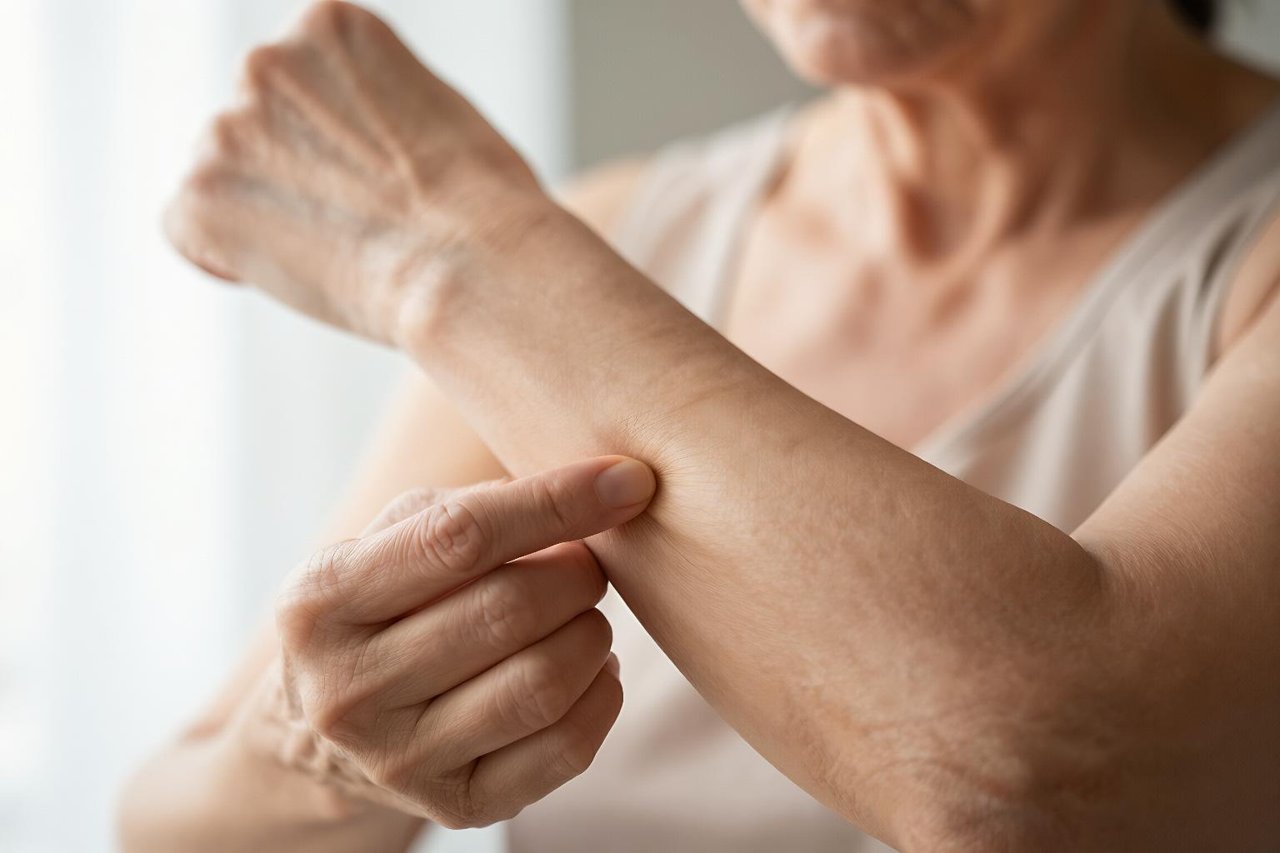
Pinch the skin on the back of your forearm and let go. Younger skin snaps back like a stretched rubber band. Skin that has turned crepey settles slowly, and while it’s pinched it folds into dozens of fine, shallow crinkles that look a bit like crepe paper. That’s where the name comes from.
The change isn’t a surface problem. It starts in the dermis, the thick middle layer that holds water, collagen and elastin. When that layer thins and its support fibres fragment, the epidermis above has nothing firm to sit on. It creases, sags and loses that plump, cushioned look.
Collagen and Elastin: The Scaffolding Gives Way
Collagen gives skin its strength. Elastin lets it stretch and spring back. Both are built by cells called fibroblasts, and those cells become slower and fewer with every decade.
From your mid-twenties onwards, you lose roughly 1% of your dermal collagen each year. Elastin is trickier: the fibres you’re born with are largely the ones you keep, and once they fray, the body rebuilds them poorly. Think of an old mattress. The springs are still there, but they’ve lost their bounce, so the fabric on top creases in the same spot over and over.

Sun Exposure: The Biggest Single Culprit
If you want one answer to what causes crepey-looking skin, this is it. Ultraviolet light does more visible damage than birthdays do.
What UV does beneath the surface
UVA rays travel deep into the dermis and switch on enzymes called matrix metalloproteinases, which break down collagen. Decades of that add up to a condition dermatologists call solar elastosis, where healthy elastin is replaced by clumped, useless material that can’t support anything. Many researchers attribute around 80% of visible facial ageing to UV exposure rather than the passing years.
A quick comparison proves it. Look at the skin on the back of your hand next to the skin on your inner upper arm or buttock, which barely sees daylight. Same person, same age, wildly different texture.
Photoageing versus chronological ageing
Chronological ageing thins skin evenly and gradually. Photoageing is patchy, faster and far more dramatic, which is why a 45-year-old who grew up on a boat can have crepier arms than a 60-year-old who stayed in the shade.
Windows, cars and cloudy days
UVA passes straight through glass. If you drive a lot, your left arm and the left side of your neck get a steady, unnoticed dose. Winter sun and overcast skies still deliver UV, so the damage accrues all year rather than in a few summer weeks.
Weight Loss and Lost Volume
Fat pads under the skin act like filler. When they shrink, the skin that was stretched over them doesn’t always retract, particularly after 40 when elastic recoil has already declined. Losing 20 to 30 pounds over a year, whether through diet, illness or GLP-1 medication, often leaves loose, finely wrinkled skin on the upper arms, thighs, neck and abdomen. It’s a volume problem dressed up as a texture problem.
Smoking and Vaping
Nicotine narrows blood vessels, so skin receives less oxygen and fewer nutrients. Each cigarette also triggers a burst of those collagen-chewing enzymes while temporarily suppressing new collagen production. Long-term smokers develop what’s sometimes called smoker’s face: grey-toned, hollowed and crepey, especially around the mouth and eyes where the crinkling from pursing and squinting adds mechanical wear on top.
Hormones, Especially Around Menopause
Oestrogen supports fibroblast activity and skin thickness. When levels fall, the drop is steep. Women can lose up to 30% of their dermal collagen in the first five years after menopause, which is why crepiness often appears suddenly in the late forties and fifties rather than creeping in slowly. Lower oestrogen also reduces oil production and hyaluronic acid, so skin looks drier at exactly the moment it becomes less resilient.
Dehydration and a Weakened Barrier
Drinking more water won’t erase crepiness, but dehydrated skin makes it far more obvious. The outer layer needs a healthy lipid barrier to hold moisture in. Long hot showers, foaming cleansers, alcohol-heavy toners, central heating and winter air all strip that barrier. Skin that’s slightly dehydrated shows every fine line more sharply, then looks noticeably smoother within days of proper moisturising.
Genetics and Skin Type
Some of this is written in your DNA. Fair, thin, dry skin tends to crepe earlier than oily or darker skin, which has more natural protection and thicker dermal structure. Connective tissue differences run in families too. Two 55-year-olds can have completely different forearms despite similar habits, and that’s largely inherited.
Medications and Health Conditions
Certain drugs thin the skin directly. Topical and oral corticosteroids are the classic example, and long-term use on the face or arms can produce fragile, papery skin within months. Poorly controlled diabetes, thyroid problems, kidney disease and circulation issues all affect skin quality. So do nutritional shortfalls, particularly low protein and vitamin C intake, since both are needed to manufacture collagen.
Where Crepey Skin Appears First
Skin thickness and sun exposure vary across the body, so the order is fairly predictable:
- Under the eyes, where skin is thinnest to begin with
- The neck and décolletage, which people routinely leave unprotected
- The backs of the hands, the most sun-exposed area on the body
- Upper arms and forearms, especially above the elbow
- Knees and inner thighs, where decades of friction add to the effect
- The abdomen, often after pregnancy or significant weight change
What Actually Helps
Daily habits that slow the process
Broad-spectrum SPF 30 or higher on your hands, neck and arms whenever they’re exposed is the single highest-return habit. A retinoid applied to the forearms and neck two or three nights a week builds collagen over six to twelve months, though you’ll see smoother texture before you see firmer texture. A moisturiser containing urea, glycerin or ceramides plumps the outer layer and makes crepiness look calmer within a week. Stop smoking and switch to lukewarm showers and a non-foaming cleanser, and you remove two ongoing sources of damage.
In-clinic options with real evidence
If you want structural change rather than a temporary smoothing effect, microneedling, fractional laser resurfacing and radiofrequency all stimulate new collagen in the dermis. Hyaluronic acid filler works well on crepey hands and thin under-eye skin. Expect improvement, not a reversal, and budget for maintenance sessions, because the underlying ageing process doesn’t stop between treatments.
Be sceptical of firming creams that promise to rebuild collagen. The molecules are too large to reach the dermis in meaningful amounts. What they can do is hydrate and temporarily tighten the surface, which is a legitimate but short-lived result. Judge any product by whether your skin looks better at the end of the bottle, not the end of the first hour.


