
Table of Contents
Ask five people how much protein you need and you’ll get five answers. Fifty grams. A hundred grams. “One gram per pound.” “Just eat more meat.” A protein intake calculator exists to settle that argument with a number you can actually work with.
It mostly works, too. But only if you know what’s happening inside the box. Here’s the whole thing explained from zero, no nutrition degree required.
What a Protein Intake Calculator Is Actually Doing
Strip away the branding and every calculator runs the same three-step recipe. It takes your body weight, multiplies it by a grams-per-kilogram factor, then nudges that result up or down depending on how active you are and what you’re trying to achieve.
That factor is the whole ballgame. The official RDA sits at 0.8 grams per kilogram of body weight — a figure designed to prevent deficiency in a sedentary adult, not to build anything. Research on resistance training lands somewhere between 1.6 and 2.2 g/kg for muscle growth, and higher still for people eating in a calorie deficit who want to hold onto what they’ve already built.

So when two calculators disagree, they usually aren’t wrong. They’re using different multipliers, or handling body fat differently, or rounding at different points. If a tool just told you 180 grams and a different one said 120, there’s a comparison of which protein intake calculator is worth using that walks through exactly why those gaps appear.
The Four Inputs That Change Your Answer
Most tools ask for the same handful of things. Each one moves the output more than beginners expect.
Body weight — and which number you type in
This is the big one. A 95 kg person carrying 25 kg of excess fat doesn’t need the same protein as a lean 95 kg athlete, because protein requirements track lean mass far more closely than total mass. Some calculators let you enter lean body mass directly. If yours doesn’t and you’re carrying significant body fat, expect the result to run high.
Activity level
Sedentary, lightly active, three sessions a week, five sessions a week — the factor climbs with each step. A desk-bound adult might sit near 1.0 g/kg. Someone training hard five days a week can justify 1.8 to 2.2. That’s a difference of 80 grams for the same 80 kg body.
Your goal
Maintaining weight, building muscle, and losing fat all pull the number in different directions. Cutting is the one people get wrong most often. Protein needs go up in a deficit, not down, because it’s the nutrient doing the heavy lifting on muscle retention while you’re eating less.
Age and life stage
Adults over about 60 typically need more protein than younger people to get the same muscle-building response, often 1.0 to 1.2 g/kg at minimum. Pregnancy, illness, and recovery from injury all shift things too. A generic calculator may not ask about any of this — a reason to treat its output as a starting point rather than gospel.
A Worked Example, Start to Finish
Take a 70 kg office worker who lifts three times a week and wants to add muscle.
- Body weight: 70 kg (about 154 lb)
- Activity factor for regular training: 1.6–2.0 g/kg
- Daily target: roughly 112–140 g of protein
Compare that with the RDA figure of 56 g for the same person. More than double, from the same body, because the goal changed. Someone with no training history and no muscle-building goal genuinely doesn’t need the higher number.
Now switch the goal to fat loss while keeping the training. The multiplier typically rises to about 2.0–2.4 g/kg to protect muscle in a deficit, giving 140–168 g. Same person, same gym sessions, different plate. Working through a step-by-step protein calculator example with your own numbers takes about two minutes and makes this click fast.
Grams per Kilogram vs. Percentage of Calories
Some calculators hand you “30% of calories from protein” instead of a gram figure. It sounds tidy. It’s also the weakest method going, because the target moves whenever your calories do.
A 2,000-calorie day at 30% gives 150 g. Drop to 1,600 calories while dieting and the same 30% now gives 120 g — a lower protein intake at precisely the moment you need a higher one. Weight-based maths doesn’t have that problem. When a tool offers both, trust the grams.
Why the Answer Is a Range, Not a Single Number
Calculators hand you an exact figure because exact figures look confident. Reality is messier. Appetite, digestion, training quality, sleep, and genetics all change how much of that protein actually gets used. A 15-gram swing in either direction rarely matters.
Pick a number near the middle of your range, hold it for three or four weeks, and let the scale and your training log tell you whether it’s working. If strength is climbing and recovery feels fine, you’re in the right zone. If you’re constantly sore and losing weight you didn’t want to lose, eat more.
Beginner Mistakes That Quietly Skew the Number
- Entering a goal weight instead of a current weight, which undercuts the target by 20 grams or more.
- Counting a whole chicken breast as 50 g of protein when 150 g of cooked chicken is closer to 45 g.
- Forgetting that plant proteins vary in digestibility, so a bean-heavy day delivers less usable protein than the label suggests.
- Setting the target once and never revisiting it after losing 8 kg.
- Hitting the number on training days and forgetting it entirely at weekends.
These add up. There’s a useful rundown of protein intake calculator mistakes that skew your daily target if you want to audit your own approach properly.
From a Number to an Actual Plate
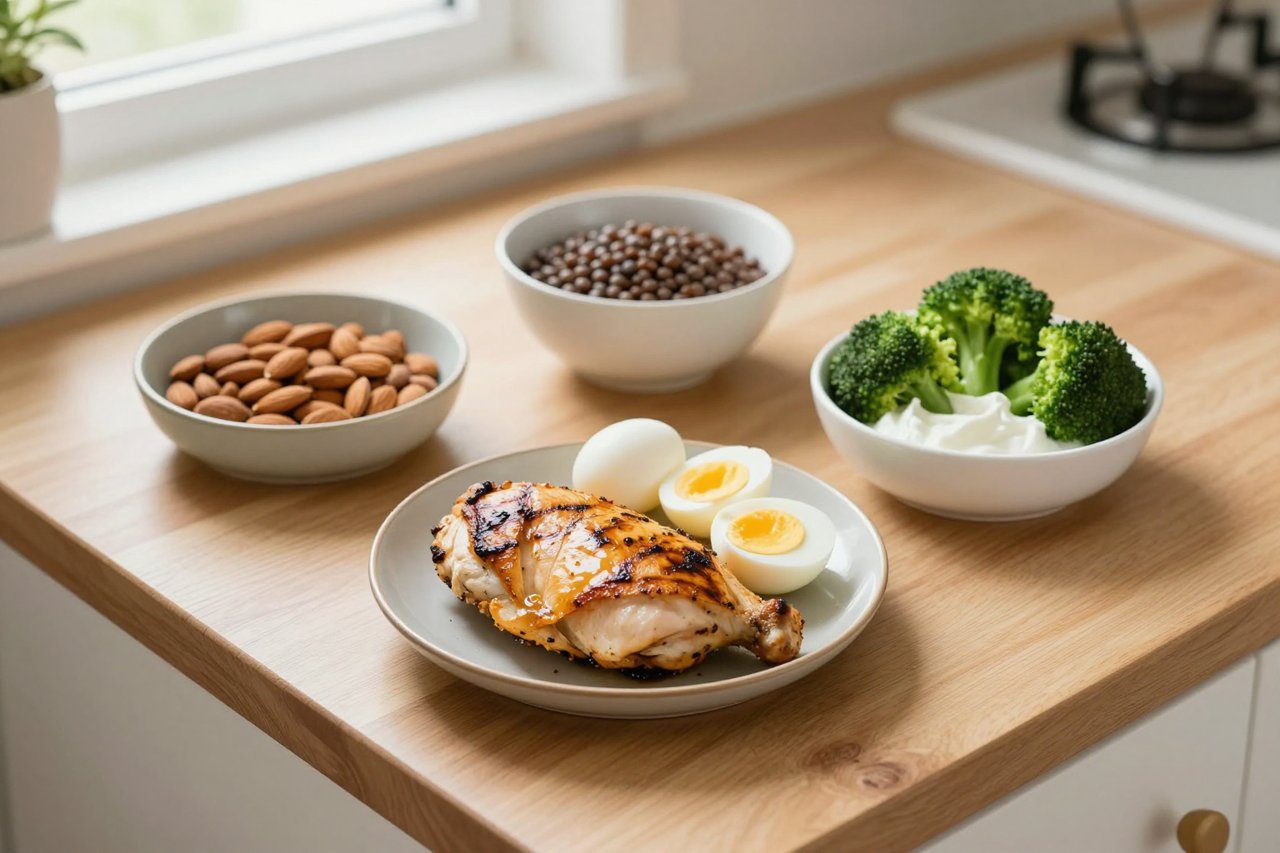
150 g sounds abstract until you split it across four meals, which is roughly 35 to 40 g each. That’s a Greek yogurt with breakfast, a palm-sized portion of chicken at lunch, a scoop of powder after training, and a lentil-and-egg dinner. Nothing heroic.
Most people find breakfast is where they’re bleeding protein without realising it. Toast and coffee contributes almost nothing, and chasing 60 g at dinner to compensate is miserable. Spreading it out is easier on both appetite and digestion. If you’re starting from scratch in the kitchen, this beginner’s guide to building high protein meals covers the practical side, and if you’d rather drink part of your target, there’s advice on choosing a first protein powder without overpaying.
What the Calculator Can’t Do for You
No tool knows whether you actually ate the food it recommended. That part is on you, and it’s the part that decides results.
Weigh yourself once a week under the same conditions, log your main lifts, and give it a month before you judge anything. If your weight is stable and your strength is trending up, the number you picked is fine. If you’re dropping weight faster than you’d like, or feeling flat in sessions, add 15 to 20 grams and reassess. The calculator gave you a starting line. The next four weeks tell you whether it was the right one.


