
Table of Contents
In November 1922, a boy carrying water jars for Howard Carter’s workmen tripped over a carved step cut into the limestone floor of the Valley of the Kings. By nightfall, sixteen steps had been cleared and a doorway appeared, its clay seals still intact. Whatever was behind it had been sitting in the dark for over 3,000 years.
That stumble is why we know so much about royal tombs, and so little about most hidden burial chambers. The ones we find are almost always the ones somebody lost. What follows is the story of how kings tried to disappear, and why it kept failing.
Why Kings Started Hiding
An Egyptian royal tomb was never just a grave. It was a machine for eternity, stocked with food, furniture, jewellery, wine and servants in painted form, built so the king’s spirit could keep functioning after death. Which made it, from a thief’s point of view, the richest address in the country.
Pyramids had a fatal flaw: you could see them from a mile away. Every pyramid complex in Egypt was opened and stripped, often within a few generations of the burial. So the New Kingdom pharaohs changed tactics. Around 1500 BC, Thutmose I moved his burial into the cliffs west of Thebes, and his architect Ineni left an inscription boasting that he had supervised the excavation “alone, no one seeing, no one hearing.” That sentence is the birth certificate of the hidden royal tomb.

The same obsession with permanence drove the building of the Egyptian pyramids, which stayed standing for millennia while everything inside them walked away.
The Valley of the Kings: A Map of Deliberate Confusion
Sixty-five tombs have been numbered in the valley, from KV1 to KV65, and the numbering follows discovery, not chronology. The layout is chaos on purpose. Ramesses II built his tomb almost on top of an older one. Later kings dug into the debris of earlier burials. Corridors bend, shafts drop without warning, and at least one tomb was cut so its entrance sat directly beneath a flash-flood channel, which is exactly the kind of place nobody would think to look.
Tutankhamun Was the Exception
KV62, the tomb behind that 1922 staircase, is small: four cramped rooms, roughly 110 square metres. Tutankhamun died around 19, and the evidence suggests his burial was squeezed into a tomb built for someone else. It held about 5,400 objects, and Carter spent nearly ten years clearing them. The reason it survived is almost comic: flood debris buried the entrance, and the huts of later tomb workers were built on top of it.
The Tomb That Turned Out to Be a City
KV5 was dismissed for decades as a minor shaft. In 1995, Kent Weeks pushed through the rubble and found a corridor lined with dozens of side chambers. The count now runs past 120, with possibly 150 in total, and the walls carry the names of the sons of Ramesses II. It is the largest tomb in the valley and it had been erased from memory for 3,000 years by a single flood.
Hidden Burial Chambers Around the World
Egypt has no monopoly on concealed royal graves. The pattern repeats wherever a ruler had enough wealth to be worth robbing and enough paranoia to plan for it.
- Tanis, Egypt (1939): Pierre Montet opened the tomb of Psusennes I and found a solid silver coffin, a gold death mask and jewellery that rivalled Tutankhamun’s. The announcement landed in 1940 and was swallowed by the Second World War.
- Ur, Iraq (1920s): Leonard Woolley’s Royal Cemetery yielded the tomb of Queen Puabi, buried with attendants, oxen and a headdress of lapis and gold. The pits had been picked over in antiquity but the grave goods still stunned the world.
- Palenque, Mexico (1952): Alberto Ruz Lhuillier noticed stone plugs in the floor of the Temple of the Inscriptions and followed a rubble-choked staircase down to the sarcophagus of the Maya king Pakal, carved with a lid weighing several tonnes.
- Luxor, Egypt (2025): A joint Egyptian-British mission announced the tomb of Thutmose II, the first royal burial found in the Theban area since Tutankhamun. Water had wrecked the interior, but fragments of alabaster jars bearing his name and his wife’s settled the identification.
What Tomb Robbers Left Behind
Almost every royal tomb in Egypt was entered in antiquity, and the trial records survive. The Abbott and Amherst papyri describe inspectors finding a tomb open, the mummy moved and the gold gone, and then questioning the men of the village of Deir el-Medina, the community of craftsmen who cut and decorated the royal tombs. They knew every entrance. Robbery was an inside job with a payroll.
For archaeologists, that is a strange gift. Thieves took metal and left pottery, linen, seal impressions, garlands, food remains and the resin dockets that record exactly when a tomb was resealed. A looted tomb still tells you what was inside it. An empty one tells you nothing.
Finding Chambers Without Breaking Ground
Nobody is going to dynamite the Valley of the Kings, so the search has moved to instruments. Ground-penetrating radar and electrical resistivity mapping can reveal voids beneath a surface without a single shovel. Muon tomography, which reads cosmic-ray particles passing through rock, detected a previously unknown void inside the Great Pyramid in 2017. Thermal imaging picks out cooler patches of stone that might hide a chamber behind them. Satellite surveys have mapped hundreds of undocumented tombs and settlement sites across the Theban plateau.
The results are mixed, and that is honest science. Radar scans of the area around Tutankhamun’s tomb, once hoped to hide the burial of Nefertiti, have been disputed by repeated surveys. The valley’s limestone is fractured, wet and full of natural cavities, and every one of them looks a bit like a doorway on a printout.
Standing Inside One
Most of the famous royal tombs are open to visitors, and a few practical points make the difference between a memory and a blur.
- A standard Valley of the Kings ticket covers three tombs; Tutankhamun, Seti I and Ramesses V/VI cost extra and are worth it.
- Go at opening time. By late morning the corridors are hot, crowded and humid from human breath, which damages the paint.
- Many tombs close on a rotation for conservation, so check the board at the entrance rather than trusting a guidebook.
- The painted ceiling of Ramesses VI’s tomb and the astronomical ceiling of Seti I’s burial chamber are the two most photographed surfaces in the valley.
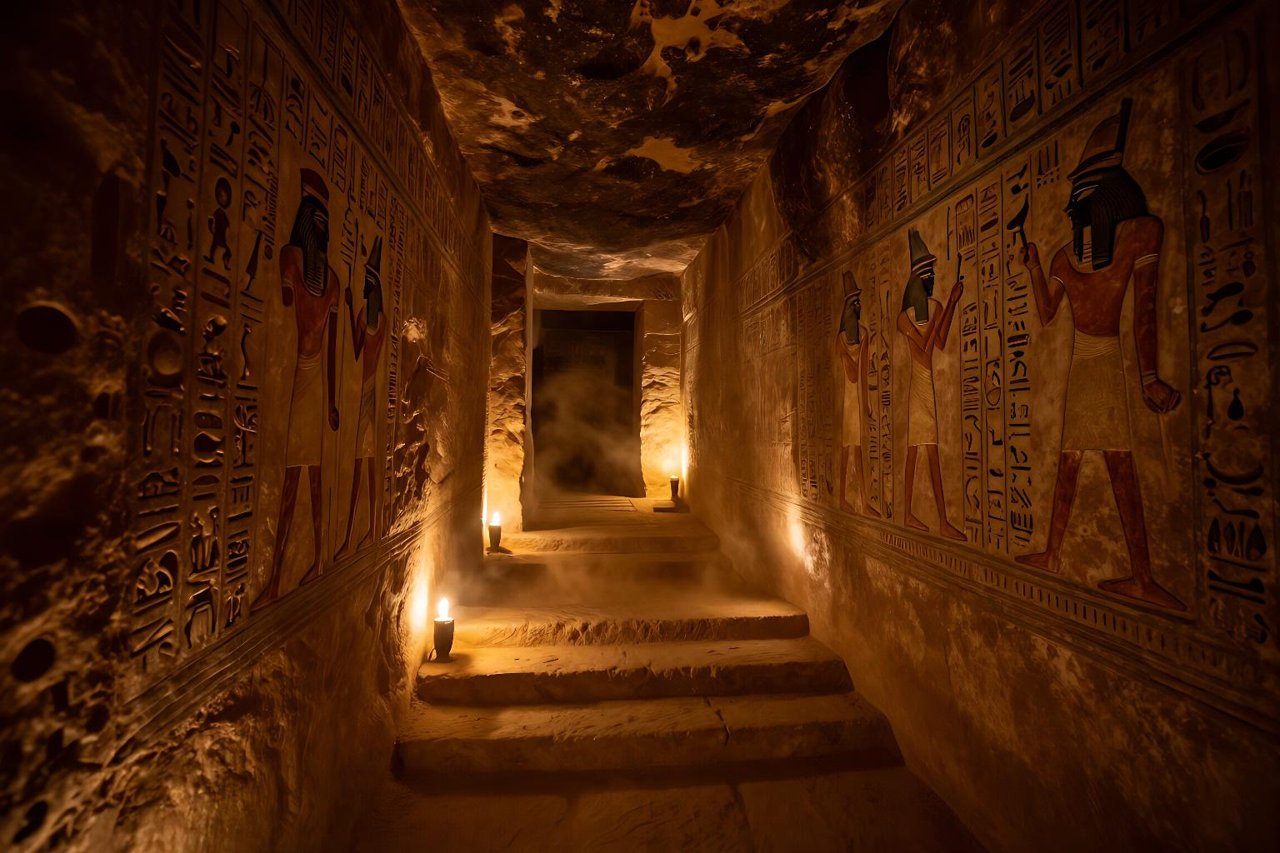
What strikes people underground is not the gold, which is mostly gone, but the effort. A corridor a hundred metres long, cut by copper chisels into solid limestone, then plastered and painted with a full underworld guidebook in the dark. The kings wanted to be forgotten by history and remembered by the gods, and they built for the second audience. Every hidden burial chamber we open is a message that arrived late, addressed to nobody in particular, and still perfectly legible.


