
Table of Contents
A reading of 148/94 doesn’t hurt. There’s no ache to point at, no swelling, nothing that tells you something is wrong. That silence is why roughly a third of adults with high blood pressure don’t know they have it, and why plenty of people who do know let it drift for years.
Hypertension behaves like a slow mechanical problem. Every day the pressure stays high, blood pushes harder against artery walls, and those walls respond the way any overworked material does. They thicken. They stiffen. They lose the flexibility that lets them absorb each heartbeat. Then the consequences turn up somewhere far from the number on the cuff.
The Damage Starts Long Before the Diagnosis
Normal blood pressure sits below 120/80 mmHg. Readings between 120 and 129 systolic count as elevated, and 130/80 or above is stage 1 hypertension. Those thresholds dropped a few years ago for a reason. Imaging studies show measurable artery stiffening and early organ strain in people whose readings live in the 130s for a decade.
Cardiovascular disease, the family hypertension belongs to, still tops the list of diseases with the highest global burden, and raised blood pressure is the largest modifiable contributor to that total. It’s also the thread running through many of the chronic diseases affecting adults that fill hospital beds. Here’s what happens when the pressure never comes down.

1. Stroke
High blood pressure is the leading risk factor for stroke, involved in roughly half of cases worldwide. Two mechanisms do the damage. Years of high pressure weaken the small arteries deep in the brain, and the same pressure accelerates plaque buildup in the carotid arteries in the neck. A vessel either clogs, which causes an ischemic stroke and accounts for about 85% of cases, or it bursts. Hemorrhagic strokes are less common and often far more lethal.
The lifetime risk isn’t abstract. About one in four adults will have a stroke at some point, and a 20 mmHg rise in systolic pressure roughly doubles stroke mortality. Flip that around and the news is good: bringing pressure down cuts stroke risk by around 35% to 40%, a bigger effect than most drugs on the market achieve for anything else. The practical side of rehab and plate-level changes is covered in this guide to stroke treatment, prevention and diet.
2. Heart Attack and Heart Failure
Pumping against resistance is like lifting weights 100,000 times a day with no rest day. The left ventricle thickens into something called left ventricular hypertrophy, then turns stiff and can’t fill properly between beats. That’s heart failure with preserved ejection fraction, a condition that lands people in the emergency department gasping after a walk to the mailbox. Roughly half of people diagnosed with heart failure die within five years.
Coronary arteries take a separate beating. High pressure injures the endothelium, the one-cell-thick lining of the vessel, and gives LDL cholesterol a place to lodge. Plaque builds quietly. A clot lands on it, and an artery that was 60% blocked becomes 100% blocked in minutes.
3. Kidney Damage That Stays Silent Until Stage 4
Your kidneys filter around 180 litres of blood a day through millions of glomeruli, tiny knots of capillaries that act as strainers. High pressure scars those strainers. Protein starts leaking into the urine, a sign most people never notice because it has no symptoms, and the filtration rate slides year by year.
Hypertension is the second leading cause of kidney failure requiring dialysis, behind diabetes, and accounts for roughly a quarter of new cases. By the time swelling, fatigue and poor appetite show up, most of the filtering capacity is gone. A urine albumin-to-creatinine ratio and a creatinine blood test cost very little and catch the problem at stage 1 or 2, when it’s still reversible.
4. Vision Loss From Hypertensive Retinopathy
The arterioles in the retina are among the smallest vessels in the body, and an optometrist can look straight at them through a lens. That makes the eye a window onto what hypertension is doing everywhere else. Narrowed arterioles, flame-shaped hemorrhages, cotton wool spots and swelling of the optic disc all show up on a routine exam.
Advanced retinopathy can permanently reduce vision. At the extreme end, a pressure reading above 200/120 can cause sudden vision loss from a blocked retinal vein or fluid building up under the macula. People who’ve had uncontrolled hypertension for a decade often have changes on the retina long before they notice blurring.
5. Aortic Aneurysm and Peripheral Artery Disease
The aorta is the body’s largest artery, and constant pressure weakens its wall over time. An abdominal aortic aneurysm can grow for years without a twinge, then rupture. Fewer than one in five people who reach hospital with a ruptured aneurysm survive. Men between 65 and 75 who have ever smoked should ask about a one-off ultrasound, because that scan detects the problem while it’s still fixable.
Peripheral artery disease shows up differently: calf cramps after walking two blocks, cold feet, hair loss on the shins, sores that take months to heal. It matters beyond the legs. A blocked leg artery usually means the same process is well underway in the arteries feeding your heart and brain.
6. Vascular Dementia and Brain Shrinkage
Small vessel disease is the quiet version of stroke. Tiny vessels deep in the white matter narrow and close off, leaving small scars called lacunar infarcts. Some people accumulate a dozen of them without ever having what a doctor would call a stroke.
The result isn’t the memory loss people associate with Alzheimer’s. It looks more like slowed thinking, trouble planning a grocery run, poor balance, and a flatness that family members notice before the patient does. Midlife hypertension, meaning readings in your 40s and 50s, is more strongly tied to later dementia than pressure measured in your 70s. MRI scans of adults with long-standing hypertension routinely show white matter changes decades before any cognitive complaint.
7. Sexual Dysfunction and Pregnancy Complications
Erectile dysfunction is often a vascular warning shot. The arteries supplying the penis are 1 to 2 mm wide, so plaque that wouldn’t trouble a coronary artery for another five years can cause problems there first. Men with erectile dysfunction carry a substantially higher risk of a cardiac event in the following years, which is why it’s worth mentioning at a checkup rather than treating as an isolated issue.
In pregnancy, chronic hypertension raises the risk of preeclampsia, restricted fetal growth and preterm delivery. Women with readings above 140/90 before 20 weeks usually need closer monitoring, low-dose aspirin in some cases, and blood pressure medication that’s safe during pregnancy.
The Multipliers That Make Hypertension Deadlier
Seven complications, one driver, and a set of factors that speed all of them up:
- Smoking. It damages the endothelium and stiffens arteries on its own, then compounds everything hypertension does. It’s also the main cause of COPD, which makes breathlessness from heart failure far harder to spot.
- Sodium. Average intake sits around 3,400 mg a day against a recommended 2,300 mg, and most of it comes from bread, deli meat, sauces and restaurant food rather than the salt shaker.
- Sleep apnoea. Up to half of people with hard-to-control hypertension have it. Snoring, morning headaches and daytime exhaustion are worth investigating.
- Alcohol and NSAIDs. Both raise pressure, and regular ibuprofen use is a common reason readings creep upward without explanation.
Readings That Need Help Today
Most hypertension gives you years to act. A handful of situations don’t. Call emergency services if a reading of 180/120 or higher comes with any of the following:
- Chest pain, pressure or breathlessness
- Weakness, numbness or drooping on one side of the face or body
- Sudden trouble speaking or understanding
- Abrupt change in vision
- A severe headache unlike any you’ve had
No symptoms at that level still warrants a call to a doctor the same day, not next month.
What to Do With a Number You Don’t Like
Delay is the norm with this condition. People put off care for all sorts of things, from a nagging cough to the sort of kidney stone treatment mistakes that turn a bad week into a bad month, and hypertension is the easiest of all to postpone because it never gives you a reason to go in.
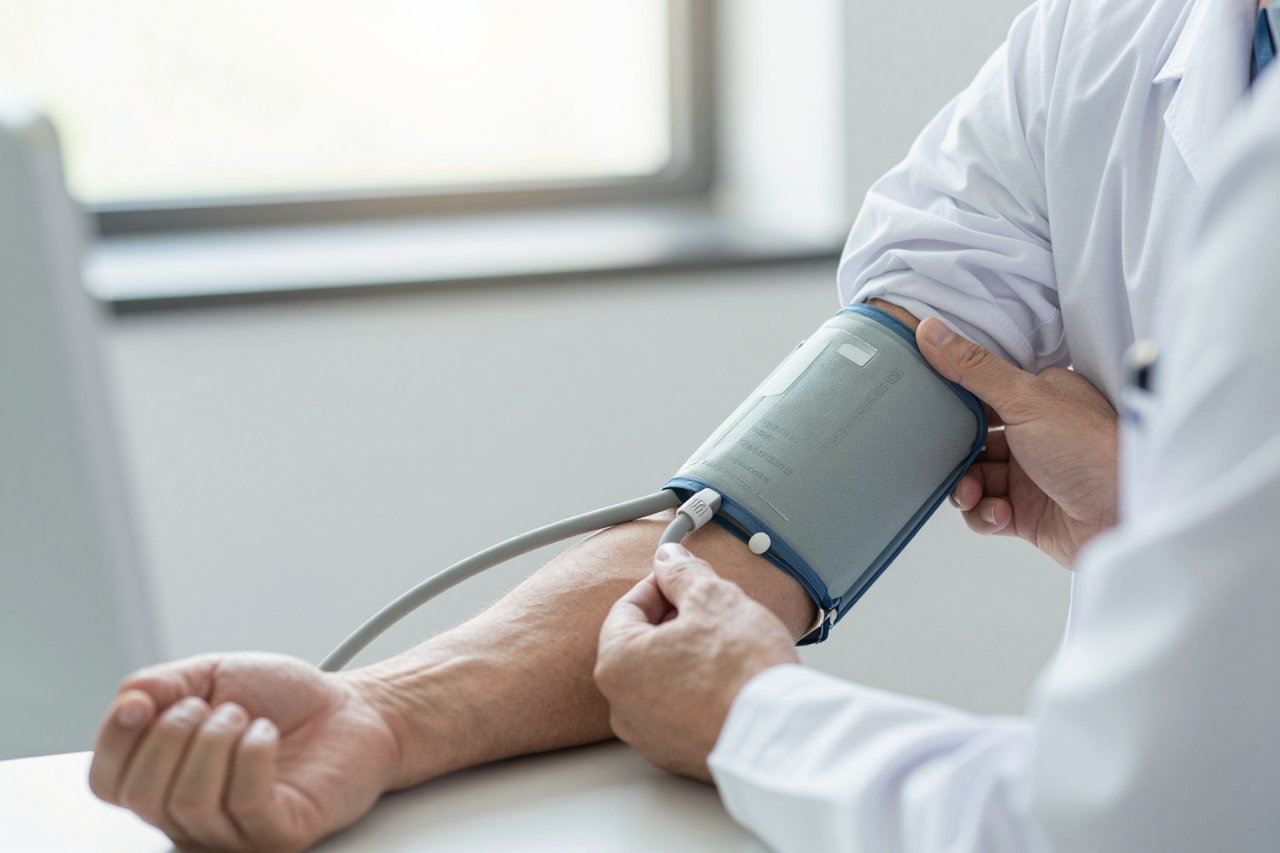
Make the number mean something. Buy a validated upper-arm cuff rather than a wrist device, and measure properly: sit quietly for five minutes, feet flat, back supported, arm at heart level. Take two readings a minute apart, morning and evening, for seven days. Average them. That average, not any single reading, is what tells you whether 142/91 is a one-off or a pattern.
For many people, 30 minutes of brisk walking five days a week lowers systolic pressure by 4 to 9 mmHg. Cutting sodium hard can add another 5 to 6. Losing 10 kg drops it around 5 to 20. None of that is enough on its own for a reading of 160/100, and that’s fine. Most people need two or three drugs at low doses rather than one at maximum, and modern combinations are well tolerated. The point isn’t to avoid medication. It’s to keep your brain, heart, kidneys and eyes from paying the bill for a number you decided to ignore.


