
Table of Contents
Roughly one in three adults has high blood pressure, and about half of them have no idea. There’s no ache, no rash, no obvious signal. The first hint is often a number at a routine check-up, or a stroke.
The list of things that push blood pressure up isn’t mysterious. Most of it comes down to a handful of habits and conditions that quietly stiffen artery walls and keep your body holding onto fluid. Some are obvious, like salt. Others hide in places people don’t think to look, like a loaf of supermarket bread or a bottle of nighttime cold medicine.
Below are the top 7 causes of high blood pressure, with the specific numbers behind each one.
What Counts as High, and Why Nobody Notices
Two numbers matter. Systolic pressure is what your arteries see while your heart squeezes; diastolic is the pressure between beats. Most guidelines draw the line at 140/90 mmHg, while the American Heart Association and American College of Cardiology use 130/80. Either way, damage starts earlier than most people assume. A reading that sits at 135/85 for ten years does real work on your kidneys, your retinas and your artery walls.

Because nothing hurts, hypertension usually gets found by accident, at a dentist’s appointment or a pre-surgery form. It also announces itself in less friendly ways. Persistently high pressure is one of the main drivers behind the warning signs of a heart attack, and it is the single biggest risk factor for stroke.
1. Sodium, Mostly From Food You Never Salted
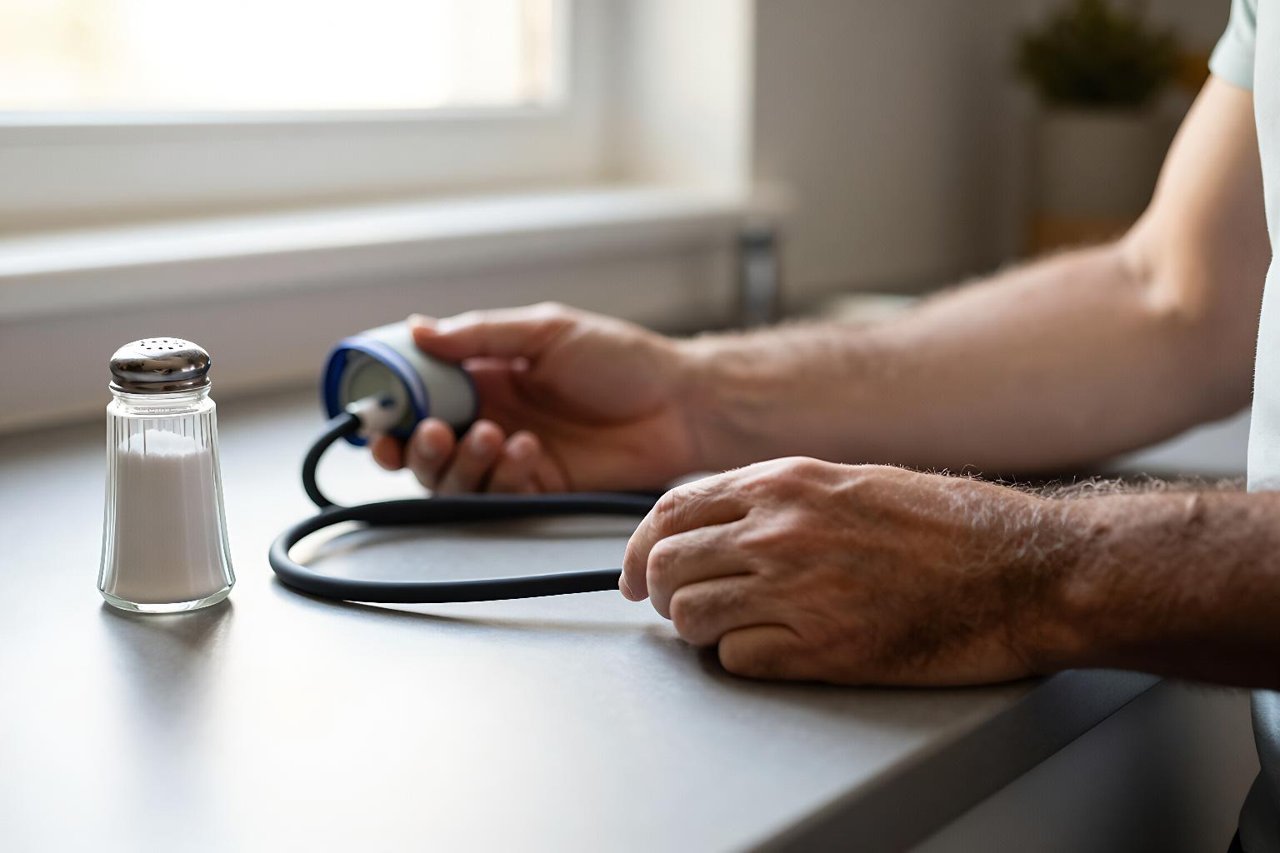
About 70% of the sodium in a typical Western diet comes from packaged and restaurant food. The shaker on your table is a minor player.
- A deli sandwich on a roll: 1,500–2,000 mg
- One cup of canned soup: 700–900 mg
- Two slices of supermarket bread: 300–400 mg
- Two slices of pizza: 600–700 mg
- Two tablespoons of bottled salad dressing: 200–300 mg
The daily ceiling is 2,300 mg, roughly a teaspoon of salt, and 1,500 mg is the better target if your numbers are already elevated. Trim 1,000 mg a day and most people with hypertension drop about 5 mmHg systolic. That’s comparable to a low-dose medication, minus the prescription.
Pushing potassium in the other direction helps too. Beans, potatoes with the skin, spinach, bananas and yoghurt all nudge sodium out through the kidneys.
2. Extra Weight, Especially Around the Waist
Visceral fat is not a passive storage depot. It behaves like an endocrine organ, releasing hormones that tell your kidneys to hold onto sodium and your blood vessels to tighten. The practical rule most cardiologists quote: roughly 1 mmHg of systolic pressure for every kilogram lost. Someone carrying 8 extra kilos who loses half of it can move from 142/92 to something closer to 135/88.
Waist measurement is a better warning light than the scale. Above 102 cm (40 in) for men and 88 cm (35 in) for women signals the kind of fat that raises pressure. Losing 5–10% of body weight is usually enough to see a measurable shift.
3. Alcohol, Even at Levels People Call Moderate
Three or more standard drinks a day reliably raises blood pressure, and the effect is dose-dependent: more drinks, higher numbers. It shows up within weeks of a habit changing, in both directions. Cutting back from two drinks a night to one drops systolic pressure by around 5 mmHg in people who drink regularly.
Alcohol also blunts the effect of blood pressure medication, and binge drinking produces short, sharp spikes that can trigger an arrhythmia in an otherwise healthy heart. The useful question isn’t whether you drink, but how many days a week you do it.
4. Sitting Still for Most of the Day
Aim for 150 minutes a week of moderate cardio, like brisk walking, cycling or swimming, and expect a 5–8 mmHg drop. Isometric holds work surprisingly well too: four sets of a two-minute wall sit or handgrip squeeze, three days a week, has produced 8–10 mmHg reductions in trials.
Timing matters. A ten-minute walk after a meal blunts the post-meal pressure rise, and breaking up long stretches of sitting every 30 minutes keeps vessels from stiffening through the afternoon. Regular movement is one of the levers that separates the preventable diseases you can actually influence from the ones you can’t.
5. Short Sleep and Untreated Sleep Apnoea
Sleeping under six hours a night is linked to a meaningfully higher risk of hypertension, partly because the body never gets its overnight dip in pressure. Sleep apnoea is the bigger issue. Breathing pauses cause oxygen to drop, adrenaline surges, and blood pressure climbs night after night.
As many as half of people with stubborn, medication-resistant hypertension turn out to have obstructive sleep apnoea. Signs worth mentioning to a doctor: loud snoring, waking with a dry mouth, morning headaches, and falling asleep at your desk by 2pm. Properly used CPAP therapy can pull systolic pressure down by 5–10 mmHg in people who actually stick with it.
6. Smoking, Vaping and Every Other Form of Nicotine
Each cigarette spikes blood pressure by 5–10 mmHg for 20 to 30 minutes. Smoke a pack a day and your arteries spend most of their waking hours in that elevated state, which stiffens them permanently over time. Nicotine replacement, pouches and vapes all deliver the same vasoconstriction, just without the tar.
Quitting is the rare change that pays off twice, since the same habit sits near the top of the list of cancer risk factors that actually move the needle. Blood pressure starts falling within 20 minutes of the last cigarette, though the full benefit to your arteries takes months.
7. Other Conditions, and the Pills Already in Your Cabinet
A meaningful share of high blood pressure is secondary, meaning something else is causing it. Kidney disease is the most common culprit. Type 2 diabetes, thyroid disorders and rare adrenal problems such as Conn’s syndrome can all drive pressure up, which is why a sudden jump in numbers after years of stability deserves investigation rather than a stronger prescription. These sit alongside hypertension among the chronic diseases affecting adults that quietly compound one another.
The medicine cabinet problem
Common over-the-counter drugs raise pressure more than most people realise. Ibuprofen and naproxen can add 3–5 mmHg with regular use. Decongestants like pseudoephedrine constrict vessels within minutes. Combined oral contraceptives raise pressure in a small but significant minority of users, and some antidepressants, steroids and ADHD stimulants do the same. Liquorice eaten daily, and energy drinks heavy on caffeine and taurine, round out the list.
The Two Things You Inherited
Family history and age aren’t on the list above because you can’t change them, but they set the terms. A parent or sibling with hypertension before 55 roughly doubles your own risk, and the condition tends to arrive earlier and hit harder in people of African ancestry. By age 60, roughly two in three adults have it, largely because arteries stiffen as the elastin in their walls wears out.
None of that is a reason to shrug. It’s a reason to own a cuff and check quarterly instead of waiting for a doctor to bring it up.
Where the First Win Usually Comes From
For most people, the fastest gains come from the boring stuff: sodium, alcohol and 3 or 4 kilos of weight. Supplements and gadgets rarely compete.
Run a four-week experiment. Buy a validated upper-arm cuff rather than a wrist model, sit quietly for five minutes, and take two readings each morning before coffee. Write them down. Then change exactly one thing: swap the deli lunch for leftovers, or cut drinking to two days a week. After four weeks, average the readings. Most people see 4–8 mmHg, which is small enough to dismiss and large enough to matter over a decade.
Keep taking your medication throughout. And if home averages stay at 130/80 or above, book the appointment and bring the log with you. A month of morning numbers tells a doctor more than a single reading taken in a hurry.


