
Table of Contents
Your passport has a clock on it
The agent slid the passport back across the counter with a sigh. “It expires in eleven weeks,” she said. “You’re not getting on this flight.”
Travel disasters rarely arrive in cinematic form. Nobody loses their luggage in a monsoon. More often a whole trip collapses over a document with three months left on it, a debit card frozen at 2 a.m., or a strip of pills with no label on the bottle.
So here are the things you should never forget when traveling, in the order they tend to bite people.
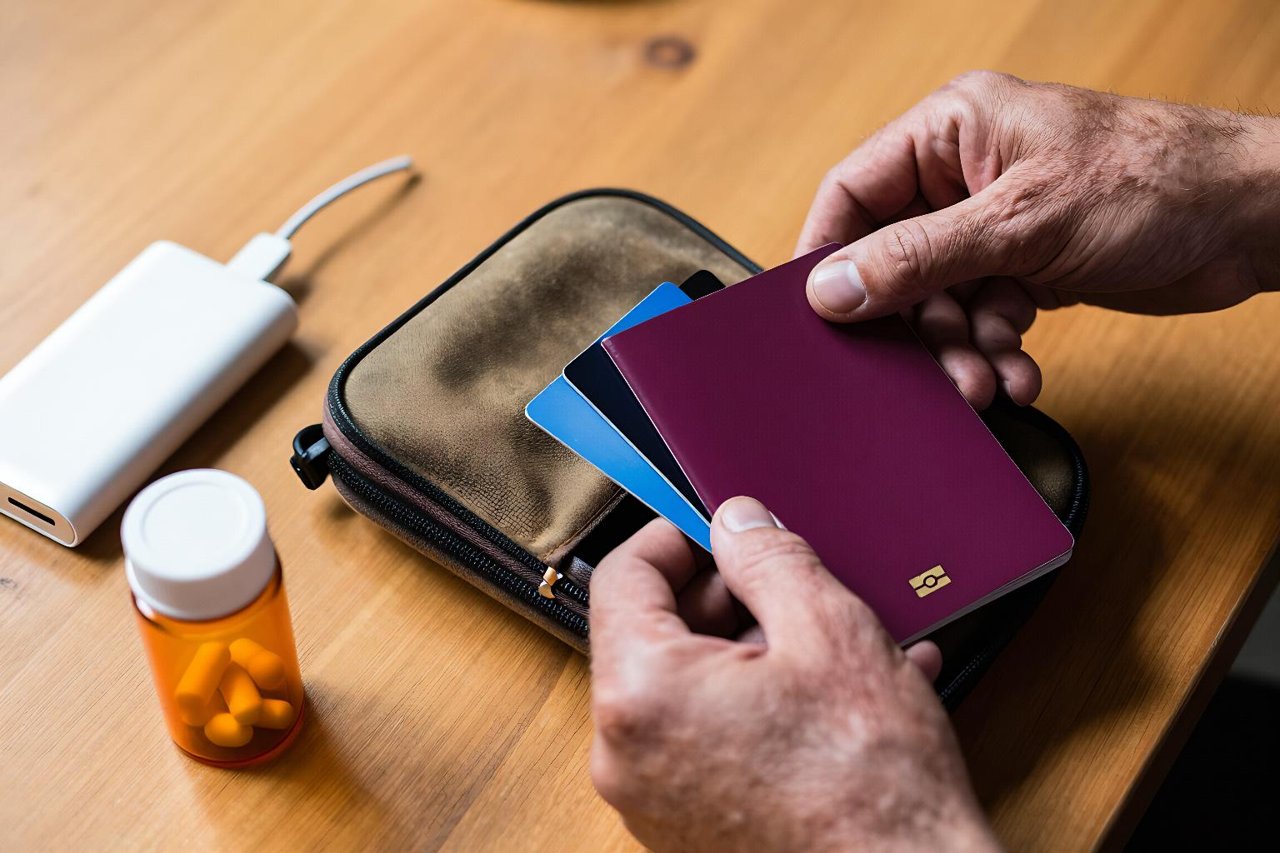
First, the clock. Dozens of countries require six months of validity beyond your return date. The Schengen area wants at least three months past your planned departure, and your passport has to have been issued within the last ten years. Airlines enforce this at check-in because they get fined if you’re refused entry at the other end, so “I’ll sort it at immigration” is not a plan.

Check the blank pages too. Some countries, South Africa among them, want two consecutive empty pages for stamps.
Photograph the boring pages
Not just the photo page. Shoot your visa stamps, travel insurance policy number, and the confirmation for your first two nights. Then email them to yourself and leave them in your drafts folder. That way you can open them on hotel wifi when your phone is dead or stolen, which happens on a statistically surprising number of trips.
Two cards, two networks, one PIN you actually remember
Carry one Visa and one Mastercard from two different banks. American Express is patchy across much of Europe and Asia, and a single card from a single bank is one fraud alert away from leaving you with no money and no way to get any. Tell both banks you’re traveling if they still let you.
Then find out what each card charges for a foreign transaction. A 3% fee on a $900 hotel bill is $27 you handed over for nothing.
Learn your PIN as digits, not as finger memory. Petrol pumps in France and ticket machines in Italy often ask for chip-and-PIN and won’t accept a signature, and a surprising number of travelers discover this standing in the rain with a queue behind them.
When a terminal asks whether you want to pay in your home currency or the local one, choose the local one. That’s called dynamic currency conversion, and the markup runs somewhere between 3% and 7%. The machine is not being helpful.
Prescriptions, written in the generic name
Keep medication in the original labelled pharmacy packaging and put it in your hand luggage, not the hold. Bring more than you need: a three-day delay is common, and running out of a daily prescription in a foreign city is a genuinely grim way to spend an afternoon.
Know the generic name of everything you take. Ask for Tylenol in Italy and you’ll get a blank look; ask for paracetamol and you’ll have it in two minutes. Adrenaline pens, insulin, and asthma inhalers all travel more smoothly with a doctor’s letter in English that states the drug, the dose and the condition.
Japan is the one to research properly. Some stimulant medications and certain inhalers are prohibited outright, and others require an import certificate applied for before you fly. Turning up with the wrong box in your bag is not a paperwork problem there.
Check the season, not just the price
A cheap flight in the wrong month is expensive in every other way. If the aurora is the reason for the trip, plan around the fact that the best time to chase one runs roughly from September to March, and that midsummer above the Arctic Circle is daylight at midnight. Our guide to the destinations with the best northern lights viewing is worth reading before you book anything.
Go the other direction and the Caribbean has its own calendar. Hurricane season runs June to November, with the worst risk from August to October, and plenty of small islands quietly shut their hotels in September. A weekend there in the shoulder weeks is a different experience from a weekend in October, and our piece on choosing a quiet Caribbean island for a short break gets into the timing.
Same logic closer to home. A lot of Puglia’s best trattorias close between about 3 p.m. and 7:30 p.m., and half the coast empties after September, which is either the point or a disappointment depending on what you wanted. Skim what’s actually worth doing in Bari and check the opening days before you build an itinerary around a restaurant that’s shut on Mondays.
The power bank the security officer will take off you
Most airlines cap lithium batteries at 100 watt-hours, and spare batteries must travel in the cabin. They cannot go in checked luggage, full stop.
Do the maths once. A 20,000mAh power bank is roughly 74Wh, which is fine almost everywhere. A 30,000mAh unit lands near 111Wh and needs airline approval on many carriers. Charge the thing before you leave, because the moment you’ll want it most is hour six of a layover with two working sockets in the entire terminal and a queue at both.
Pack for the trip you’re taking, not the one you pictured
People pack for the brochure. They bring four evening outfits and nothing for the 14-hour bus ride. Crew members are a good reality check on this, and their take on what to pack for a cruise applies well beyond ships.
- A plug adapter for the right country. The UK uses type G, most of Europe uses C or F, and a cruise cabin might give you two US-style sockets for the whole room.
- One warm layer, even in the tropics. Airport terminals, overnight coaches and over-air-conditioned restaurants are uniformly cold.
- A tiny first aid kit. Plasters, rehydration sachets, antihistamine. Resort shops sell sunscreen at three times the supermarket price, so buy it before you arrive.
- Something to do for four hours without wifi. A paperback, a deck of cards, a downloaded series.
- Cash in small notes. Taxi drivers and market stalls rarely have change for the equivalent of a $50 bill.
The first night deserves more attention than the last
Late arrivals are where budget travel falls apart. Before you fly, confirm two things: that reception will still be open when you land, and exactly how much the airport transfer costs. Plenty of small European guesthouses stop answering the phone at 8 p.m., and the person who booked the cheapest room on the internet is often the one standing outside at midnight.
Save the address in the local script. A driver in Tbilisi or Tokyo will get there much faster with a screenshot in Georgian or Japanese than with your spoken attempt at it. Also check whether the metro actually runs at 1 a.m., because in most cities it very much does not.
Twelve words that do more work than any gadget
Hello, please, thank you, sorry, excuse me, yes, no, how much, where is, water, the bill, help. Write them on your phone’s lock screen for the first three days. The attempt buys you patience, and patience is worth more than a currency converter app when you’ve missed a train.
If Greece is on the itinerary, a handful of phrases go a long way, and knowing that a taverna bill can be split or paid at the counter saves an awkward five minutes. There’s a good primer in what to know before visiting Greece, plus the phrases locals actually use. Nobody expects fluency anywhere. They notice the try.


