
Table of Contents
Around 3,500 BC, a potter somewhere in Mesopotamia worked out that a spinning disc shapes clay faster than fingers ever could. That potter’s wheel is the oldest member of the wheel family, and nothing about the underlying idea has worn out. It survives in your car’s gearbox, in the rollers of a printer, in the casters under an office chair.
The top 7 ancient inventions still used today all pass the same test: people kept using them, in much the same form or as a direct descendant, thousands of years after someone first tried them out. Some are obvious. A couple tend to surprise people.
1. The Wheel, and Everything Built On It
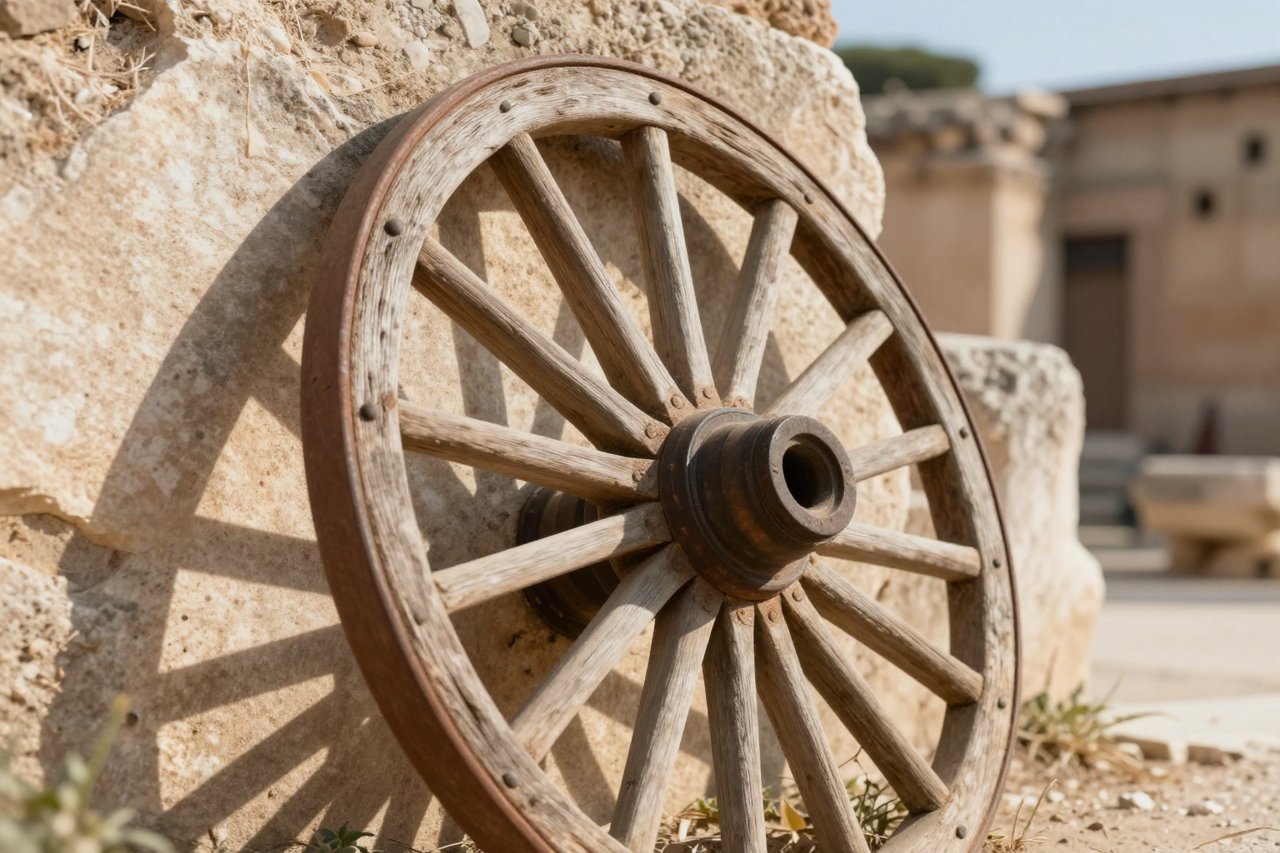
The oldest surviving wooden wheel, pulled out of the Ljubljana Marshes in Slovenia, is roughly 5,150 years old. It’s two ash planks pegged together, about 70 cm across, with an oak axle beside it. Early wheels were solid discs. Spoked versions appeared around 2000 BC, probably on chariots built by the Sintashta culture in the southern Urals, and the weight saving turned a slow cart into somethingfast.
What’s remarkable is how little the principle has changed. A wheel is a lever that converts rotation into forward motion, and once you have that, gears, pulleys, cranks and bearings follow logically enough. The same mechanical thinking runs through the inventions that changed the modern world. A clock’s gear train, a skateboard’s ball bearings and a power station turbine are all descendants of that first spinning disc.

2. Roman Concrete That Thrives in Seawater
The dome of the Pantheon, poured around AD 126, spans 43 metres and has never needed a steel frame or a reinforcing bar. It is still the largest unreinforced concrete dome on earth. Roman builders mixed their material in layers rather than pouring one homogeneous mass, and the recipe was short:
- Lime, burned and slaked into a putty that binds everything else
- Pozzolana, volcanic ash from the Bay of Naples that reacts with lime to form strong cementitious compounds
- Aggregate, chunks of tuff or broken brick, often far larger than modern gravel
The seawater version is the strangest part. Harbour concrete made with pozzolana gets stronger over centuries, not weaker. In 2017, geologist Marie Jackson and colleagues showed why: a mineral called aluminous tobermorite grows inside the concrete when it meets salt water, filling cracks as they form. A 2023 MIT study found a second trick, lumps of unreacted lime that dissolve into cracks and recrystallise when water gets in.
What modern engineers are borrowing
Portland cement, patented by Joseph Aspdin in 1824, now accounts for something like 8% of global carbon dioxide emissions. That has sent materials scientists back to Roman recipes in search of lower-temperature binders. Two thousand years on, the old formula is being read as new research.
3. Aqueducts and the Drains Under Rome
Rome’s Cloaca Maxima started out around 600 BC as an open channel draining the marsh between the hills. It was roofed over, extended, and it still carries rainwater away from the city centre today. The aqueducts came later and went further: by the third century AD, eleven of them delivered something in the region of a million cubic metres of water a day, running for kilometres on a gradient so gentle you barely notice it.
The Pont du Gard in southern France is the showcase. Its 50 km system dropped just 17 metres end to end, a gradient of about 1 in 3,000, across a bridge nearly 49 metres high. Public water supply, sewerage and gravity-fed distribution are still standard municipal engineering, and the decisions behind them belong with the historical turning points that shaped our world.
4. The Archimedes Screw
Take a helix inside a cylinder, tilt it, turn it, and water climbs. Archimedes of Syracuse described the device in the third century BC, and it was used to empty ships’ bilges, irrigate fields and lift water out of mines. It has no valves, no seals and nothing much to break.
Wastewater treatment plants still use it because it moves sludge without clogging. Grain elevators use it. Fish passes on weirs use it, letting salmon swim up a spiral instead of a ladder. Small hydropower schemes run Archimedes screw turbines at roughly 70 to 80% efficiency. Even the manuscript record survives in fragments, like a long-lost page of Archimedes’ writings turned up in France after being reused as a prayer book.
5. The 365-Day Calendar
Egyptian astronomers settled on a 365-day year several thousand years before Julius Caesar borrowed the idea in 46 BC. The Julian calendar drifted by about one day every 128 years, which by 1582 had pushed the spring equinox ten days out of place, so Pope Gregory XIII dropped those ten days and tightened the rules. A year now averages 365.2425 days against the true 365.2422, an error of about one day in 3,000 years.
Nothing about a calendar is purely mathematical. Every reform has been a political act, and Mesoamerican societies ran their own precise systems: the Aztec sun stone, carved in the 15th century and now in Mexico City’s National Museum of Anthropology, encodes a 584-day Venus cycle alongside the solar year. It’s one of the more unexpected surprising facts about Mexico’s scientific history.
The leap year rule that keeps clocks honest
Century years are not leap years unless divisible by 400. That single clause is why 2000 had a 29 February and 1900 did not, and it’s why your phone’s calendar will still be right long after the hardware fails.
6. Soap
Babylonian clay cylinders from around 2800 BC describe boiling fat with ash, which is soap. Pliny the Elder noted that Gauls used a greasy substance for their hair, and by the eighth century Aleppo in Syria had turned soap-making into an export industry with olive oil and laurel. The chemistry has not shifted: fat plus alkali gives glycerol plus a salt of a fatty acid, and that salt grabs oil and rinses it away with water.
Mass production, fragrance and milling are modern. The reaction in the kettle is not. Every bar on a supermarket shelf is a refined answer to a question someone asked nearly five thousand years ago.
7. The Magnetic Compass
Chinese inventors were using lodestone to find south by the Han dynasty, first with a spoon-shaped stone that swivelled on a bronze plate. By 1088, Shen Kuo was writing in the Dream Pool Essays about magnetised needles and about magnetic declination, the gap between true north and magnetic north that navigators would spend centuries arguing over. The dry compass reached Europe around 1300 and changed ocean travel permanently.
The needle is still on the bridge of every commercial ship, required by regulation and relied on precisely because it needs no power, no satellite and no software. Your phone contains a magnetometer built on the same principle, and GPS receivers use magnetic heading to work out which way you are facing. When a vessel loses electrical power in open water, the oldest instrument on board is the one that still answers.


