
Table of Contents
Most of history is sensible. Crops failed, borders moved, a treaty got signed in a language half the room couldn’t read. Then there are the other entries in the record. A pope put a corpse on trial. A national army deployed machine guns against flightless birds. A city spent six years in court over a flood of molasses.
The same instinct that sends people hunting for answers to the deep ocean mysteries that still baffle scientists is what makes these stories so hard to walk away from. The ships supposedly lost to the Bermuda Triangle have nothing on a town where hundreds of people danced until their bones broke. Here are seven of the strangest, best-documented oddities in the historical record.
1. The Dancing Plague of 1518
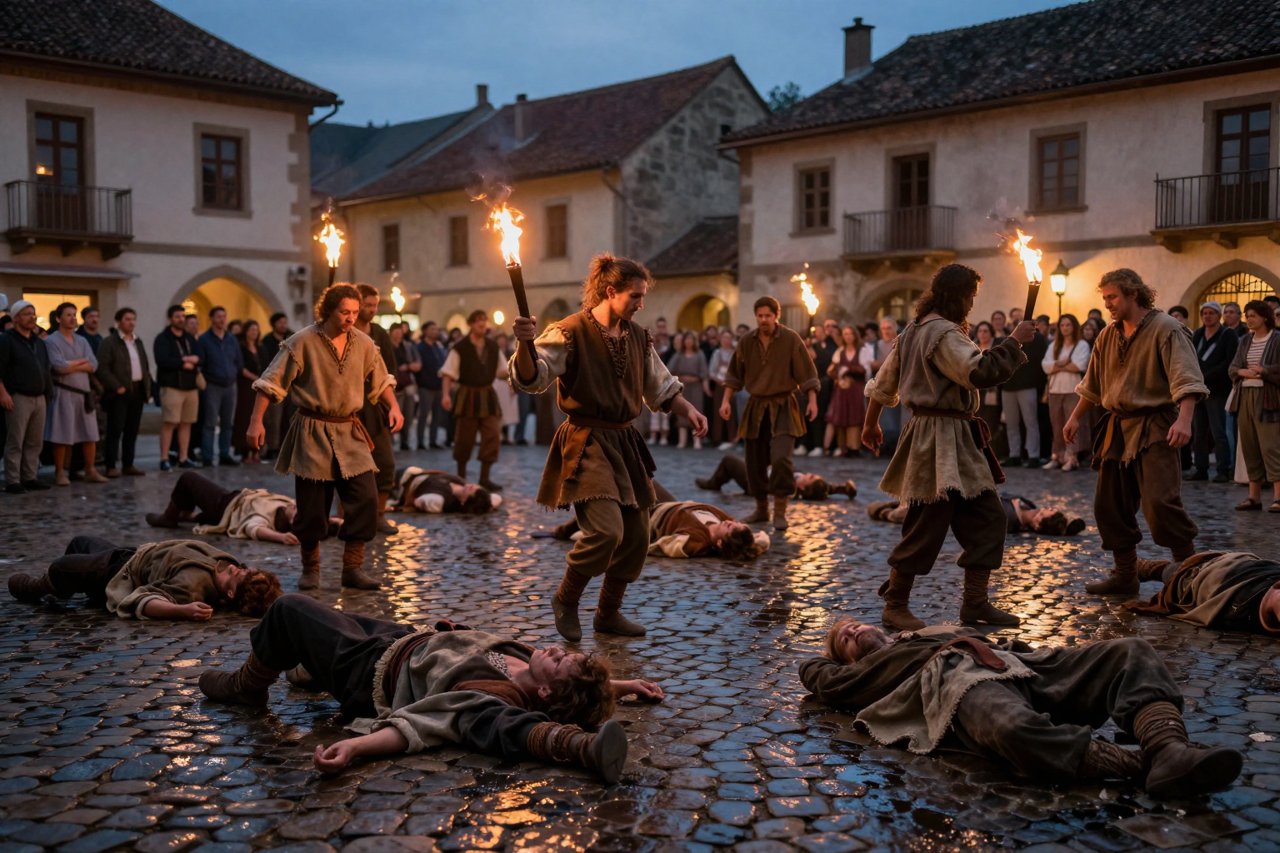
In July 1518, a woman known to chroniclers as Frau Troffea walked into a street in Strasbourg and started dancing. No music, no festival, no obvious reason. She kept going for days. Within a week roughly three dozen neighbours had joined her. Within a month, contemporary accounts put the number in the hundreds.
This was not joyful. Witnesses described dancers collapsing with exhaustion, screaming for help, unable to stop. Some reportedly died of strokes or heart attacks. The city’s response made things worse: convinced the sufferers simply needed to dance it out, officials cleared a guild hall, hired musicians and built a stage. Physicians blamed overheated blood; the clergy blamed Saint Vitus. Victims were eventually carted to a shrine in the hills to be prayed over. Outbreaks of compulsive dancing were recorded in the Rhineland for centuries, making this one of the earliest well-attested cases of mass psychogenic illness.

2. The Cadaver Synod
In January 897, Pope Stephen VI had the body of his predecessor, Formosus, dug out of its tomb, dressed in full papal vestments, and propped upright on a throne in a Roman basilica. A deacon crouched behind the corpse to answer the charges on its behalf. The accusations: perjury and illegally accepting the papacy.
The verdict was never in doubt. Formosus was found guilty, his decrees annulled, his robes torn off, and the three fingers of his blessing hand hacked away. The body was dragged through the streets and dumped in the Tiber. Monks fished it out. A later earthquake was blamed on the whole affair, Stephen was thrown in prison and strangled, and Formosus was posthumously retried, reinstated, and buried in Saint Peter’s. It is arguably the only court case in history with a dead defendant, a dead prosecutor, and three separate verdicts.
3. The War of the Bucket
In 1325, soldiers from Modena slipped into neighbouring Bologna and walked off with an oak bucket used to draw water at one of the city gates. Bologna demanded it back. Modena refused. The insult landed on top of a long-running feud between the two cities’ rival political factions, and several thousand men met at the Battle of Zappolino. Around 2,000 were killed.
The bucket never came home. More than seven centuries later it is still in Modena, kept in a locked room inside the Torre della Ghirlandina, and once a year the city parades it through the streets. Italy produced plenty of wars over territory, trade routes and dynastic claims. This is the only one you can buy a postcard of.
4. The Erfurt Latrine Disaster
On 26 July 1184, King Henry VI convened an assembly of nobles at the monastery of Saint Peter in Erfurt. So many dignitaries crowded into the building that the old wooden floor gave way beneath them, dropping dozens of men into the latrine pit in the cellar. Roughly sixty people drowned in sewage.
Henry survived, apparently because he was sitting in a stone alcove by a window. Among the dead were a landgrave of Thuringia and several counts. Medieval chroniclers recorded the event with a straight face, and later generations of German historians mostly treated it as an embarrassment rather than a joke. It is a grim reminder that for most of human history, the floor you were standing on was a structural gamble.
5. Mary Toft and the Rabbits
In 1726, a cloth merchant’s wife in Godalming, Surrey, began producing what appeared to be parts of rabbits during labour. The local surgeon, John Howard, was convinced. So was Nathaniel St André, surgeon to the royal household, who travelled down from London and personally attended several of the deliveries. The case became the talk of the country.
Then Cyriacus Ahlers, a German surgeon sent to investigate, examined the specimens and noticed rabbit dung and traces of corn. The story collapsed when a servant was caught trying to buy a rabbit nearby, and Toft confessed in December. She had undergone gynaecological examinations by several eminent men who all wanted to believe. The episode embarrassed the medical establishment for years and is still cited in discussions of how expert witnesses can be fooled by their own expectations.
6. The Great Emu War
In 1932, around 20,000 emus wandered into the wheat belt of Western Australia. They flattened crops, broke fences, and ignored the farmers entirely. The government’s solution was military: two soldiers, two Lewis machine guns, and 10,000 rounds of ammunition, overseen by Major G. P. W. Meredith.
It went badly. The birds scattered into small groups, outran the trucks, and absorbed gunfire with infuriating resilience. Meredith wrote in his report that the emus “can face machine guns with the invulnerable tenacity of a Zulu warrior.” The operation was withdrawn after about six days with barely fifty birds confirmed killed. A second attempt did better, and the official total eventually reached somewhere near 986. Nobody involved came out of it looking clever.
7. The Great Molasses Flood
On 15 January 1919, a steel tank in Boston’s North End gave way. It held 2.3 million gallons of molasses, and when it split, the wave hit a height of about 25 feet and moved at close to 35 miles an hour through the streets. Twenty-one people died and around 150 were injured. Buildings were crushed, an elevated railway was bent, and the harbour ran brown for months.
The tank had been leaking since the day it was filled, and locals had been collecting free molasses from its seams for years. The court case dragged on for six years, involved 119 claimants, and ended with roughly $300,000 paid out. The city responded with some of America’s first serious building codes for industrial storage. Bostonians still claim you can smell molasses in the North End on a hot day.
How Historians Verify a Story This Strange
Scepticism is the right instinct. Some of these accounts grew in the retelling, and details like the exact death toll at Erfurt vary between sources. What keeps them alive is that someone at the time wrote the thing down, and the paperwork survived.
- Contemporaneous chronicles written by monks and clerks, often within a few years of the event and sometimes by witnesses.
- Legal and parish records, including trial transcripts, claims registers and burial entries, which are harder to fake than a good story.
- Physical evidence that still exists, from the oak bucket in Modena to fragments of the Boston tank.
- Newspaper archives, which turned the Emu War and the Toft case into public scandals in real time.
Look closely and the causes of these episodes repeat: a group under pressure, an authority improvising a bad solution, and a crowd willing to believe whatever the confident person in the room says. The dancing plague wasn’t cured by hiring an orchestra. The emu war wasn’t won with machine guns. Understanding that pattern is more useful than laughing at it.
If the appetite for this stuff doesn’t fade, there’s plenty more where it came from. A collection of 50 weird facts that sound fake but are actually true is a decent next stop. And when you’re done reading, remember that the bucket is still in Modena. You can go and look at it.


