
Table of Contents
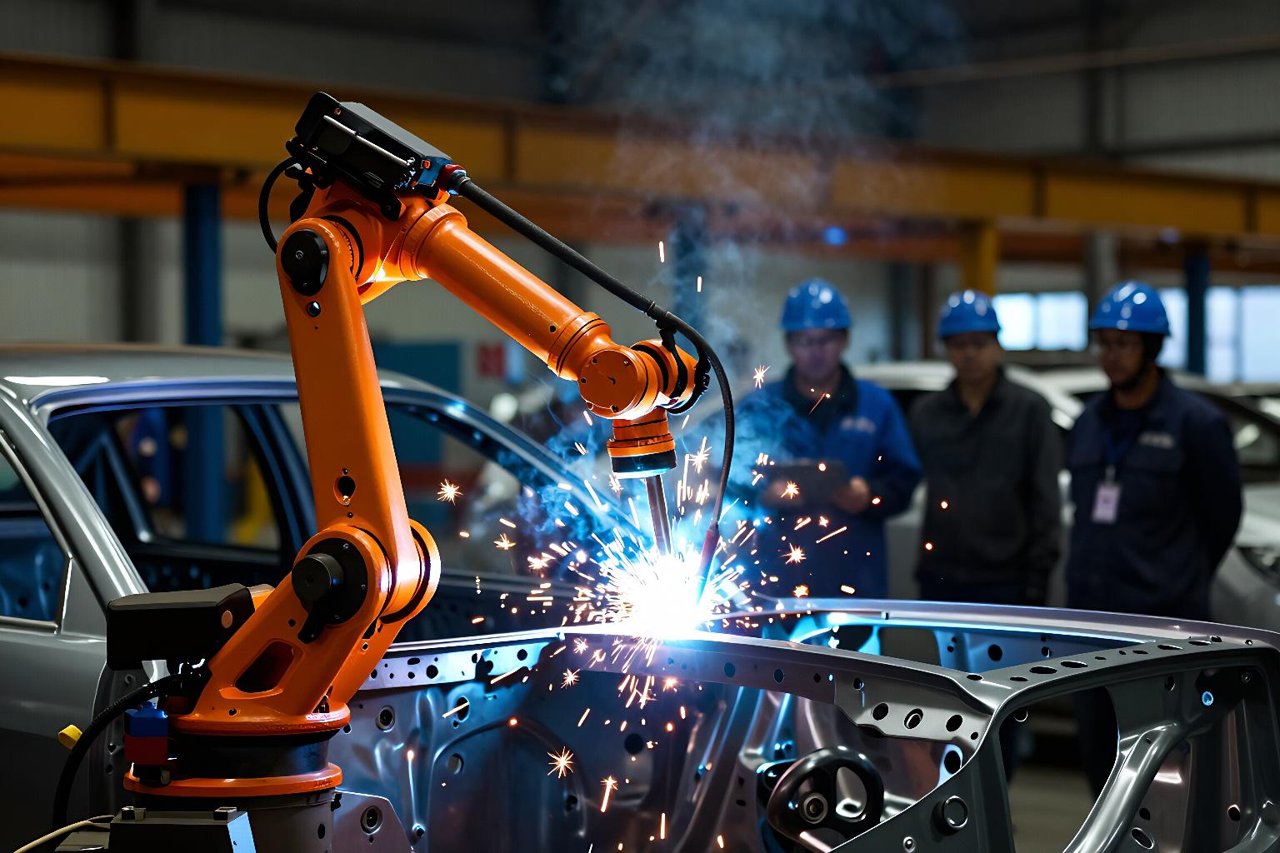
A robot welding a car frame, a surgical arm steadying a needle, a driverless tractor seeding a field at 2 a.m. Robotics has slipped out of the lab and into ordinary work. The International Federation of Robotics counted more than 4.2 million industrial robots operating in factories worldwide in 2023, with another 541,000 installed that year. Those numbers miss the service robots, warehouse movers, and field machines now doing quieter work. Here are the top 7 industries using robots today, and the practical details behind the headlines.
1. Manufacturing and Automotive: The Original Robot Heartland
Automotive plants remain the busiest robot users. Welding, painting, stamping, and parts handling are dangerous, repetitive, and precision-heavy, which makes them a natural fit. A modern car body can pass through dozens of robot cells before it ever reaches a human inspector. South Korea, Singapore, and Germany lead on robot density, with hundreds of machines per 10,000 manufacturing workers.
The newer shift is collaborative robots, or cobots, that work beside people without cages. They handle screws, inspections, and machine tending. The economic payoff from this kind of automation tends to arrive later than the press release promises, as the delayed payoff from technological innovation shows. Factories still need time to retrain staff, redesign lines, and fix the inevitable integration headaches.
2. Healthcare and Surgery: Precision at Human Scale
Hospitals use robots in ways patients rarely see. Surgical systems such as da Vinci let a surgeon control fine instruments through small incisions. The robot does not operate on its own. It translates the surgeon’s hand movements, filters out tremor, and improves visibility. Millions of procedures have now been performed with these systems, from prostate surgery to hernia repair.

Beyond the Operating Theatre
Hospital logistics robots haul linen, medication, and lab samples through corridors. Pharmacy robots count and package pills. Rehabilitation exoskeletons help stroke patients relearn walking patterns. The common thread is not replacing clinicians. It is removing the fetch-and-carry work that eats into patient care.
3. Logistics and Warehousing: The Quiet Revolution
E-commerce turned warehouses into small cities of moving parts. Amazon alone has deployed more than 750,000 mobile robots across its fulfillment network. They carry shelving pods to workers, reducing the miles people walk each shift. Other operators use shuttle systems, robotic arms, and automated storage towers.
- Goods-to-person systems bring inventory to a picker instead of sending the picker down aisles.
- Autonomous mobile robots move pallets between zones without fixed conveyor belts.
- Robotic arms handle repetitive packing, labeling, and palletizing at the end of the line.
Robotics is one of the most practical routes to overcoming supply chain challenges using technology, especially when labor is tight and order volumes swing wildly. The catch is integration cost. A warehouse full of robots still needs software that can route work sensibly and humans who can fix a jam at 3 a.m.
4. Agriculture: Robots in the Field, Not Just the Factory
Farming has become a robotics testbed because labor is seasonal, fields are vast, and chemical use is under pressure. John Deere sells an autonomous tractor that can till fields without a driver in the cab. Carbon Robotics makes a laser weeder that zaps weeds without herbicide. Drone sprayers map crop stress and apply inputs only where needed.
Fruit picking remains hard. Soft produce bruises, branches tangle, and every orchard is different. That is why much of the progress is in repeatable tasks: seeding, mowing, spraying, and transport. The payoff is less about fully unmanned farms and more about a farmer managing a fleet from a tablet while seasonal crews handle the delicate work.
5. Food Processing and Food Service: Consistency Sells
Food plants were early adopters of robotic arms for packaging, sorting, and palletizing. Meat processing uses robots for deboning and portioning, though the work is still partly manual because carcasses vary. The pandemic accelerated interest in automation because close-quarters production lines became a public health problem.
In food service, robots flip burgers, fry baskets, and make coffee. Miso Robotics’ Flippy works fry stations, and automated pizza lines stretch dough and add toppings. These machines are not cheap theatre. They solve turnover, portion control, and consistency in high-volume locations. A robot that makes the same burger 400 times a night has a clear appeal for a chain with 1,000 outlets.
6. Construction and Demolition: Dusty, Dangerous, and Automating
Construction is behind manufacturing on automation, but the gap is closing. The SAM100 bricklaying robot can place up to 3,000 bricks a day. 3D-printed concrete systems build walls and small structures. Demolition robots from Brokk fit through doorways and break concrete in places where a human crew would be at risk from dust, noise, and falling debris.
Drones survey sites and track progress. Exoskeletons help workers lift heavy materials. The industry’s labor shortage and safety record make a strong case for more machines, yet every site is a one-off. Robots struggle with messy, unstructured environments, which is why construction automation has arrived in focused tasks rather than a fully robotic job site.
7. Energy, Mining, and Utilities: Robots Where People Should Not Be
Mining companies run autonomous haul trucks in remote pits. Rio Tinto’s Pilbara operations use driverless trucks and trains to move iron ore across hundreds of kilometers. Offshore oil platforms use crawling and flying robots to inspect pipes, valves, and tanks. Solar farms use robotic cleaners to brush dust off panels without sending crews into harsh heat.
Utilities use drones and ground robots to inspect power lines, substations, and pipelines. Boston Dynamics’ Spot has been tested on offshore platforms and industrial sites, climbing stairs and carrying sensors into areas with gas leaks or high voltage. The value is simple: a machine can be lost. A person cannot.
What the Next Wave Will Test
Cheaper sensors, better vision models, and easier programming are pushing robots into smaller companies. A decade ago, a robotic arm required a specialist to code every motion. Now some systems learn from demonstration or adapt to slight changes in part position. That lowers the barrier for bakeries, labs, and small machine shops.
The jobs question remains messy. Surveys on AI job displacement show public trust is mixed, and factories often struggle to fill robot technician roles even as they cut routine tasks. The companies that get this right train existing staff to maintain, program, and supervise machines. They do not simply buy a robot and hope the org chart sorts itself out.
Looking further ahead, the forecasts for AI in 2026 and beyond suggest more autonomy, more sensors, and more machines that can handle unstructured spaces. The top industries using robots today will not stay fixed. Agriculture, construction, and healthcare are all moving from pilots to production. The interesting question is no longer which industry will use robots. It is which companies will redesign work around them instead of bolting a machine onto an old process and calling it innovation.


