
Table of Contents
Most weight-loss plans don’t collapse in the middle of a diet. They collapse at the start, quietly, before anyone has skipped a meal or laced up a pair of trainers. Someone picks a target weight, downloads a tracking app, and sets off with a plan that has no room in it for a Friday night out, a bad night’s sleep, or a Tuesday when everything tastes like cardboard.
The seven ideas below are the ones that tend to separate people who lose 15 kg and keep most of it off from people who lose the same 5 kg three times in a row.
1. The scale is measuring water as often as fat
Two days of salty restaurant food, a heavy leg session, a long flight, or the week before your period can move the number on the scale by one to three kilos without a single gram of fat changing. Glycogen holds roughly three grams of water for every gram of carbohydrate it stores, which is exactly why a low-carb week can look like a miracle and then stall the moment you eat bread again.
Judging progress by a single morning weigh-in is like judging your finances by checking your bank balance once at random. It’s not that the number is meaningless. It’s that it’s noisy.

What to track instead
- A weekly average. Weigh daily if it doesn’t bother you, then compare seven-day averages rather than individual days.
- Waist circumference at the navel, same time of day, once a week.
- Progress photos every four weeks in the same light, same spot.
- Gym numbers. If your squat and your row are holding steady while the scale drops, you’re losing fat and keeping muscle.
2. The deficit is the engine. Everything else is bodywork
Fat loss requires eating less energy than you burn. A kilogram of body fat holds roughly 7,700 kcal, so a 500 kcal daily deficit lands you near 0.45 kg a week. You can build that deficit with keto, with three meals and no snacks, with an eating window from 10am to 6pm, or with a plain calorie target and a food scale.
The method matters far less than whether you’ll still be running it in March. Pick the version that fits your actual life, whether that’s a flexible, realistic meal plan framework or something stricter and simpler. Both work. Neither works if you abandon it in week three.
3. Protect muscle, or you’ll lose the wrong kind of weight
On an aggressive diet with low protein and no resistance training, somewhere between 20 and 30 percent of the weight you lose can come from lean tissue. That’s a terrible trade. Muscle is what keeps your resting metabolism respectable, your joints stable, and your arms looking like arms rather than sleeves of loose fabric.
Two levers do most of the work here. First, protein: aim for roughly 1.6 to 2.2 grams per kilo of body weight daily, spread across three or four meals, with 30 to 40 grams at breakfast rather than a token slice of toast. Second, lift something heavy two or three times a week. Bodyweight circuits count. Ten minutes of squats, push-ups, and rows in your living room counts. Walking alone is great for your heart and your step count, but it won’t hold onto muscle the way resistance work does.
4. Hunger is data, not weakness
Feeling ravenous at 9pm isn’t a character flaw. It’s feedback about what you ate at 1pm, how you slept, and how steep your deficit is. Treat it as information and you’ll adjust the plan instead of blaming yourself for it.
The practical fixes are boring and effective: more protein, more fibre (aim for 25 to 35 grams a day), more volume from vegetables and soups, and enough water that you’re not mistaking thirst for appetite. Sleep belongs on that list too. Short sleep raises ghrelin and lowers leptin, and controlled studies consistently show people eat a couple of hundred extra calories the day after a five-hour night. Fat quality counts as well, since the cheap stuff is easy to get wrong: these common omega-3 fish oil mistakes are a five-minute fix that has nothing to do with willpower.
5. Choose a rate you can actually hold
A sensible target is 0.5 to 1 percent of body weight per week. For a 90 kg person, that’s 450 to 900 grams. People carrying more body fat can sit at the faster end; leaner people should drift toward the slower end, because the last five kilos are always the stubborn ones.
Faster isn’t better. Very low-calorie diets cost you muscle, wreck your training performance, disturb sleep, and make the following weekend’s takeaway feel less like a choice and more like an inevitability. A slower deficit that you can run for sixteen weeks beats a brutal one you survive for nine days.
6. Your kitchen wins arguments your willpower loses
Willpower is a mood-dependent, finite resource. It’s a terrible long-term strategy and a perfectly fine emergency backup. Design the environment so you need less of it:
- Keep the biscuit tin out of sight and the fruit bowl on the counter. Visible food gets eaten; hidden food gets forgotten.
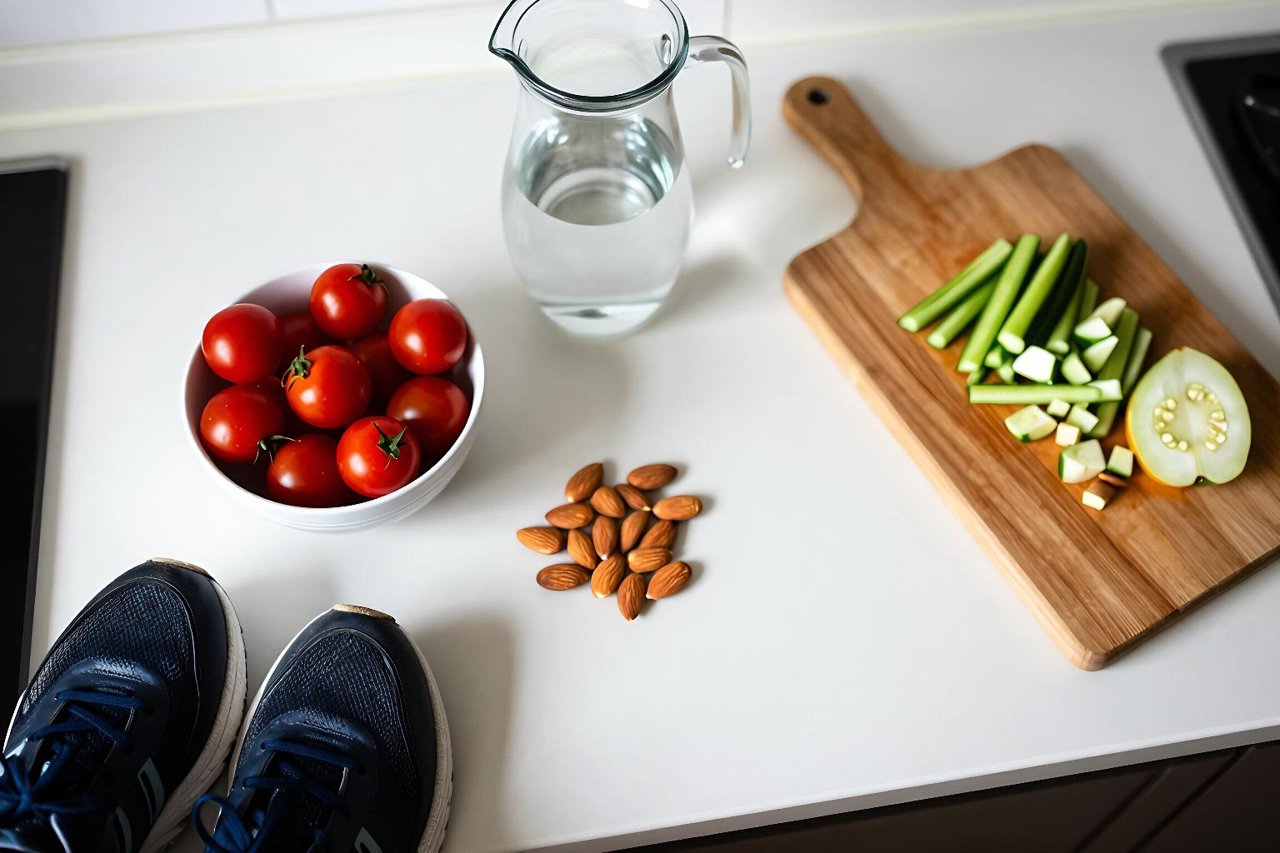
- Chop vegetables on Sunday so the easy snack is also the good one.
- Serve dinner on smaller plates and leave the serving dish in the kitchen, not on the table.
- Do the supermarket shop after a meal, with a list, and skip the aisle that has nothing on it you planned to buy.
- Count alcohol honestly. At 7 kcal per gram it adds up fast, and it lowers your resistance to everything else on this list.
Social events need a plan too, not a hope. Eat a protein-rich meal before a party, decide your drinks before you arrive, and treat one big dinner as one big dinner rather than the end of the week.
7. Decide now what you’ll do when progress stalls
It will stall. That’s not failure, it’s the normal shape of a long diet. A genuine plateau means three to four weeks with no change in your weekly average, flat measurements, and honest adherence. If your tracking has slipped, that’s not a plateau, that’s a data problem.
When it does happen, give yourself options in advance: take a one to two week diet break at maintenance calories, recalculate your targets for your new body weight, audit portion sizes for a few days, or add 2,000 steps a day instead of cutting more food. And if you’ve been white-knuckling hunger for months, or you have a health condition that makes weight loss complicated, it’s worth a proper conversation with your GP about the options, including medication. This guide to talking to your doctor about GLP-1s walks you through what to ask and what to bring.
The plan that works isn’t the strictest one you can follow on a good day. It’s the one you can still run on a bad one, with a kitchen that helps, a protein target you hit most days, and a clear idea of what to do when the scale stops being polite.


