
Table of Contents
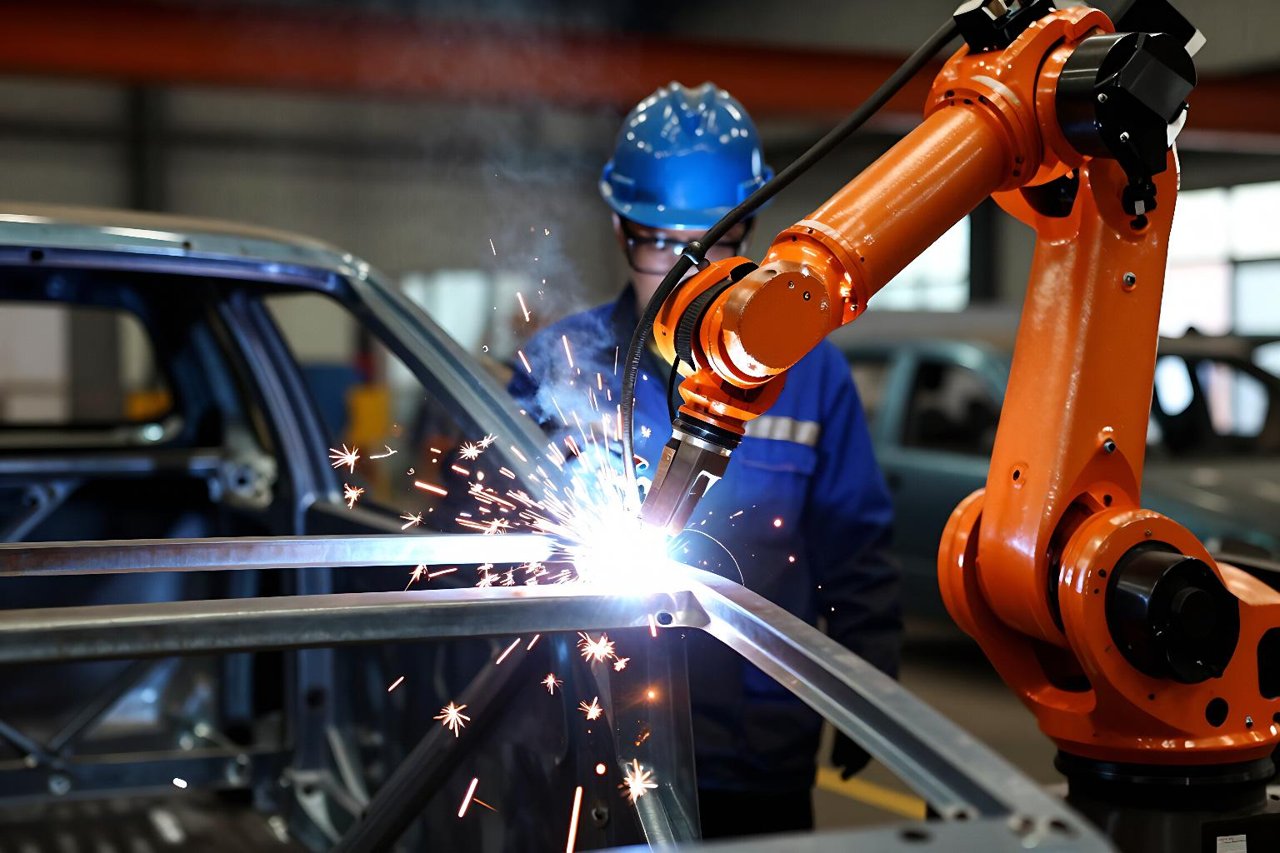
Walk into a mid-sized metal fabricator outside Cleveland and the first thing that strikes you isn’t the noise. It’s how few people are standing at the machines. Two orange arms weld brackets in a rhythm too fast for the eye to follow, a low-slung mobile unit hauls a pallet of blanks across the aisle, and a single technician watches a screen from a stool, coffee going cold beside him.
That scene would have looked exotic in 2010. Today it’s a Tuesday. Robots have been part of manufacturing since the Unimate clocked in at a General Motors plant in 1961, but the past decade has changed what they can do, who can afford them, and what happens to the people who used to do the work.
The safety cage is coming down
For most of their history, industrial robots were dangerous animals kept behind fencing. You programmed one with a handheld pendant, then let it repeat the same motion a million times. Trip a light curtain and everything stopped.
Collaborative robots broke that model. Built with force-torque sensors and rounded joints, a cobot slows or halts when it touches a person, which means it can share a bench with a human instead of living in a cage. Universal Robots shipped its first unit in 2008; every major automation vendor now sells something similar.

Cobots still make up a modest slice of global installations, somewhere in the high single digits by most industry counts. Their influence is outsized for a simple reason: they show up in small job shops, electronics lines and machine-tending cells that run 300 parts a day rather than 300,000. That’s a market the big six robot makers spent forty years ignoring.
Robots stopped being blind
The bigger shift is sensory. A 1990s robot executed a fixed path no matter what sat in front of it. A modern one looks.
Vision and force feedback
3D cameras paired with machine-learning grasp planners now let a robot reach into a bin of randomly jumbled castings and pick one out. That capability, random bin picking, was a research problem for two decades and is now close to commodity. Force-torque sensors do something similar for assembly: the arm feels a bolt start to cross-thread and backs off instead of stripping it.
Programming without a controls engineer
Teaching a robot used to mean a week with a specialist. Newer systems let a machinist physically guide the arm through a motion once, then refine it on a tablet. Vendors claim setup in under an hour for simple pick-and-place. It’s rarely that clean in practice, but the direction is unmistakable.
Those improvements pushed automation into sectors that once looked too messy or too varied for a machine, and you can see the spread in how different industries actually deploy robots day to day, from food packing lines to electronics assembly to warehouse picking.
What the numbers actually say
- Roughly 541,000 industrial robots were installed worldwide in 2023, according to the International Federation of Robotics.
- Global operational stock passed 4 million units, nearly double the figure in 2015.
- South Korea leads on robot density at around 1,000 units per 10,000 manufacturing employees. Singapore and China follow, with the United States closer to 300.
- China alone installs more than half the world’s new industrial robots, a share that would have seemed absurd fifteen years ago.
Density figures are a blunt instrument. A country full of large automotive plants will always look more automated than one dominated by small workshops. Still, the trend line is hard to argue with, and it has held through recessions, pandemics and supply shocks.
Automation and the reshoring argument
Politicians love to talk about bringing factories home. The arithmetic is harder than the slogan. Domestic labor is expensive, and recent trade fights have made imported components pricier and supply chains less predictable, as the ongoing debate over sweeping tariffs and the US manufacturing rebound makes clear.
Robots change that math. A plant that runs a welding cell unattended overnight competes on a completely different cost curve than one paying three shifts of welders. Automation also solves a problem that rarely makes headlines: there aren’t enough welders. The American Welding Society has projected a shortfall of several hundred thousand welding professionals in the coming years. You cannot reshore work you cannot staff.
The honest version of the jobs story
Every deployment kills some roles and creates others, and the mix depends heavily on the plant. What tends to disappear is work that is repetitive, physically punishing or genuinely dangerous: palletizing, spot welding, loading a press, holding a grinder for eight hours straight. What grows is maintenance, integration, programming, quality inspection and process engineering.
A rough rule used by automation consultancies: each new robot creates one to two skilled roles while displacing one to two low-skill ones. Cold comfort if you’re the one displaced, which is why training budgets matter far more than press releases. Public attitudes are shifting too. Surveys collected in research on AI job displacement and worker trust suggest people are more open to automation than the headlines imply, provided someone actually explains the plan.
The payback period finally works for small shops
A single industrial arm might run $25,000 to $60,000. The cell around it, fixtures, safety scanners, integration and commissioning, often costs two to four times that. A complete weld cell can land between $150,000 and $250,000.
Set that against a loaded labor rate of $30 to $45 an hour for a skilled welder, and the payback for a two-shift operation frequently falls in the 12 to 24 month range. Robot-as-a-service deals, where you lease the cell and pay by the hour, have pushed the entry point lower still for shops that can’t stomach the capital outlay.
The catch is that automation punishes sloppy processes. If parts vary by three millimetres, or the fixture is worn, or nobody documented the sequence, the robot will fail in ways that are maddening and expensive to chase down. Fix the process first. Automate second.
What’s coming in the next five years
Mobile manipulators, an arm bolted to a self-driving base, are starting to tend machines across several stations without fixed conveyors. Humanoid pilots are running in warehouses, mostly doing tote handling nobody wants. Simulation software now lets engineers build a full production line digitally before a single bolt is tightened.
Most of this is early. Fewer than a few thousand humanoids exist in industrial settings worldwide, against millions of conventional arms. But the direction of travel among the inventions expected to reshape industry by 2030 points toward machines that are more mobile, more adaptable, and far less dependent on a perfectly structured environment.
If you’re the one making the call
Three things separate plants that get real value from automation from plants that end up with an expensive statue in the corner:
- Start with the worst job. The one with the highest turnover, the most injuries, the least variation. Not the flashiest technology on the trade show floor.
- Measure before you buy. Cycle time, scrap rate, changeover frequency. If you can’t describe the process numerically, you can’t automate it.
- Plan for the exceptions. Someone still has to clear the jam at 2 a.m. Build that into the staffing model instead of assuming the robot never stops.
None of it is glamorous. It is, however, how a factory floor actually changes: one cell at a time, usually starting with the job nobody wanted in the first place.


