
Table of Contents
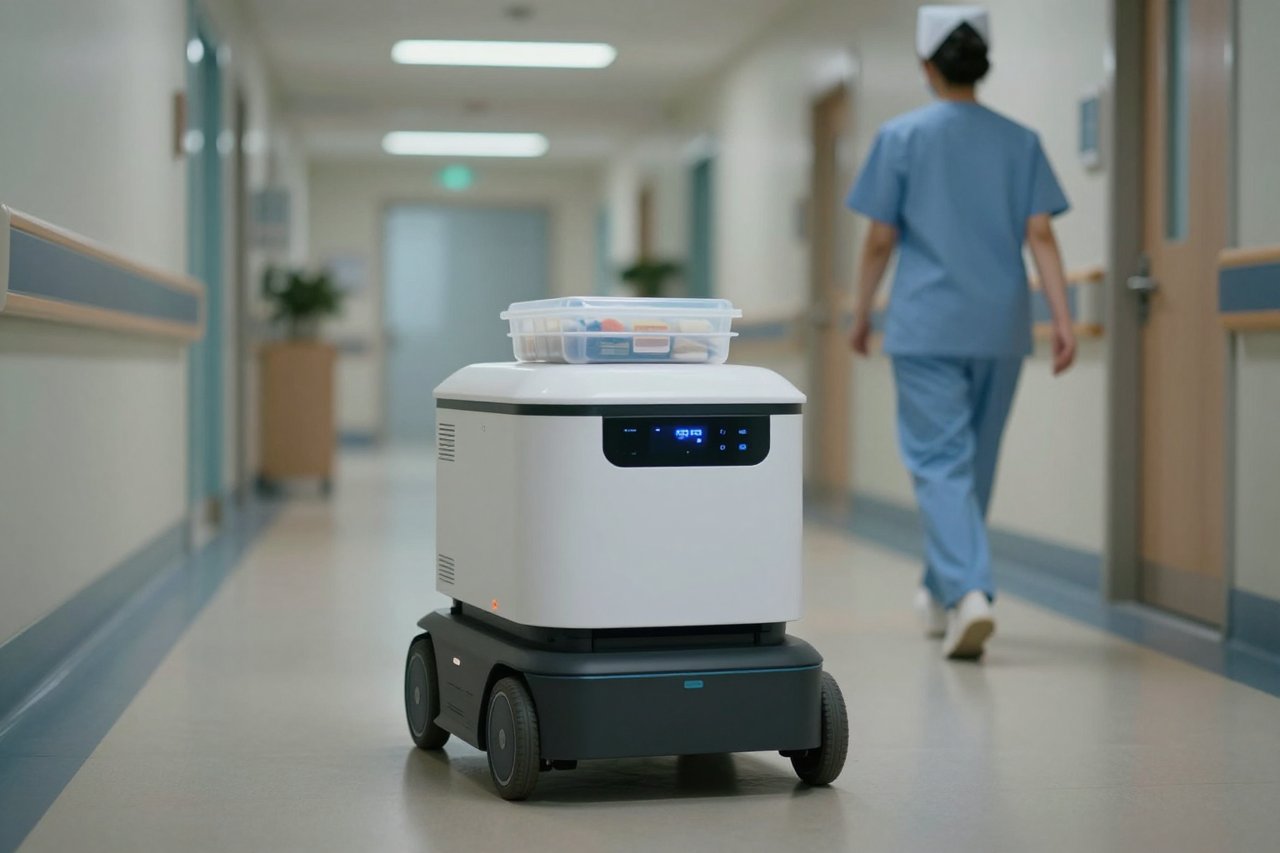
At 2:40 a.m. in a hospital in Dallas, a boxy machine the size of a filing cabinet rolls down a corridor carrying a tray of sterile gauze and a bag of IV fluids. It stops at the lift, where a passing nurse taps the button for it, and continues up to the fourth floor. Nobody looks up. That is exactly the point.
Hospital robots have quietly become part of the furniture in many large medical centres. They are not the sleek humanoids of science fiction. They are carts, arms, cameras and ultraviolet lamps, and they do specific, unglamorous jobs extremely well.
The couriers that never sleep
The most common hospital robot is a delivery cart. Aethon’s TUG, now part of ST Engineering, has been hauling linen, lab samples, meals and pharmacy orders through hospital corridors since the early 2000s. The robot maps the building, plans a route, and navigates around wheelchairs and gurneys using laser sensors. When it reaches a department, staff punch a code into a keypad on top to unlock the compartment.
Diligent Robotics built a different version of the same idea. Its robot, Moxi, has a single arm and a friendly face made of lights, and it was designed after researchers watched nurses and found they spend roughly a quarter to a third of their shift fetching things that aren’t in the room. Moxi picks up supplies from central storage and drops them at the nurses’ station. It can’t insert a cannula or read a chart. It just removes the walk.

These machines belong to a broader family of service robots that has grown fast in the last decade, from warehouse pickers to agricultural drones. If you want a wider picture of the main types of robots and what they actually do all day, the delivery cart is a good reminder that the most useful ones are rarely the most impressive.
In the operating theatre, the robot is a tool, not a surgeon
Nothing in a hospital gets more attention than the surgical robot, and nothing is more misunderstood. The da Vinci system from Intuitive Surgical has four arms, a 3D camera and a console where the surgeon sits, often a few metres away, with her hands in grips and her eyes in a viewer. The instruments inside the patient are about the width of a pencil and bend at the wrist.
What the machine adds is translation. It scales hand movements down to a fraction of their size, filters out natural tremor, and lets a surgeon stitch in a space she couldn’t otherwise reach through a keyhole. More than ten million procedures have been performed on these systems worldwide, most of them prostate, gynaecological and hernia operations.
What the evidence actually says
Robotic surgery is not automatically better surgery. Large reviews have found similar complication rates to standard keyhole techniques for several common operations, with the trade-offs landing in recovery time, blood loss and, sometimes, cost. Orthopaedic robots such as Stryker’s Mako take a different approach, using a pre-operative plan and a robotic arm to guide a saw within millimetres during knee replacement. The benefit there is consistency of implant alignment, not magic.
The pharmacy that runs itself in the basement
Walk into the basement of a big teaching hospital and you’ll often find a robot packing prescriptions. Automated dispensing systems from Omnicell, ARxIUM and ScriptPro store thousands of doses, count tablets with a camera, label the packet and send it to a pharmacist for a final check. Some sites also run IV compounding robots that draw up chemotherapy drugs behind glass, which keeps staff away from hazardous compounds.
The measurable win here is error reduction. Barcode scanning at every step catches the wrong drug, the wrong dose and the wrong patient, and the machine never works a double shift.
Twenty minutes with an ultraviolet lamp
Cleaning a hospital room by hand is only as good as the person doing it, and human beings miss spots. Pulsed xenon systems such as Xenex’s LightStrike and mercury-vapour units from other vendors are wheeled into an empty room and flash high-intensity UV-C light for around ten to twenty minutes, which damages the DNA of bacteria, spores and viruses on surfaces and in shadowed areas a cloth can’t reach.
There are limits. UV systems need the room emptied, so they’re usually deployed after discharge and before the next admission. Dust and bodily fluids still have to be removed first, because light doesn’t penetrate grime. They are a second pass, not a replacement for the cleaner.
A stroke specialist on screen, thirty seconds later
Telepresence robots are the plainest idea in this field and one of the most useful. A wheeled unit with a screen and camera rolls into a room, a remote clinician dials in, and suddenly the patient is being assessed by a neurologist two hundred miles away. In stroke care, where clot-busting drugs are time-critical, that connection can cut the gap between arrival and treatment dramatically.
The technology has moved well past video calls. Research teams are experimenting with augmented and mixed reality so a remote expert can annotate what a local team sees in real time. Work like Xiangyi Cheng’s AR research for classrooms and hospitals points to a future where the remote specialist has almost the same view as the person standing at the bedside.
Rehabilitation, and robots that simply keep company
A patient relearning to walk after a stroke needs hundreds of repetitions of the same motion, which is exhausting for both the patient and the two physiotherapists holding them up. Gait-training systems such as the Lokomat and powered exoskeletons like Ekso Bionics take that weight, moving the legs through a correct pattern while sensors log how much effort the patient contributes. Robotic gloves do something similar for hand recovery.
At the softer end sits Paro, a fluffy robot harp seal with tactile sensors and a small speaker. It responds to being stroked by turning its head and making sounds. It is an approved medical device in several countries and has been trialled extensively in dementia care, where it appears to reduce agitation in some patients. It is not a cure for anything. It is company, on demand, at 3 a.m.
Why the economics are harder than the demonstrations
Hospitals are not startup labs, and the case for a robot has to survive a finance committee. A surgical system costs roughly two million dollars before you add instruments, service contracts and the training days surgeons lose while learning it. Delivery carts need clear corridors, lifts that play nicely with their software, and someone to maintain the maps when a ward is renovated. The pattern repeats far beyond medicine, as this look at where robotics and automation genuinely pay off makes clear: the return usually shows up in labour that is repetitive, predictable and hard to fill.
Energy is the other practical constraint. A cart that runs out of charge at the far end of a basement corridor is a blockage, not an assistant, and most hospital robots still need a human to dock them or swap a battery. That problem is not unique to healthcare, and researchers are working on it hard, as this piece on why robots run out of energy long before they run out of work explains.
- Staff time: who cleans, docks, loads and troubleshoots the unit?
- Infrastructure: door widths, lift interfaces, wifi coverage and charging bays.
- Integration: does it talk to the electronic record, or is it a separate logbook?
- Throughput: does it save steps, or just move them somewhere else?
What’s landing in the next few years
The direction of travel is away from spectacle and towards plumbing. Expect more small, single-purpose machines that dock themselves and need no button presses: sample runners that ride the service lifts overnight, pharmacy robots that prepare a discharge prescription before the doctor has finished the ward round, and disinfection units small enough to sit in an ambulance bay.
Surgical platforms are shrinking too, with single-port systems and flexible instruments that enter through one incision, plus AI layers that highlight anatomy on the console in real time and warn when an instrument drifts toward a nerve. None of this replaces judgement. It gives a tired clinician at the end of a twelve-hour shift a steadier hand and a second pair of eyes.
Healthcare is only one of the sectors absorbing these machines at speed, as a survey of the industries using robots today shows, but it may be the one where the details matter most. A hospital robot earns its place by being boring, reliable and invisible, doing the fetch, the count, the flash of ultraviolet light, so the people in the building can stay with the patient.


