
Table of Contents
Around 800 BCE, a scatter of farming villages and small towns started talking to each other across the Aegean. They shared a language, a set of gods, and a stubborn habit of arguing. What they never built was a single unified state. That is the strange thing about the ancient Greek civilization: it was hundreds of separate communities that spent as much time fighting each other as they did fighting outsiders. Athens, Sparta, Thebes and Corinth were rivals, not teammates. Somehow that fractured, competitive arrangement turned out to be one of the most productive setups in human history.
A civilization made of cities, not a country
Greeks organised themselves into the polis, usually translated as city-state, and there were roughly a thousand of them scattered from the coast of Asia Minor to Sicily and southern Italy. Each had its own laws, army, coinage, calendar and patron deity. Cross a mountain ridge and the dialect changed.
Athens was the giant, with perhaps 250,000 residents at its peak in the fifth century BCE, counting enslaved people, women and foreign residents who had no political rights. Sparta controlled a far larger territory but kept its citizen body deliberately small. Places like Plataea or Aegina were tiny by comparison, a few thousand people, and still fielded armies and minted silver.
Climbing out of the dark age
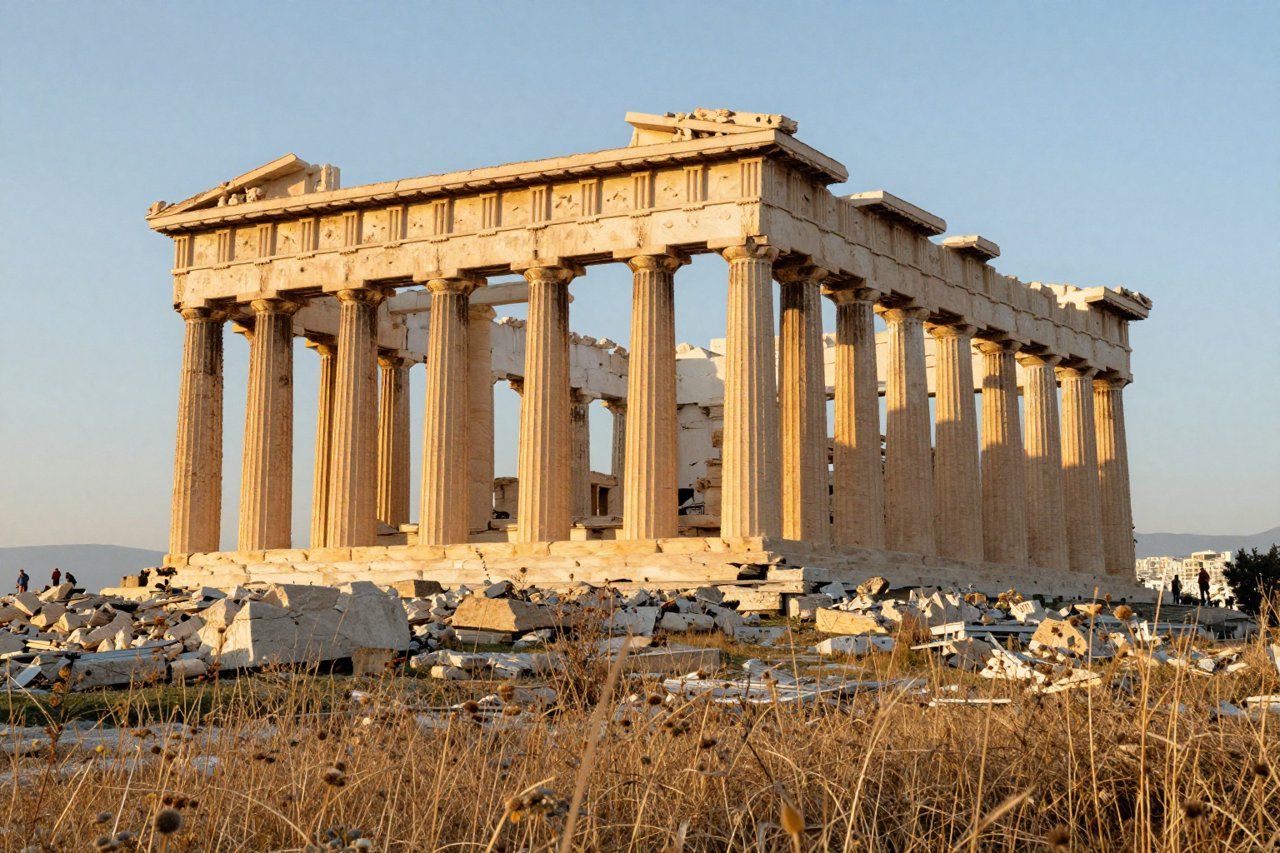
The Greece of the Parthenon was not the first Greece. Bronze Age Mycenaean palaces collapsed around 1200 BCE, and the writing system that went with them, Linear B, vanished with the buildings. Population dropped, long-distance trade thinned out, and for roughly four centuries there are no written records at all. Archaeologists call it the Greek Dark Age, though a better name might be the quiet age.

Recovery came partly through contact with older, richer neighbours. Greek traders working the eastern Mediterranean borrowed the Phoenician alphabet around 800 BCE and did something clever with it: they added vowels. Twenty-two consonant signs became a flexible system almost anyone could learn in a few weeks, unlike the hundreds of signs a scribe in the cuneiform world of ancient Mesopotamia had to master. Literacy spread far beyond a priestly class.
Around the same period, someone wrote down the Iliad and the Odyssey. Whether that someone was one poet called Homer or several, the effect was the same: a shared set of stories that every Greek city could claim.
The Persian Wars and the invention of “us”
In 499 BCE the Greek cities of Ionia revolted against Persian rule. Athens sent twenty ships to help, and the Persian king Darius never forgot it. His expedition in 490 BCE landed at Marathon, where roughly 10,000 Athenians and Plataeans met a much larger Persian force and, according to Herodotus, lost 192 men against 6,400 of the enemy. Those casualty figures are almost certainly inflated, but the strategic result was real.
Ten years later the Persians came back with a far bigger army. Three hundred Spartans and about 7,000 allied troops held the pass at Thermopylae for three days before being outflanked. The Athenians evacuated their city, let it burn, and destroyed the Persian fleet in the narrow strait at Salamis with around 300 triremes. It was a gamble that paid off, the kind of rise-and-near-collapse arc that runs through how the first great empires rose, ruled and lost everything.
The aftermath mattered more than the battles. Athens turned a defensive alliance, the Delian League, into a tax-collecting empire of some 200 member states and moved the treasury to its own acropolis. That money built the Parthenon.
Athens and the strange experiment of democracy
In 508 BCE a reformer named Cleisthenes reorganised Athenian society so that loyalty ran through neighbourhoods rather than aristocratic clans. Out of that came a system where the assembly of citizens, the ekklesia, voted directly on laws and war. Attendance could reach 6,000 on a big day.
The machinery was surprisingly bureaucratic:
- A Council of 500, chosen by lottery each year, set the assembly’s agenda.
- Jury courts ran with 501 or more jurors, odd numbers by design so there could never be a tie.
- Ostracism let citizens vote to exile one person for ten years, and it needed 6,000 votes to stick.
- Most public offices were filled by lot, not election, on the theory that ordinary men could do the job.
The catch was who counted as a citizen. Women, enslaved people, and free foreign residents were shut out. Perhaps 30,000 to 60,000 adult men out of a quarter of a million people held all the political power. Athenian democracy was radical for its beneficiaries and brutally exclusive at the same time. Both things are true.
Philosophy as a contact sport
Public arguing was the local sport, and it produced Socrates, who wrote nothing and questioned everything until Athens executed him in 399 BCE. Plato turned his teacher into dialogue, Aristotle turned Plato into a research programme, and between them they set the questions that European universities were still arguing about 2,000 years later. The Sophists, often dismissed as hired rhetoricians, taught anyone who could pay how to win an argument in court. That market for persuasion is arguably the origin of higher education.
Sparta, and the other way to run a city
Sparta solved the problem of stability differently. Two hereditary kings shared power, checked by a council of elders and five annually elected overseers called ephors. Male citizens entered a state education system, the agoge, at seven and lived in barracks into their thirties. The whole system rested on controlling the helots, a subjugated population outnumbering citizens by perhaps seven to one.
Spartan women could inherit and manage property, ran estates while husbands were away, and ate better than their Athenian counterparts. They were also, as far as we can tell, largely illiterate. Sparta won the Peloponnesian War in 404 BCE after 27 grinding years, then discovered that victory had cost it the manpower to hold anything together.
What ordinary life looked like
Most Greeks farmed. Houses were mudbrick with small windows and a central courtyard, cool in summer and cheap to build. Meals were barley bread, olives, figs, cheese, onions and salted fish. Meat turned up mostly at religious festivals, when animals were sacrificed and shared out. Wine was drunk diluted, roughly three parts water to one, and drinking it neat was considered barbaric.
Clothing was two rectangles of cloth pinned at the shoulders, the chiton and the himation, with no buttons anywhere in the wardrobe. Children played with hoops, knucklebones and clay dolls. Homes had no chimneys, so cooking smoke escaped through the roof tiles.
Science, medicine and machines
Greek thinkers were not always right, and they knew it. Thales reportedly predicted a solar eclipse in 585 BCE. Hippocrates and his followers argued that disease had natural causes rather than divine ones, which is why the oath doctors still recite carries his name. Eratosthenes measured the circumference of the Earth around 240 BCE using shadows in two Egyptian cities and got within a few percent of the true figure.
Engineering was equally blunt and effective. Archimedes described the screw pump, the compound pulley systems that let one man move a loaded ship, and allegedly designed war machines that held off the Roman siege of Syracuse for two years. The Antikythera mechanism, a shoebox-sized bronze device with at least thirty hand-cut gears, modelled the movements of the sun and moon and predicted eclipses. It is one of the technologies ancient civilizations beat us to by nearly two millennia.
Alexander and the world the Greeks left behind
Philip II of Macedon, a kingdom the southern Greeks considered half-barbarian, defeated Athens and Thebes at Chaeronea in 338 BCE. His son Alexander took that army east in 334 BCE and did not stop for eleven years. He crushed the Persian Empire, founded Alexandria in Egypt, and died in Babylon in 323 BCE at thirty-two.
His generals carved the conquests into kingdoms: the Ptolemies in Egypt, the Seleucids across Syria and Mesopotamia. Greek became the shared language of trade and administration from the Adriatic to the Indus, a status it held for centuries and the reason the New Testament was written in it rather than Aramaic. Alexandria’s library and its scholar-poets sat at the centre of that network, in a region whose history never stopped being a crossroads, as you can see across the long history of the Middle East.
Rome absorbed Greece in 146 BCE and then absorbed its culture so thoroughly that Horace complained about it. Wealthy Romans hired Greek tutors, copied Greek statues, and studied Greek rhetoric. Even the neighbouring three-thousand-year run of ancient Egyptian civilization ended up recorded by Greek writers like Herodotus, who reported what priests told him and got some of it wrong.
What still runs on Greek software
The Olympic Games ran from 776 BCE until around 393 CE, roughly 293 festivals, before a Roman emperor shut them down; they restarted in Athens in 1896. Greek theatre began as a festival for Dionysus and gave us the masks, the amphitheatre shape, and the split between tragedy and comedy that playwrights still work inside. The word theatre itself comes from theatron, “a place for seeing”.
The language never died. Greek has been spoken continuously for about 2,800 years, which is a longer unbroken run than almost any other in Europe. And the vocabulary is everywhere: democracy, politics, philosophy, biology, physics, drama, music, history, geography, chaos, panic, school. The ancient Greek civilization did not leave us a capital city or an emperor’s tomb worth touring. It left a method, which is to argue in public, write the argument down, and let the next person try to knock it over.


