
Table of Contents
At its greatest extent, the ancient Roman Empire ran from the rain-soaked hills of northern Britain to the deserts of Mesopotamia. That is roughly five million square kilometres of territory, and somewhere in the region of 60 million people living inside it. Put another way, about one in every five humans alive at the time answered, in some fashion, to Rome.
What makes the number worth sitting with is how ordinary the starting point was. No grand plan, no prophecy, no single genius. Just a town on a marsh in central Italy that proved unusually good at absorbing its enemies, copying what worked, and refusing to stay beaten. Everything else followed from that.
From Seven Hills to a Mediterranean Superpower
Roman tradition dated the founding of the city to 753 BC, and the archaeology broadly backs the idea that people were living in huts on the Palatine Hill around that period. For the first few centuries Rome was a regional player with a strange habit: lose a battle, study the winner, come back better armed. The Gallic sack of around 390 BC burned that lesson into the city’s politics. Rome stopped trusting its neighbours and started installing them.
By 146 BC the city had destroyed Carthage, annexed Greece, and dominated the western Mediterranean. That leap from city-state to empire is the same pattern visible in how the first great powers rose, ruled, and lost everything — though Rome managed the trick on a scale nobody before it had attempted.

The Republic That Broke Itself
Rome’s republican system, with its consuls, senate, and tribunes, was designed for a city of a few hundred thousand. It was not built for an empire. Generals who commanded armies for years in Spain or Gaul came home with loyal veterans and no interest in sharing power. Marius and Sulla set the precedent in the 80s BC. Julius Caesar crossed the Rubicon in 49 BC and made it a habit. He was assassinated in 44 BC, and the civil wars ran another thirteen years until Octavian beat Antony and Cleopatra at Actium. In 27 BC the senate handed Octavian the name Augustus, and the Republic quietly became something else.
The Machinery That Made It Work
Empires usually get described through battles. Rome held together for four centuries mostly through infrastructure, law, and the dull administrative genius of letting conquered elites keep their dignity.
Roads and concrete
The road network eventually reached around 400,000 kilometres, of which roughly 80,000 were stone-paved. A courier on a good road could cover 60 to 80 kilometres a day; with relay stations and fresh horses on the imperial post, messages moved faster still. Roman concrete, poured rather than stacked, let engineers build harbours, vaults, and domes that would have been impossible with cut stone alone. Some of it has outlasted the civilisation that poured it.
Law and citizenship
The Twelve Tables of around 450 BC were a scrappy set of written rules, but they established the principle that law existed above individual magistrates. Over centuries this grew into a system of jurists, precedents, and provincial courts. In 212 AD the emperor Caracalla granted citizenship to essentially every free person in the empire. That single edict turned 60 million foreigners into stakeholders overnight. It was expensive and cynical and it worked.
The legions
Around 28 legions of roughly 5,000 citizen soldiers each, backed by auxiliaries of similar number, held the frontier. Every legionary carried a pickaxe and a basket as well as a gladius. The army built the roads it marched on, and the camps it dug each night sometimes became towns.
What Daily Life Actually Looked Like
The empire contained wildly different lives, and the flat phrase “Roman citizen” hides most of them.
- A senator in Rome started the day receiving clients at home, walked down to the Forum to argue and gossip, and finished at the baths by mid-afternoon. Public business was done before lunch.
- A potter in southern Gaul worked in a workshop churning out red-gloss tableware by the tens of thousands, stamped with a maker’s mark and shipped as far as Britain and North Africa.
- A wheat farmer in Egypt paid tax in grain, watched it float down the Nile to Alexandria, and never saw the ship that carried it to Ostia to feed the capital.
- A soldier on Hadrian’s Wall signed on for 25 years, earned around 1,200 sesterces a year under Domitian, and had deductions taken for boots, barley, and his own burial club.
- An enslaved worker, perhaps a third of Italy’s population at points, could be a mine labourer, a household tutor, or a doctor. Manumission was common enough that it shaped the social ladder.
The texture of all this — the graffiti, the fast-food counters, the religious festivals, the truly alarming medical advice — is where the weird, brutal, and brilliant side of Roman life really shows up.
Rome the City: Engineering on an Absurd Scale
Eleven aqueducts fed the capital, delivering something close to a million cubic metres of water a day. Most of it went to baths, fountains, and public latrines rather than drinking. The Colosseum seated somewhere between 50,000 and 80,000 people. The Pantheon’s dome, 43 metres across, is still the largest unreinforced concrete dome on earth.
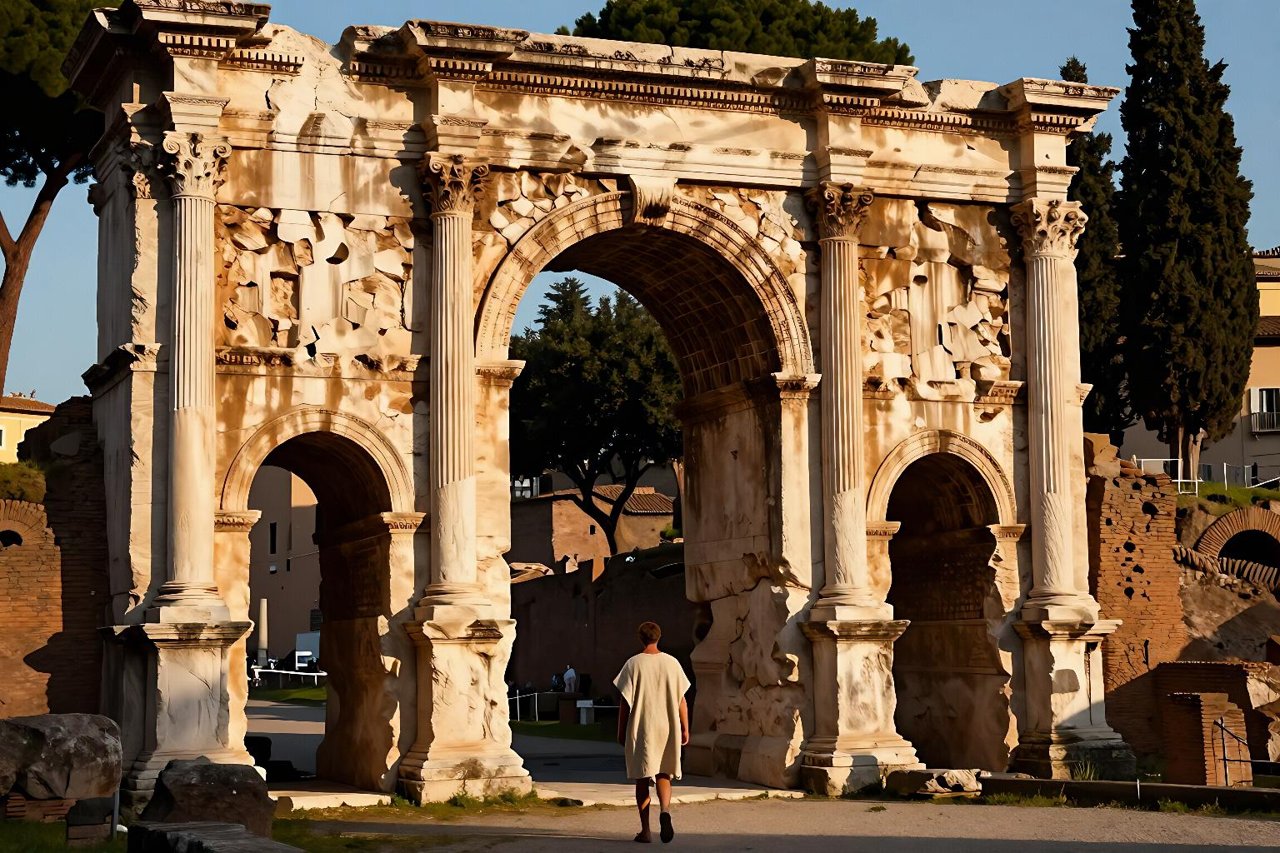
Most Romans did not live anywhere near that grandeur. They lived in insulae, apartment blocks up to five or six storeys, with no kitchens, no running water, and a genuine risk of collapse or fire. The ground floor might hold a shop; the top floors were the cheapest and the deadliest. Standing in the surviving shells of these cities today, from the Pont du Gard to Leptis Magna to Segovia’s aqueduct, is one of the more direct ways to feel the empire’s reach — as these ancient ruins scattered around the world make clear.
Emperors and the Succession Problem
Rome never solved the question of who came next. Adoption worked while it was done well, as with Nerva choosing Trajan. It collapsed the moment an emperor died without an obvious heir and a general with three legions decided he had a better claim.
The result was the Crisis of the Third Century: between 235 and 285 AD, more than two dozen men held the purple, most for only a year or two, and most died violently. Diocletian, arriving in 284, split the empire into eastern and western halves and tried to formalise succession with the tetrarchy — four emperors, two senior and two junior. It held for about a generation. Constantine moved the capital east to Constantinople in 330 and left the west to fend for itself.
The Long Unravelling
Nothing about the end was sudden. The western empire spent its last century managing a slow fiscal squeeze, repeated plague, currency debasement, and migrating peoples who were sometimes allies and sometimes not. Alaric’s Goths sacked Rome in 410, an event that shocked contemporaries far more than it damaged the city. The Vandals arrived in 455. In 476 a Germanic commander named Odoacer deposed the teenage emperor Romulus Augustulus and sent the imperial regalia to Constantinople, which is the date usually given for the fall.
The eastern half kept going for another thousand years, and for much of that time its inhabitants called themselves Romans. When Constantinople finally fell in 1453, the empire was nearly 2,200 years old by its own reckoning.
What the Empire Left Behind
Latin became Spanish, Portuguese, French, Italian, Romanian, and a dozen smaller tongues. Justinian’s sixth-century legal codification fed into medieval canon law, then into Napoleon’s code, then into the civil law systems used across much of Europe, Latin America, and East Asia today. The arch, the dome, the grid plan, and the three-course dinner all carry Roman fingerprints.
Objects travel further than governments do, and a surprising amount of what we know about Roman engineering, medicine, and domestic life comes from things pulled out of the ground — a surgeon’s bronze instruments, a glass cup that shifts colour in the light, a stamped brick that dates a whole building. The same is true of artifacts that quietly changed what historians could prove, several of them Roman.
There is a practical lesson buried in all of this. The ancient Roman Empire did not endure because it was ruthless, though it often was, or because its emperors were exceptional, which most were not. It endured because it made it worth being on the inside: a road that let you sell your pottery in three provinces, a court that would hear your case, a citizenship that survived the death of any single ruler. The day that bargain stopped feeling worth it, the whole structure began to loosen.


