
Table of Contents
A warehouse robot does not see a cardboard box the way you do. It sees a cluster of depth points about 1.2 metres ahead, a flat top surface, and a gap wide enough to pass on the left. That translation from photons and sound waves into a usable model of the world is the quiet work of robot sensors. Without it, a machine is just actuators waiting for instructions.
The short answer to how robot sensors help machines understand their surroundings is that they turn physical signals into a model the robot can test, update, and act on. Spotting obstacles, estimating distance, recognising surfaces, and knowing where the robot itself is are separate problems. Different sensors answer different questions, and the clever part is how those answers get combined.
What Robot Sensors Actually Measure
Every sensor reduces a physical property to a signal a computer can process. A camera turns light into pixels. Lidar times laser pulses. An inertial measurement unit reports acceleration and rotation hundreds of times per second. None of these devices truly understands a room. They produce measurements, and software builds the understanding.
- Cameras capture colour and texture, which helps with labels, people, and object recognition.
- Lidar and depth cameras measure distance, producing point clouds that reveal shape and free space.
- Radar detects range and speed through radio waves and keeps working in rain, dust, and darkness.
- Ultrasonic sensors bounce sound off nearby surfaces, common on mobile robots and parking systems.
- Tactile and force sensors measure contact, pressure, and torque at the gripper.
- Encoders and IMUs track wheel rotation, heading, and acceleration so the robot knows how its body is moving.
The Main Senses on a Modern Robot
Cameras and depth sensing
A 1080p camera at 30 frames per second gives a robot rich texture and colour. Stereo pairs estimate depth by comparing two images, while structured-light cameras project a pattern and measure how it deforms. A picking robot might inspect a bin from 40 centimetres away and guide a suction cup to one item.

Lidar and radar
A 16-channel lidar can produce a 360-degree scan at 10 Hz with a useful range of 50 to 100 metres. That makes it good at mapping corridors and spotting thin obstacles such as forklift tines. Radar at 77 GHz is less detailed but stronger in bad weather and can measure speed directly.
Touch and proximity
Collaborative arms use force-torque sensors at the wrist to stop when contact exceeds a set threshold, often within a few milliseconds. Vacuum grippers use pressure sensors to confirm a part is attached. Bumpers and ultrasonic rings cover the last 20 centimetres around a mobile base.
Proprioception
Wheel encoders count rotations, IMUs measure tilt and turn rate, and joint encoders report arm position. A quadruped climbing stairs relies on IMU data at 1 kHz to adjust foot placement before it tips.
Sensor Fusion: Turning Signals into a Scene
Raw measurements are noisy, delayed, and incomplete. Sensor fusion combines them into one estimate of the world. A mobile robot might fuse lidar scans at 10 Hz, camera images at 30 Hz, and IMU data at 200 Hz to track its position and nearby obstacles. Kalman filters and particle filters are common; more complex systems use factor graphs to optimise hundreds of past measurements at once.
The output is rarely a video feed. It is usually an occupancy grid that marks each cell as free, occupied, or unknown, or a point cloud labelled floor, wall, person, and pallet. Simultaneous localisation and mapping, or SLAM, lets a robot build that map while working out where it is inside it. Good SLAM can hold drift to a few centimetres over a 10,000-square-metre warehouse if the sensors stay calibrated and the space has stable features.
Why Two Good Sensors Beat One Great One
Every sensor has a failure mode. Cameras struggle in direct sunlight and darkness. Lidar returns weaken on black carpet and scatter in thick fog. Radar has poor angular resolution. Ultrasonic sensors miss soft materials. Pairing them is how robots cover each other’s blind spots.
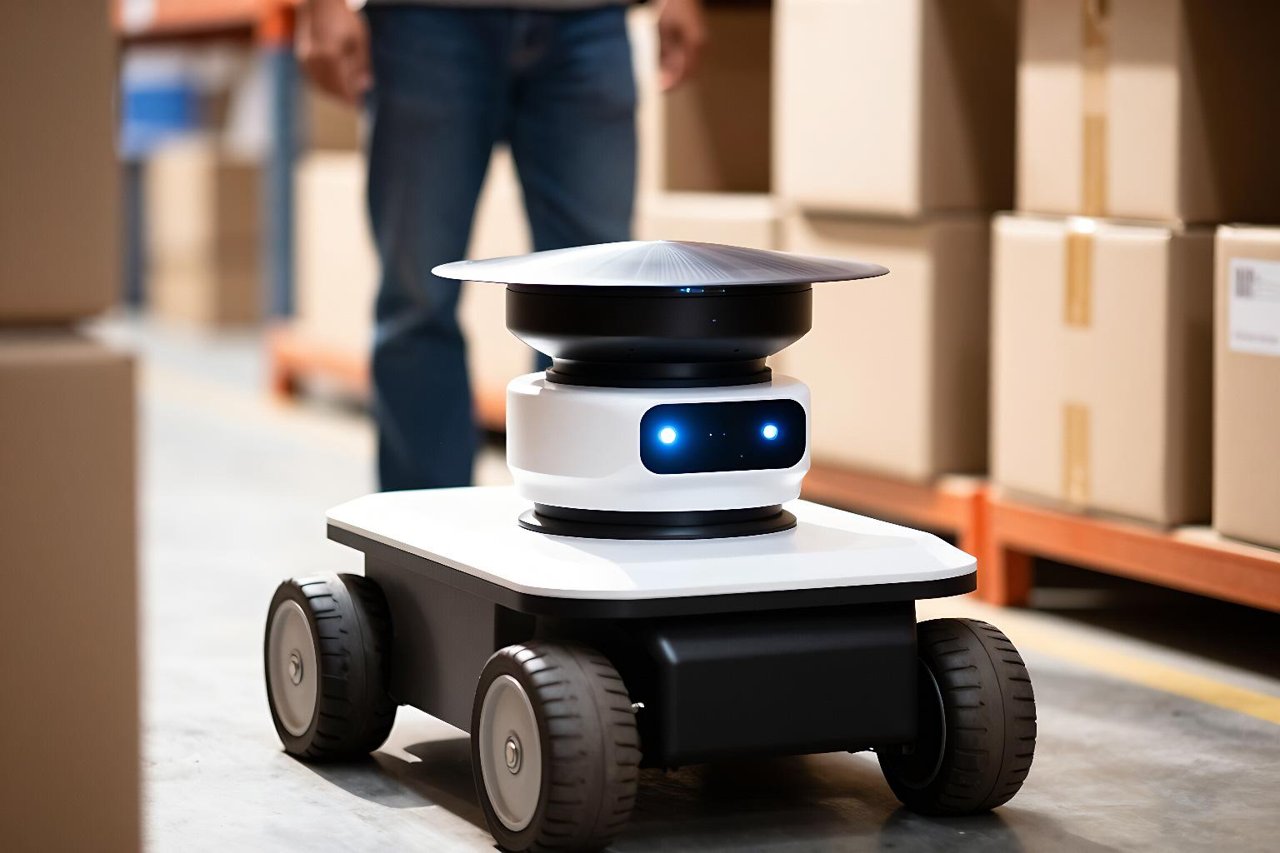
A common mobile robot setup uses lidar for mapping, depth cameras for obstacle classification, ultrasonic sensors for glass and low objects, and bumpers as a physical last resort. If the camera sees a person but lidar is unsure, the robot slows down and increases clearance. If lidar detects a transparent door the camera barely registers, the map marks it as an obstacle. The robot does not need certainty from every sensor. It needs enough agreement to act safely.
Real Machines, Real Constraints
In a fulfilment centre, a 250-kilogram tugger robot may move at 1.5 metres per second along a 2-metre aisle. Its safety scanner must detect a person at 3 metres and stop the machine before contact. That requirement shapes the suite: certified safety lidar, redundant emergency stops, and software that prioritises the nearest reliable measurement.
On a farm, an autonomous weeder faces dust, vibration, and changing light. A colour camera identifies crop rows, while a depth sensor separates leaves from soil. RTK GPS supplies absolute position to within 2 to 3 centimetres, and wheel odometry fills the gaps between satellite updates.
Inside a collaborative workcell, an arm lifting a 10-kilogram part may use a force-torque sensor to detect a 5-newton side load, roughly the force of a hand brushing the wrist. That sensitivity lets it stop before a person is hurt without a full safety cage.
The Unglamorous Work: Calibration, Noise, and Edge Cases
Lab performance is one thing. Keeping a sensor working in a factory for three years is another. Lenses get dirty. Brackets vibrate loose. Temperature changes shift the alignment between a camera and a lidar by a fraction of a degree, which becomes a 10-centimetre error at 20 metres.
Calibration is a maintenance task, not a one-time setup. Teams measure each sensor’s position and orientation relative to the robot body, then recheck after collisions or servicing. They also characterise noise. A cheap IMU may drift several degrees per minute, so software must trust it briefly and correct it with vision or lidar over longer periods. Reflective pallet wrap, black cable on a dark floor, and a forklift entering a blind corner belong in every test plan.
What Changes When a Machine Can Read a Room
Reliable sensing changes what a robot can be trusted to do. A machine that knows where the floor is, where people are, and how confident it should be can move faster without becoming reckless. It can hand a tool to a worker, pick from a cluttered shelf, or drive through a crowd at walking pace. The sensors do not make the robot intelligent on their own. They give the software something honest to reason about.
The next wave is already visible: solid-state lidar with no spinning parts, event cameras that report only pixels that change, and tactile skins that cover an entire arm. Each adds a different kind of evidence. The goal stays the same. A robot should answer a simple question before it moves: what is around me, and how sure am I? The quality of that answer separates a machine that follows a script from one that can work in messy, unpredictable places.


