
Table of Contents
At BMW’s Spartanburg plant in 2024, a matte-grey machine with two arms and two legs spent weeks lifting sheet metal and feeding it into a press. It wasn’t a stunt. Figure’s 02 robot worked roughly 10-hour shifts alongside human crews, and the pilot produced enough data to justify a second round of testing. That’s a long way from the backflip videos.
So what are humanoid robots designed to do? Strip away the marketing and the answer is narrower and more interesting than most people expect. They’re built to put human-shaped hands and eyes into environments that were never redesigned for machines. Factories with fixed workstations. Warehouses with 1-metre shelving. Hospitals with narrow corridors and door handles.
Here’s what that actually looks like in practice, and where the engineering still trips over itself.
Why bother with the human shape at all?
A wheeled robot with a single arm is cheaper, stronger and easier to certify. Ask any integrator. The reason humanoids exist is that the world is already built around a roughly 1.7-metre biped with two hands and a 70-centimetre reach.

- Door handles sit at about waist height. Stairs have 18-centimetre risers. Shelves top out around two metres.
- Tools, from torque wrenches to pallet jacks, are designed for a human grip and a human wrist.
- Walking up a step or squeezing between conveyor belts doesn’t require a facilities rebuild.
That last point is the commercial argument. Retrofitting a warehouse for a wheeled platform can cost six figures per aisle. A humanoid that can use the existing aisle costs whatever the robot costs, and nothing else.
There’s a social dimension too. A robot with a face and a torso reads as a colleague rather than a forklift, which matters in hospitals, hotels and care homes. Whether that’s a good thing is a separate question.
The jobs humanoids are actually being built for
Factory work: machine tending and part handling
Mercedes-Benz has tested Apptronik’s Apollo robot for logistics tasks at its plant in Kecskemét, Hungary. Figure’s deal with BMW focused on the unglamorous stuff: picking parts from racks and placing them into fixtures. These are jobs with high injury rates and high turnover, not jobs that require judgement.
The tasks are deliberately boring. Move a 10-kilogram casting from a bin to a conveyor 400 times a shift. Load a CNC machine. Wipe a surface. Humanoids are being designed for the 20% of factory work that’s too variable for fixed automation but too repetitive for people to enjoy.
Warehouse picking and tote handling
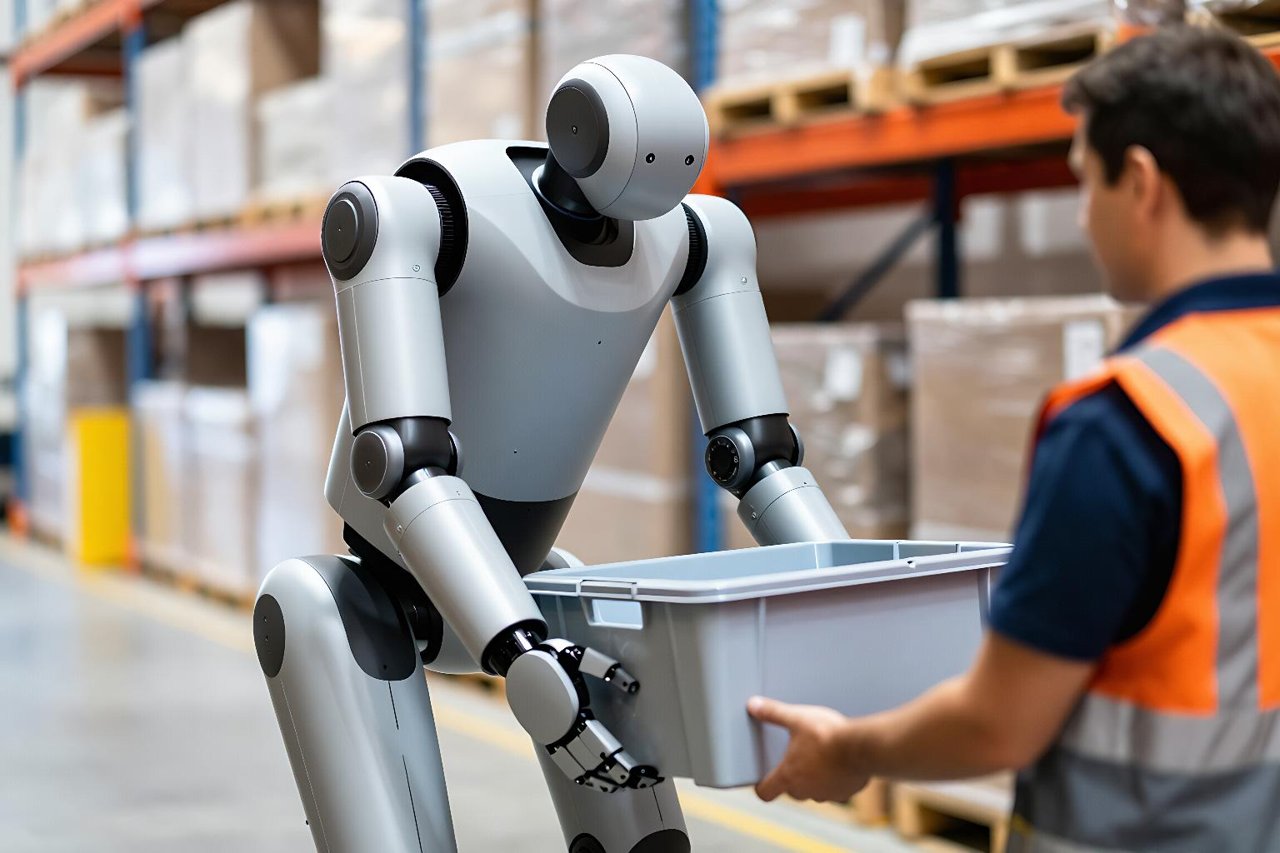
Agility Robotics’ Digit has been deployed at GXO Logistics facilities for moving empty totes and other repetitive material handling. Amazon has been testing Digit and Agility’s platform in its R&D centres. The target is straightforward: tote-to-conveyor transfers, case picking from low shelves, and the last-metre movement that conveyor systems can’t reach.
Payloads are modest, usually 15 to 25 kilograms. The point isn’t brute strength. It’s a machine that can walk to a shelf, bend, grab a soft-sided package, and put it somewhere else without a human resetting it every 20 minutes.
Dirty, dull and dangerous work
This is where humanoids might earn their keep first. Nuclear decommissioning sites, offshore oil platforms, and disaster response zones are full of tasks that are expensive to human-proof. A robot that can climb a ladder, turn a valve and operate a standard tool is genuinely useful when the alternative is sending someone into a contaminated space.
Boston Dynamics’ Atlas has been shown doing exactly this kind of manipulation in test environments. The commercial case is easier here than in a tidy factory, because the cost of human exposure is so high.
Care and clinical support
Japan has been funding care robots for two decades, driven by a shrinking workforce and a growing elderly population. Humanoids in this space are designed for patient lifting, fetching supplies, and helping someone from a chair to a bed. Lifting injuries are one of the biggest causes of lost work time among nurses, and a machine that can safely move a 70-kilogram person is worth a lot.
Clinical labs are also adopting automation for delicate, repetitive work. The same trend shows up in fertility treatment, where mobile IVF units and automated lab equipment are changing how samples are handled, as this report on cybersecurity’s shaky alert system and mobile IVF makes clear. Humanoids won’t replace embryologists soon, but the logic of automating precise, repetitive handling is the same.
Service, retail and research
SoftBank’s Pepper tried this in 2015 and mostly failed, largely because it couldn’t do anything useful. The current generation is less charming and more capable. Expect to see humanoids doing shelf restocking, inventory scanning and airport wayfinding. Research is the other big market: universities buy humanoids to test embodied AI, because a robot that can move through a real room generates training data that simulation can’t.
Where the design runs into trouble
Battery life is the obvious one. Most current humanoids run for two to five hours under load, which means shift work requires battery swaps or tethered charging. Hands are the second problem. A human hand has 27 degrees of freedom and thousands of tactile sensors. Robot hands typically have 6 to 12 degrees of freedom and far cruder sensing, which is why picking a crumpled plastic bag remains a hard problem.
Cost is falling but still steep. Early units from Figure, Apptronik and Tesla are quoted in the $50,000 to $150,000 range, before integration and maintenance. Safety certification is immature; there’s no settled standard for a 70-kilogram biped walking around people. And a connected humanoid on a factory network is another endpoint to patch. The same shaky alerting that dogs corporate security shows up here too, which is why the fragility of cybersecurity warning systems matters for robotics teams, not just IT departments.
What humanoids are not designed to do
They’re not designed to be universal replacements. A humanoid is a bad choice for welding a car frame 1,000 times a day; a fixed arm does it faster, cheaper and more accurately. They’re not designed for emotional companionship, despite what some promotional videos imply. And they’re not yet designed for fully autonomous work in messy, unpredictable spaces. Most deployments still involve teleoperation or a human supervisor nearby.
How to judge the next humanoid demo you watch
Videos are cheap. Useful deployments are not. When a company shows a humanoid stacking boxes, ask these questions:
- Is the robot autonomous, or is someone in a motion-capture suit driving it?
- What’s the cycle time compared with a human doing the same task?
- How many hours can it run before a battery swap, and who performs the swap?
- What happens when it drops something, or a person walks into its path?
- What’s the cost per hour of operation, including maintenance and supervision?
Those five answers tell you more than any slow-motion montage. The humanoid form factor is a bet that general-purpose machines will eventually beat specialised ones on flexibility. That bet is starting to pay off in factories and warehouses. Everywhere else, the evidence is still being collected.


