
Table of Contents
You wear black trousers once, and the cat finds them. Within a minute there’s a pale dusting across your thighs that no amount of tape will fully lift. Some cats do this far worse than others, and the difference isn’t luck. It comes down to the coat the cat was born with.
No furred cat is completely shed-free. Hair grows in cycles, and every cycle ends with hair leaving the body, either onto your sofa or down the plughole at bath time. What you can do is pick a breed whose coat produces far less of it. Here are nine that genuinely shed less, with the honest caveats owners don’t always mention.
What actually makes a cat a low shedder
How much hair ends up on your floor depends on three things: how many layers of coat the cat has, how long the hairs grow, and how much of it stays attached to the skin.
- Single coats have one layer of fur instead of a dense undercoat. Less to lose, less to comb out each spring.
- Short, fine hair behaves like the Siamese and Oriental types. The individual hairs are small enough that they mostly vanish into the carpet rather than forming tumbleweeds.
- Curls and waves hold loose hair close to the body until you brush or bathe it out, which is why Rex cats leave so little behind.
- Almost no coat at all takes shedding down to a trickle. Sphynx and Peterbald cats have a fine down at most.
One thing worth clearing up early: less shedding does not mean hypoallergenic. The protein most allergy sufferers react to, Fel d 1, comes from cat saliva and skin oils, not the hair itself, and a hairless cat still produces it. If allergies are why you’re shopping for a low-shedding breed, spend a few hours with one first.

Nine cat breeds that shed noticeably less
1. Sphynx
The obvious starting point. A Sphynx has no true coat, just a suede-like fuzz on the nose, ears and paws, so hair on the sofa drops out of the equation entirely. The trade-off is upkeep of another kind. Without fur to soak up body oils, a Sphynx needs a bath every week or two, plus a wipe of the ears and nail beds. They feel cold badly, so keep the house warm and give them a heated bed. They’re also relentlessly sociable and will follow you from room to room.
2. Devon Rex
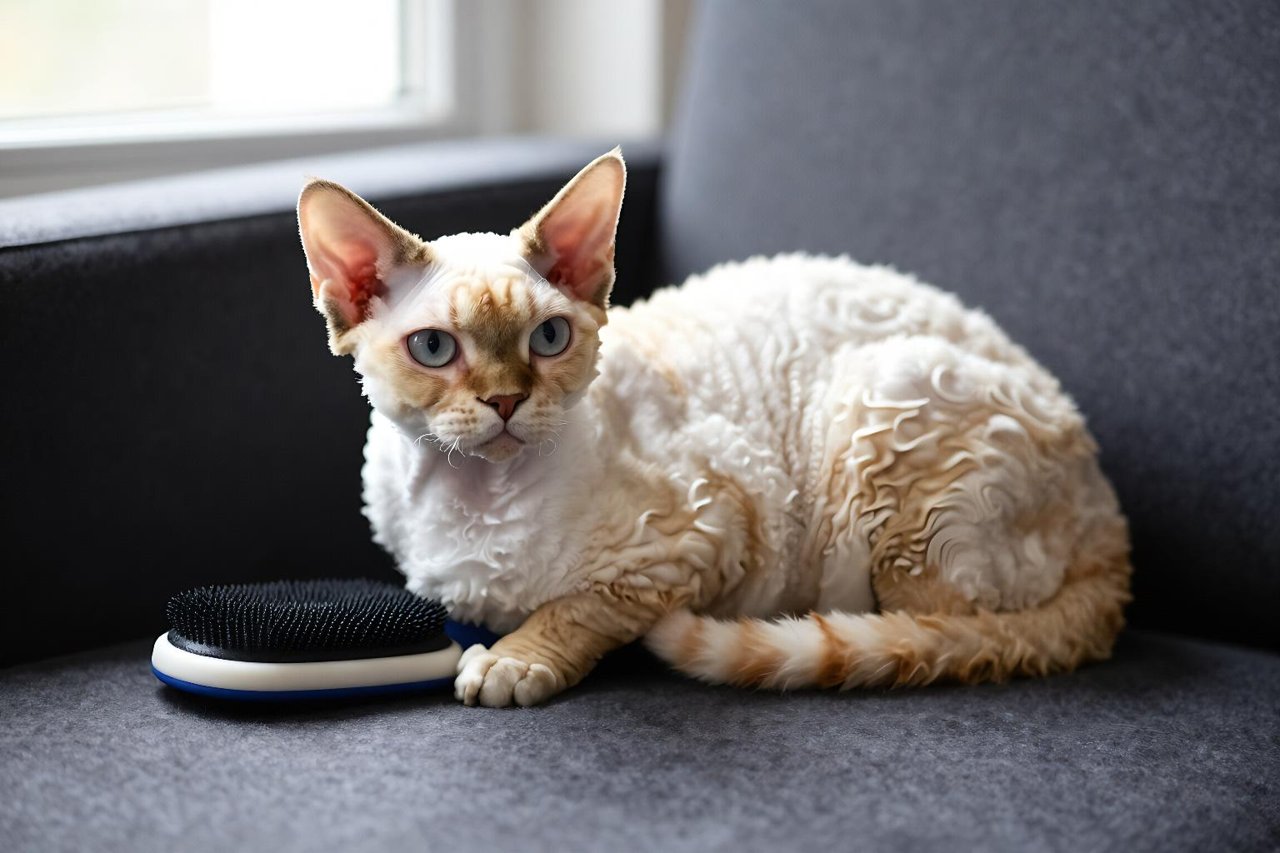
Devon Rex cats carry a thin, wavy coat that sits close to the skin, and loose hairs stay caught in the waves until you brush them out. You’ll find very little on furniture. A rubber grooming mitt once a week is enough. Go easy on the bathing, though, because the coat is delicate and over-washing strips its natural oils. Ears get waxy quickly thanks to the tucked shape of the ear canal, so a weekly wipe with a soft pad pays off.
3. Cornish Rex
Similar in spirit to the Devon but with a tighter, rippled wave and no guard hairs at all. That single-layer coat barely sheds and feels warm and chamois-like to the touch. The downside is that they get chilly fast, and you’ll often find them on the highest, warmest surface in the room. Cornish Rex cats are busy, playful and need vertical space to burn energy off, so a tall cat tree near a window does more for them than a basket of toys.
4. Russian Blue
Here’s the surprise: the Russian Blue has a dense, plush double coat and still sheds modestly. The hairs are short and fine, and most stay where they land instead of drifting. A weekly pass with a rubber curry brush keeps the coat in condition and lifts what’s loose. They’re reserved with strangers and quietly devoted to their own person, which makes them a good fit for a calm household that wants a tidy cat with a real coat.
5. Bengal
Bengals wear a short, glossy pelt with very little undercoat, so shedding is light compared with most domestic cats. The catch is energy. These cats need climbing space, puzzle feeders and proper daily play or they invent their own entertainment, and your curtains become the toy. If your home is on the smaller side, read about cat breeds that cope well in small flats before you fall for those rosettes.
6. Siamese
Short, fine, close-lying coat that sheds minimally, which makes the Siamese one of the least messy cats you can keep. What you gain in tidiness you pay for in volume. Siamese talk constantly and bond hard, and a bored one will tell the whole street about it. Two of them is often easier than one.
7. Burmese
The Burmese coat is short, satin-smooth and single-layered, and it sheds very little. Their temperament is the real draw: they tolerate handling, settle into a routine fast and stay playful well into old age, which puts them among the breeds that won’t test your patience if this is your first cat.
8. Peterbald
Peterbald cats turn up in several coat types, from completely bald to a stiff brush coat that feels like short bristles. Shedding runs from none to minimal depending on which you get. Skin needs regular wiping, warmth matters, and the breed is rare enough that you should expect a waiting list and a serious price.
9. Singapura
The smallest recognised breed, with a short ticked coat and modest shedding to match its size. Singapuras are curious and busy, but because they’re so small, a few shelves and a window perch cover most of their exercise needs. They’re also among the indoor breeds that thrive without a garden.
Low shedding still means grooming
Don’t skip the routine just because there’s less hair. Low-shedding cats still need nails clipped every couple of weeks, ears checked weekly and teeth brushed more often than most owners manage. Hairless and Rex breeds need skin care on top of that, and a Sphynx left unbathed will leave oily smudges on your bedding.
Breeds that get called low-shedding and don’t deserve it
Maine Coons, Siberians, Ragdolls and Persians all turn up in low-shedding lists, and they all shed heavily. Siberians are marketed as hypoallergenic because some of them produce lower levels of Fel d 1, which is a different claim entirely. If you want a big, fluffy cat, accept that you’re buying a good vacuum as well.
Keeping the hair off your furniture
Small habits beat big cleaning days. Brush your cat outdoors or in the bathroom, not on the rug. Keep a washable throw on the spot where the cat sleeps, since that’s where most hair concentrates. A damp rubber squeegee pulls hair off upholstery faster than any roller, and a vacuum with a proper filter stops the fine stuff blowing back into the room.
If you’re weighing up a dog instead
Cats aren’t the only option for a tidy house. Our round-up of dog breeds that shed the least covers the equivalent list on the canine side, and the principle is the same: single coats and short hair win.
Matching the breed to your household
Pick for temperament first and coat second, because a tidy cat you can’t live with is still the wrong cat. A Sphynx suits someone home most of the day who doesn’t mind bath duty. A Russian Blue settles happily with a quiet routine and a warm windowsill. Burmese and Siamese need company and conversation. Singapuras and Cornish Rex cats do well in smaller homes where vertical space makes up for floor space.
Ask a breeder how the adult coat behaves rather than judging a kitten, since several of these breeds change coat texture in the first year. And if you can, spend an hour in a house with the breed you’re considering. Your trousers will tell you more than any list.


