
Table of Contents
Most flats were not designed with cats in mind. A 45 square metre one-bedroom with single-glazed windows and a neighbour on night shifts is a very different place from a house with a garden and a cat flap. The good news is that cats adapt to small spaces far more readily than dogs do, as long as you choose a breed whose natural energy level, voice and social needs match your floor plan.
Size matters less than you would think. A five-kilo British Shorthair that sleeps eighteen hours a day will cope with a studio far better than a four-kilo Bengal that wants to hunt, climb and comment on everything at 3am. What you are really shopping for is temperament, volume and how much vertical territory the cat needs.
Why breed matters more in a flat than in a house
In a house, a bored cat has options. It can patrol the stairs, sit on a windowsill in a spare room, or stalk the hallway at midnight. In a flat, every option has to be created by you. That makes the breed’s default settings important: how vocal it is, whether it follows you into the bathroom or ignores you for six hours, and whether it treats the top of the wardrobe as a personal goal.
Three things separate flat-friendly cats from the rest: a low or moderate activity baseline, a quiet voice that will not travel through shared walls, and enough independence to handle a nine-hour workday alone. Breeds that tick all three appear again and again on lists of indoor cat breeds that thrive without a garden, and for good reason.

The best cat breeds for apartments
1. British Shorthair
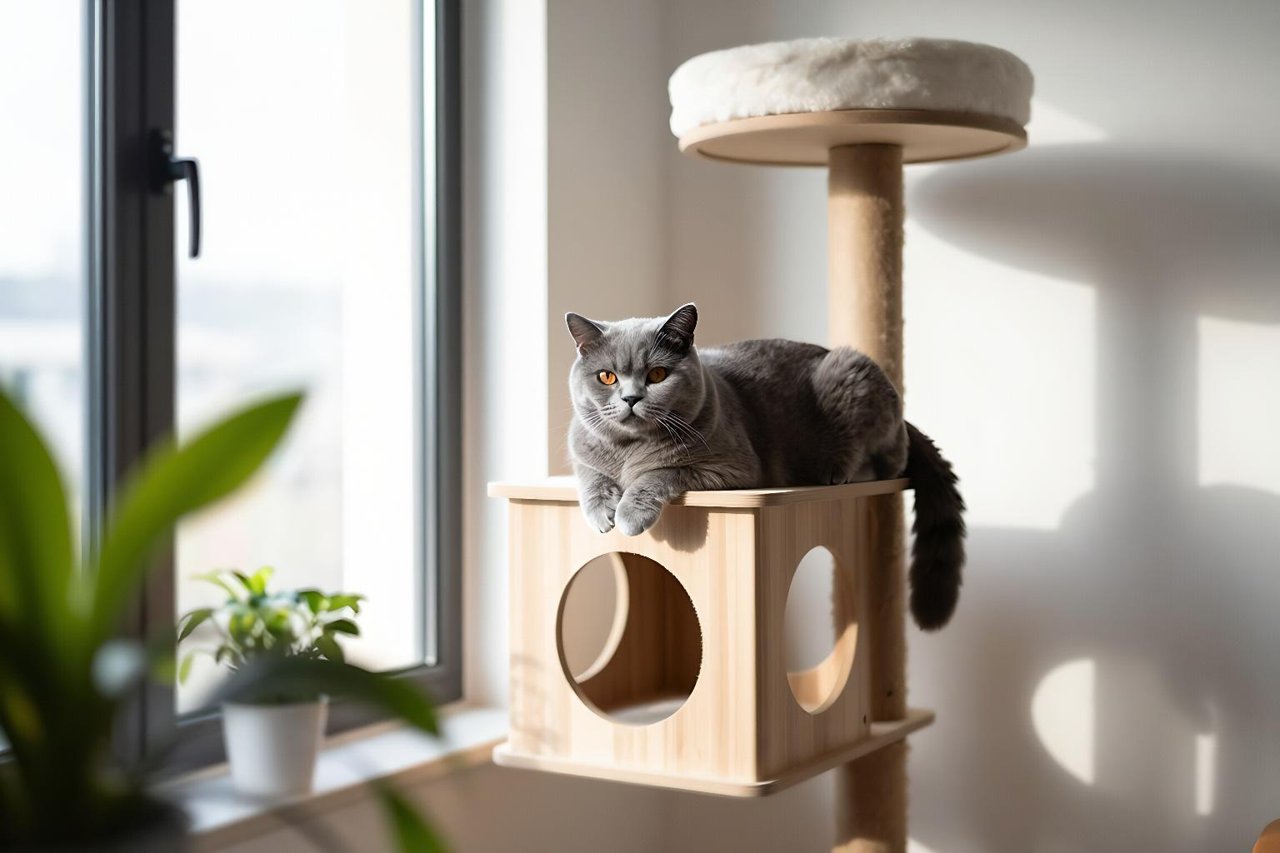
The default answer, and the right one for most renters. British Shorthairs are placid, thick-coated and largely uninterested in drama. They are quiet, rarely destructive, and genuinely content to occupy a windowsill for an afternoon. Adults weigh between 4 and 8kg, so they take up real floor space, but they do not use it much. Expect a cat that likes being near you rather than on you.
The catch is laziness. A British Shorthair will not self-exercise, and without two short play sessions a day, the weight goes on fast. Food puzzles help.
2. Ragdoll
Ragdolls are large, soft-voiced and famously relaxed about being handled. They tend to go limp when picked up, they are poor jumpers compared with most breeds, and they prefer following you from room to room to scaling the curtains. For a one-bedroom flat with a balcony, that is close to ideal.
They are sociable, though, and do not enjoy long stretches alone. If you work away from home, a pair of Ragdolls generally settles better than one lonely cat meowing at the front door.
3. Russian Blue
Quiet, tidy and a little reserved. Russian Blues pick one person and shadow them, which suits a single occupant in a small space. They are fastidious about their tray, have a short dense coat that sheds modestly, and rarely make enough noise to bother a neighbour.
The trade-off is sensitivity. Move the furniture, change your work schedule, or bring home a new partner and a Russian Blue will let you know it disapproves, usually by sulking under the bed for a week.
4. American Shorthair
An underrated pick. American Shorthairs are steady, healthy and adaptable, with medium energy rather than the frantic kind. They play hard for twenty minutes, then nap for four hours. Their voice is quiet and they are unusually tolerant of routine changes, which helps in rental flats where you might move every couple of years.
5. Birman
Birmans sit in the middle of the sociability scale: affectionate, gentle, softly spoken, and good at entertaining themselves when you are out. They are also patient with clumsy handling, which is why they show up on lists of cat breeds that cope well with young children. In a family flat, that patience earns its keep.
Budget ten minutes a day for brushing the semi-long coat, or you will find tumbleweeds of white fur under the sofa.
6. Persian
The lowest-energy cat on this list, and the one most likely to spend an entire Saturday in the same square metre. Persians are quiet, undemanding and perfectly happy in a small flat, provided the flat is not too hot. Flat faces mean breathing is harder work, so keep the room cool and avoid smoke.
Grooming is the real cost. Fifteen minutes daily, plus a professional groom every six to eight weeks, and even then the coat mats if you slack off.
7. A domestic shorthair from a rescue
Worth saying plainly: breed is a rough guide, not a guarantee. A foster carer who has lived with a cat for six weeks can tell you more about its noise level and energy than any breed profile. If you want a calm lap cat for a 40 square metre flat, ask the shelter for the adult cat that ignores the other cats and sleeps on the desk. You will get an accurate match and skip kitten chaos entirely.
Breeds that struggle in a small flat
Not every popular breed suits apartment living, and it is fairer to say so up front.
- Siamese. Wonderful cats, extremely loud. Their call carries through walls and they use it at dawn.
- Bengal. Needs climbing height, hunting games and a lot of stimulation. A studio flat becomes a demolition site.
- Abyssinian. Relentlessly curious and athletic, with a habit of reaching shelves you thought were safe.
- Sphynx. High energy plus a need for warmth, which means constant heating bills in a cold flat.
- Savannah and other hybrid breeds. Often restricted by insurers and tenancy agreements, and demanding to live with.
If you have never owned a cat before, the easier breeds on the list above are a better starting point. There is a reason these breeds for first-time owners overlap so heavily with apartment-friendly ones.
How to make 45 square metres feel much bigger
Floor space is the wrong thing to measure. Cats judge territory in three dimensions, and most flats have metres of unused wall above eye level.
- Go vertical. A floor-to-ceiling cat tree in a corner plus two or three wall shelves at 1.8 to 2.2 metres adds more usable territory than a second room would.
- Give them a window. A perch with a view of a street or bird feeder is entertainment that runs all day for free.
- Place the tray properly. Away from food and water, not in a cupboard the cat has to squeeze into, and one tray per cat plus one spare.
- Put a scratcher where the damage happens. Next to the sofa corner they have already chosen, not hidden in the hallway.
- Play in two bursts. Ten minutes before you leave and ten before bed, ending with a meal. It mimics the hunt-eat-groom-sleep cycle and buys you a quiet night.
Neighbours, noise and shared walls
Sound travels through floors and party walls in a way that surprises new cat owners. A cat dragging a bell toy across a wooden floor at 4am sounds like furniture being moved.
Keep the loudest toys for daytime. Feed the last meal late, around 10pm, so the cat sleeps through the small hours rather than campaigning for breakfast. If your flat has thin walls and a downstairs neighbour, avoid breeds known for commentary and skip anything with a bell attached.
If your household is also debating a dog, the same rules apply. These quiet dog breeds for flats and thin walls are chosen on exactly that basis, and the logic transfers: match the animal’s default volume to the building, not to your Pinterest board.
The questions worth answering before you choose
Breed shortlists are useful, but four practical questions will narrow things faster than any list.
How many hours a day will the cat be alone? Under five, a Ragdoll or Birman works. Nine or ten, and you want a British Shorthair, an American Shorthair, or two cats that keep each other company.
Have you checked the tenancy agreement? Get written permission before you fall in love with a kitten. Deposits, pet rent and breed restrictions are common, and some leases ban cats outright.
Can you afford the boring costs? Budget roughly £60 to £100 a month for food, litter, insurance and the occasional vet visit. Grooming-heavy breeds like Persians add another £40 to £60 every two months.
Who is doing the daily work? Litter, grooming and play do not happen by themselves. In a shared flat, name the person responsible before the cat arrives, not after the third week of unemptied trays.
Choose for the flat you actually live in, with the walls you actually have, and the cat will settle in within a fortnight. Choose for the flat you wish you had, and you will spend a year managing a bored, loud animal in a space that was never going to suit it.


