
Table of Contents
In 1876, a German businessman-turned-excavator named Heinrich Schliemann lowered himself into a shaft grave inside the walls of Mycenae and came out with a gold death mask. He telegrammed the King of Greece claiming he had looked upon the face of Agamemnon. He hadn’t — the mask is roughly three centuries too old for the Trojan War — but the mistake hardly mattered. It put the Mycenaean civilization on the map, and archaeologists have been arguing about it ever since.
Between about 1600 and 1100 BC, the Mycenaeans ran the show in mainland Greece. They built palaces on hilltops, kept their accounts on clay tablets, bought amber from the Baltic and tin from Central Asia, and left behind poetry-soaked ruins that later Greeks believed had been raised by giants. They were also, in a real sense, the first Greeks — the people whose language, gods and legends fed directly into the classical world.
Who Were the Mycenaeans?
The name comes from Mycenae, the citadel in the Argolid plain of the Peloponnese that dominated the region for centuries. But the Mycenaeans were never a single unified state. They were a network of competing kingdoms — Mycenae, Tiryns, Pylos, Thebes, Orchomenos, Athens — each with its own ruler, its own scribes and its own ambitions.
Their culture didn’t appear out of nowhere. Earlier Bronze Age communities on the Greek mainland traded and intermarried with Crete, and the sheer wealth visible in Mycenaean art and architecture owes an obvious debt to the island. If you want the full background on that older island culture, it’s worth reading about the Minoan civilization and how it shaped the Aegean before the mainland kingdoms took over.

Gold in the Shaft Graves
The earliest flash of Mycenaean wealth shows up in Grave Circle A, a ring of six deep shaft graves containing nineteen burials. Inside, Schliemann’s team found something like fifteen kilos of goldwork: masks, diadems, cups, a rhyton shaped like a lion’s head, swords with inlaid hunting scenes, and a dagger blade showing men with big shields fighting beside a river. The metalwork is startlingly good. These were not provincial chieftains improvising — they were plugged into a trade network that stretched across the eastern Mediterranean.
Fortress Palaces and Cyclopean Walls
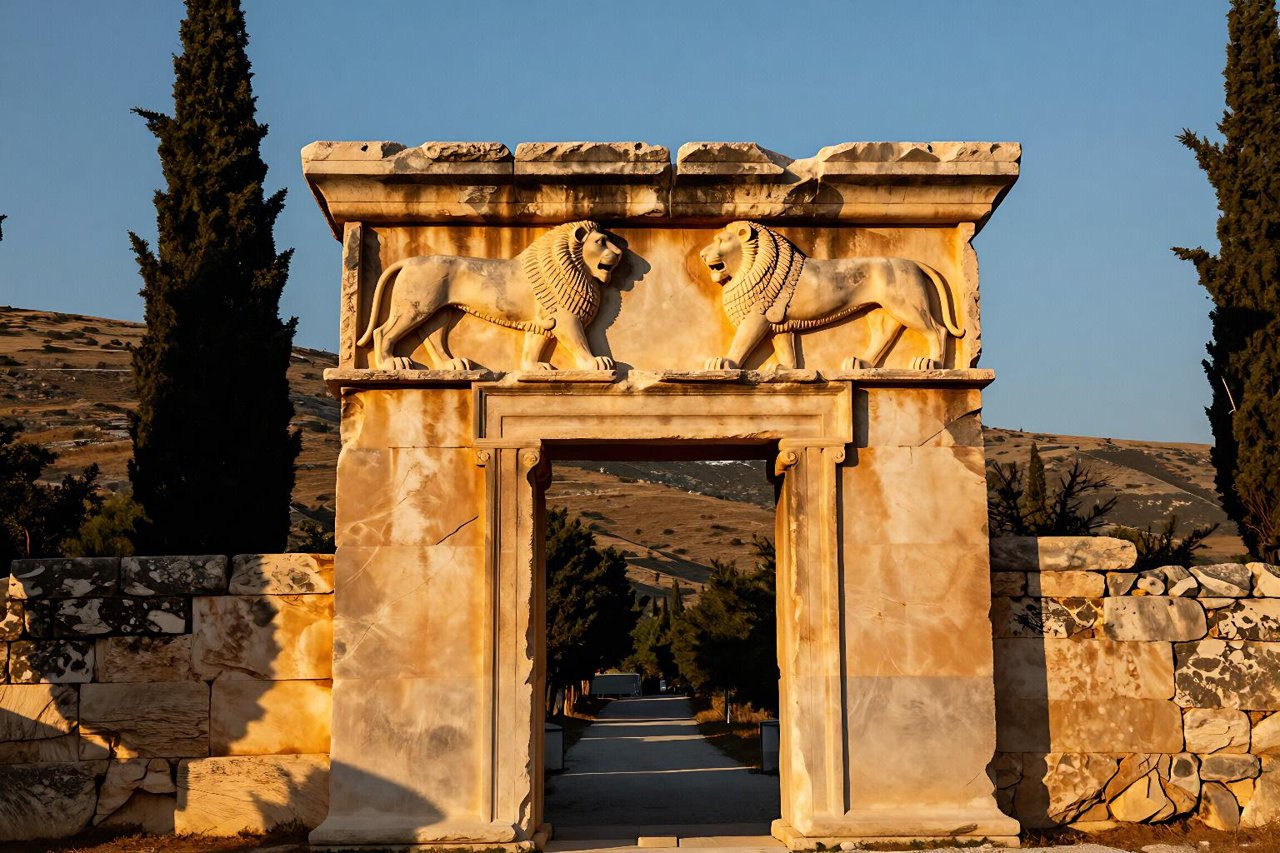
Walk up to Mycenae today and the first thing you notice is the Lion Gate. Two lionesses in relief face each other across a central column, carved above a lintel estimated at twenty tonnes, set into a wall of limestone blocks so enormous that later Greeks assumed only the Cyclopes could have lifted them. That’s where the term Cyclopean masonry comes from.
The defences weren’t decorative. At Tiryns, the walls reach eight metres thick in places, with galleries and casemates built inside the masonry. Palaces sat on fortified acropoleis, approached by ramps that funnelled visitors past guard posts. Inside, you’d find a megaton — a throne room with a circular hearth, four columns and a painted floor — along with storerooms, workshops and archives.
Living and Dying at the Palace
Kings were buried in tholos tombs: enormous beehive-shaped chambers cut into hillsides with corbelled domes. The Treasury of Atreus at Mycenae has a dome about fourteen and a half metres across and was built around 1300 BC without a single drop of mortar. The stone was dressed so precisely that a knife blade reportedly couldn’t be pushed between the joints.
- Wanax — the king, a title later used for Homer’s Agamemnon and, in altered form, for the gods of classical Greece.
- Lawagetas — literally “leader of the host,” a senior military or administrative figure beneath the king.
- Hequetai — companions or retainers, possibly a warrior elite attached to the palace.
- Damos — the land-holding community, the ordinary population whose labour fed the system.
Linear B and the Bureaucrats Who Wrote It
Mycenaean scribes wrote in Linear B, a script of around eighty-seven syllabic signs adapted from Cretan Linear A to record an early form of Greek. The tablets were never meant to last: they were temporary records, dried in the sun and wiped clean when no longer needed. Every Linear B tablet we have survives because the palace storing it burned down and fired the clay hard, like a kiln.
Michael Ventris, an English architect, cracked the script in 1952. What the tablets turned out to contain was less heroic saga and more warehouse inventory. Sheep counts, rations of barley and figs, allocations of bronze, chariot wheels, offerings of oil to Poseidon and to a “Lady of the Labyrinth.” One Pylos tablet lists row after row of women and children and the grain they were given.
That ordinariness is exactly what makes the tablets valuable. They show a tightly managed economy: palace officials tracking flocks, wool, linen, perfumed oil, and rationing labour with bureaucratic precision. It’s a world of clerks as much as kings.
Trade, War and the Wider Bronze Age World
Mycenaean pottery turns up in Egypt, Cyprus, Sicily, southern Italy and along the Levant coast — so consistently that archaeologists use it as a dating tool. Hittite documents from Anatolia mention a troublesome western power called Ahhiyawa, which most scholars now link to the Achaeans, the Homeric name for the Mycenaeans.
Shipwrecks tell the story of what moved along those routes. The Uluburun wreck off the Turkish coast, sunk around 1300 BC, carried roughly ten tonnes of copper ingots, a tonne of tin, glass ingots, ivory, and personal goods from half a dozen cultures. Mycenaean elites wanted the exotic materials, and they wanted them for display: boar’s-tusk helmets, inlaid daggers, faience, ostrich-egg rhyta.
The Trojan War: Legend, Memory and the Mask
Homer’s Iliad describes a coalition of Achaean kings besieging Troy, and there is real evidence of a fortified city at Hisarlik that was destroyed and rebuilt repeatedly, including a violent destruction layer around 1180 BC. Whether a specific war matches the poem is a different question. The Mycenaean world was already fragmenting by the time Troy VIIa burned, and the epics were composed some four centuries later by people who could no longer read Linear B.
What survived was memory: place names, genealogies, the idea of a great expedition, and a set of stories that classical Athens later rebuilt into a national mythology. The through-line from these warlords to Pericles’ city is a long one, but it’s real — as the story of how the ancient Greek city-states grew from this Bronze Age inheritance makes clear.
Why Did the Mycenaean World Collapse?
Between roughly 1200 and 1150 BC, the palaces burned. Pylos went up in flames around 1180 BC. Mycenae and Tiryns were destroyed, partially rebuilt and then abandoned. Within two generations, Linear B vanished, long-distance trade dried up, and populations fell sharply. Greece slid into a period historians call the Dark Age, and it lasted centuries.
Nobody agrees on the cause, and the honest answer is probably that several pressures combined:
- Climate stress, including drought and crop failure suggested by pollen and sediment records.
- Raiding and migration by groups the Egyptians lumped together as the Sea Peoples.
- Earthquake damage across a seismically active region.
- Internal revolt against a palace economy that hoarded grain while farmers went hungry.
- Systems collapse — a chain reaction in which the loss of trade partners broke everything downstream.
The collapse remains one of the genuinely open questions of Aegean archaeology, sitting alongside other puzzles from the period in this roundup of archaeological mysteries researchers still argue about.
What the Mycenaeans Left Behind
Strip away the Homeric gloss and you’re left with something more interesting than a legend: a literate, literate-adjacent, highly organised set of kingdoms that ran a command economy on clay and bronze, built domes with no mortar, and traded with half the known world. Their gods — Poseidon, Dionysus, Zeus in later form — reappear in classical temples. Their word for king survives in the language. Their ruins were still standing when Romans toured Greece and bought souvenirs.
Hike up to the Lion Gate in late afternoon light, when the Argolid plain goes yellow and the shadows lengthen across the threshold where the lintel has held for thirty-three centuries, and the scale of the achievement lands. The people who built it could not read their own past by the end. We can, and only because they fired their paperwork and left it in the ashes for us.


