
Table of Contents
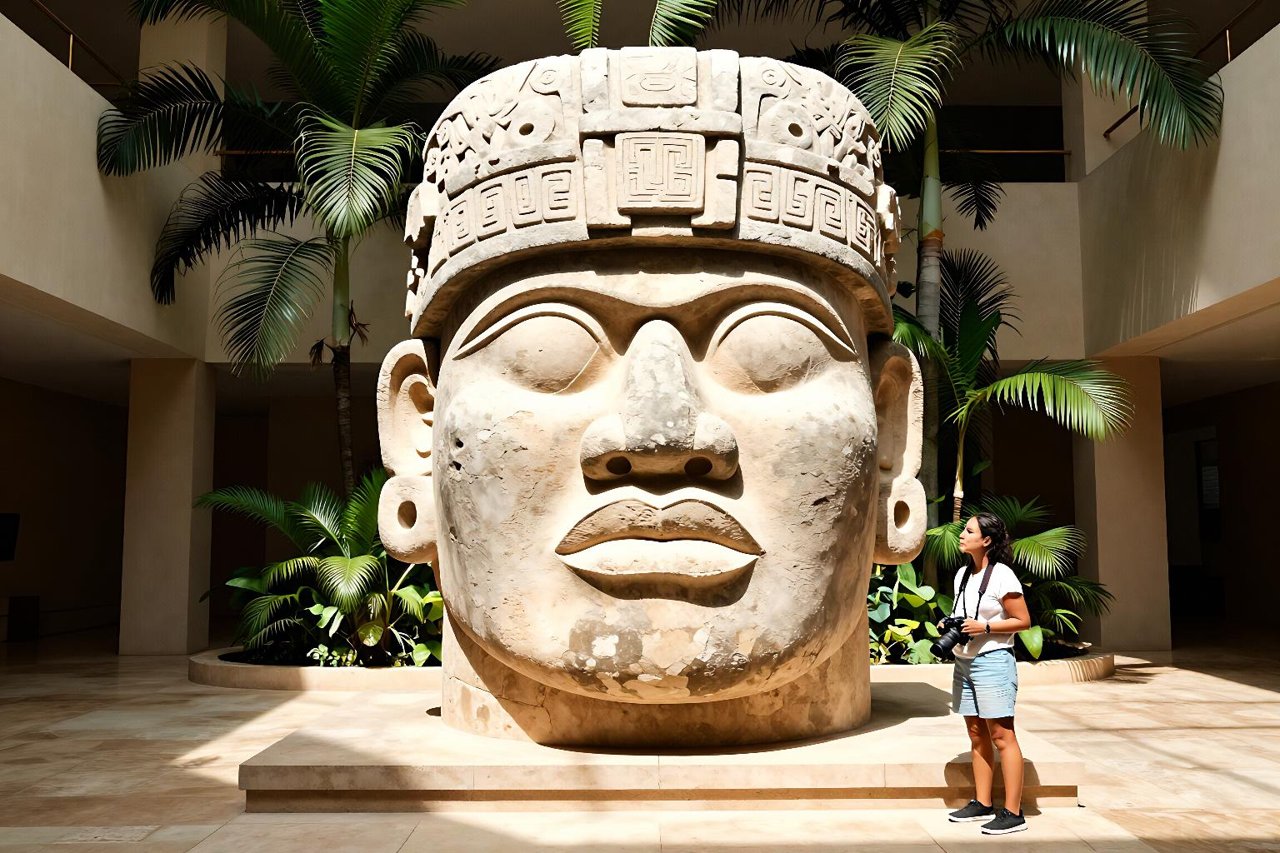
A basalt head nearly three metres tall sits in the heat of southern Veracruz, its lips pressed into a flat line, a helmet strapped tight across the brow. It weighs somewhere around twenty-five tonnes. The nearest source of that stone lies more than sixty kilometres away, on the far side of rivers and swamps. Nobody in the Americas had built a city before this. Somebody moved that rock anyway.
That is the Olmec civilization in a single image: staggering effort, obsessive craft, and a bundle of ideas that would echo across Mesoamerica for the next two thousand years. And it happened early — centuries before the Maya built their first great temples, before Teotihuacan rose in the highlands.
Who Were the Olmec?
The Olmec lived in the hot, humid lowlands of what is now Veracruz and Tabasco, along Mexico’s Gulf Coast. Their culture took shape around 1600 BCE and hit its stride between roughly 1200 and 400 BCE. They farmed maize, beans and squash on river floodplains, built permanent towns, and organised labour on a scale nobody in the region had managed before.
They also left us no readable account of themselves. Everything we know comes from dirt, stone and broken pottery — which is exactly why the deep past still shapes the present in ways we rarely notice.

A name they never used
“Olmec” is a label stuck on them long after the fact. It comes from Nahuatl, the language of the Aztecs who arrived more than a thousand years later: ōlli, meaning rubber, plus mēcatl, meaning rope. Roughly, “rubber people.” The name stuck because the Spanish chroniclers picked it up, and by then nobody could ask the original inhabitants what they called themselves.
Three Centres of Power
Olmec history is really the story of a handful of ceremonial centres, each dominating its stretch of river for a few centuries before fading.
San Lorenzo
San Lorenzo Tenochtitlán, in southern Veracruz, was the earliest great centre, peaking between about 1200 and 900 BCE. It sits on a plateau that engineers artificially raised and shaped — thousands of tonnes of fill, moved by hand. Ten of the seventeen known colossal heads come from here. Around 900 BCE the place was deliberately damaged and largely abandoned, possibly after internal revolt or a shift in the river’s course.
La Venta
La Venta, in Tabasco, took over as the dominant centre from roughly 900 to 400 BCE. It’s an island of raised ground in a swamp, which makes its monuments all the more remarkable. At its northern end stands a conical earthen pyramid about thirty metres high, built from nothing but packed clay and earth. Around it: basalt column fences, buried mosaic pavements of serpentine blocks, and four more colossal heads.
Tres Zapotes
Tres Zapotes outlasted both, flourishing into what archaeologists call the Epi-Olmec period. A stela found there carries a date corresponding to 32 BCE — one of the earliest securely dated inscriptions in the Americas.
The Colossal Heads
These are the images that made the Olmec famous, and they still stop people mid-step in museum galleries. A few facts worth knowing:
- Seventeen heads are known, ranging from about 1.5 to 3.4 metres in height and weighing up to roughly 25 tonnes.
- Each appears to be a portrait of a specific individual — the facial features vary noticeably from head to head.
- The stone is basalt from the Tuxtla Mountains. Transporting it meant dragging or floating multi-tonne blocks tens of kilometres, then carving them without metal tools.
- All of them wear a tight-fitting helmet or headdress, which has fuelled endless speculation about ballplayers, warriors or ancestor rulers.
- Most were later moved, buried or otherwise disturbed — several were found far from their original settings.
Gods, Shamans and the Were-Jaguar
Olmec art is full of creatures that are half human and half feline: downturned mouths, cleft heads, snarling expressions. This “were-jaguar” motif appears on figurines, celts, masks and the famous altars — which many scholars now think were actually thrones, carved with a ruler seated in a niche above a crouching supernatural figure.
Jade was the prestige material of choice, imported from the Motagua Valley in Guatemala, hundreds of kilometres away. Olmec craftsmen worked it into axe-shaped celts and figurines with drilled details so fine you need a magnifier to appreciate them. They also polished iron ore into concave mirrors, probably for ritual use, and carved bloodletting tools that anticipate practices found across later Mesoamerican cultures.
At El Manatí, a bog site in Veracruz, archaeologists pulled wooden busts, jade celts and rubber balls out of waterlogged deposits dated as early as 1600 BCE. The rubber balls are the oldest known in the world — a genuine Olmec invention, made by mixing latex from the Castilla elastica tree with the juice of a morning glory vine.
Trade and the Reach of Olmec Influence
Olmec goods and styles turn up far beyond the Gulf Coast. Obsidian from Pachuca, greenstone from Guerrero, shell from both coasts, cacao from the Pacific slopes — the Olmec were plugged into networks running the length of Mesoamerica. Whether that spread was conquest, migration, trade or simply fashion is one of the field’s most durable arguments.
Cotton growing and weaving were already established in these lowlands, and the textile skills of the region never really died out. You can trace a line from those early looms to the living craft traditions that survive in Mexico today — the kind of continuity explored in this piece on heritage textiles and embroidery across the region.
Did the Olmec Invent Writing?
This is where things get genuinely contested. In 1999, road builders unearthed a serpentine slab near the village of Cascajal. Known now as the Cascajal Block, it carries sixty-two incised glyphs, some repeated, arranged in what looks like rows of text. It has been dated to around 900 BCE — which would make it the earliest writing found in the Americas by a wide margin. Sceptics argue the marks may be decorative or the block may be out of context.
A different find at San Andrés, Tabasco, produced a cylinder seal with a bird-like symbol, tentatively dated to 650 BCE. And the later Isthmian script, best known from La Mojarra Stela 1, shows a fully developed writing system in the same region by the second century CE. Taken together, the evidence points to the Gulf Coast as the place where Mesoamerican script first stirred — even if the Olmec weren’t quite signing their names yet.
The Mother Culture Debate
For decades, textbooks called the Olmec the “mother culture” of Mesoamerica: the source from which the Maya, Zapotec and others drew their templates. That tidy story has softened. Archaeologists now point out that regions like the Valley of Oaxaca developed complex societies on their own timetable, and that influence flows in more than one direction.
What’s harder to argue with is the Olmec footprint on later art and belief. The ballgame, the feathered serpent, ritual bloodletting, the sacredness of jade, the ruler flanked by supernatural attendants — all of it shows up in Olmec contexts first. The vocabulary may have been borrowed, but the Olmec wrote a good chunk of it.
Where to See Olmec Art for Yourself
The best single collection is the Museo de Antropología de Xalapa in Veracruz, where several colossal heads are displayed in a light-filled hall alongside hundreds of figurines and celts. In Villahermosa, the Parque-Museo La Venta displays the original monuments from that site in a semi-wild outdoor setting, monkeys and all. San Lorenzo itself can be visited near Acayucan, though you’ll need a car and patience — the mounds are grass-covered and the interpretation is thin.
If you’re building a trip around it, it’s worth knowing that Veracruz and Tabasco are just two stops in a country with an absurd depth of archaeological sites, food and landscape. Our list of 24 interesting facts about Mexico is a decent place to start planning.
Stand in front of one of those heads and the scale does something to you. Each was carved by hand from stone hauled across a landscape with no wheels and no pack animals. There’s no inscription to explain who the man was, no chronicle of the wars he fought, no record of the language he spoke. Just a face, cut in rock, watching a plaza that has long since turned to grass — and a thousand years of later Mesoamerican history quietly building on what his people started.


