
Table of Contents
On 4 November 1922, a water carrier named Hussein Abdel-Rassel was clearing sand in Egypt’s Valley of the Kings when his hands scraped against something flat and man-made: a carved step, cut into the bedrock. He called for Howard Carter. Within days, Carter had exposed a staircase, a sealed doorway, and a plaster seal stamped with the name of a pharaoh most scholars had written off as a minor footnote.
When Carter finally lifted a candle to a chink in the door and peered into the darkness, he was asked whether he could see anything. “Yes,” he said. “Wonderful things.”
A century on, that moment still sets the bar for what an archaeological discovery can feel like. But the greatest finds aren’t always gold. Some are fragments of scroll, a corroded lump of bronze, or a ring of stones that shoves human history back thousands of years. These are the ones that genuinely changed what we know.
Tutankhamun’s Tomb: The Find That Made Archaeology Famous
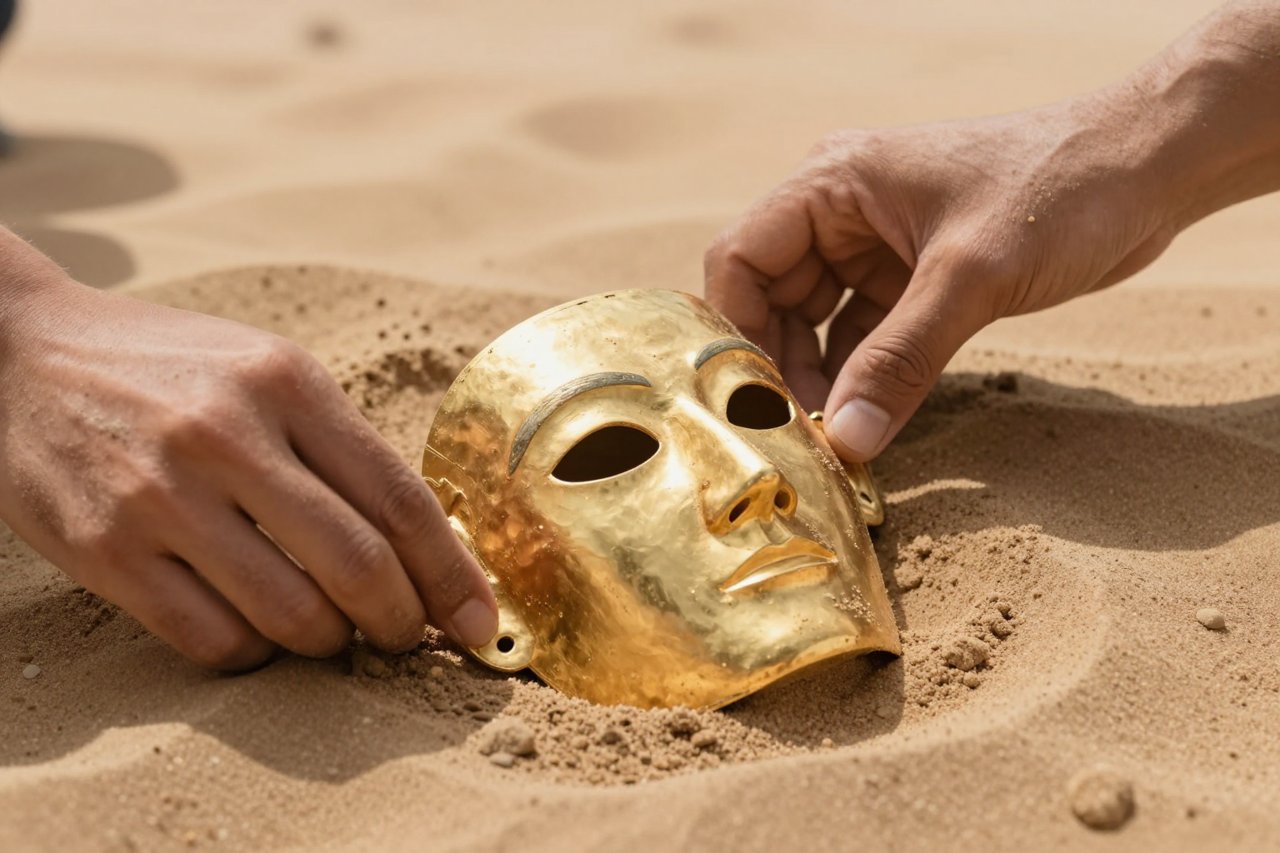
Carter’s excavation took ten years and catalogued more than 5,300 objects, right down to jars of dried food and the boy king’s sandals. The burial chamber alone held three nested coffins and a death mask of roughly 10 kilograms of solid gold. Tutankhamun’s tomb was small, partly because he died at around nineteen, and that cramped scale is exactly why ancient robbers missed the burial chamber after twice ransacking the outer rooms.

The story that outlived the treasure was the curse. Lord Carnarvon, who bankrolled the dig, died in Cairo in April 1923, five months after the tomb was opened, from an infected mosquito bite. Newspapers did the rest. In reality, most of the people present when the chamber was opened lived long, unremarkable lives. Carter himself died of lymphoma in 1939, aged 64.
Pompeii and Herculaneum: Two Towns Stopped Mid-Moment
When Vesuvius erupted in AD 79, Pompeii disappeared under four to six metres of pumice and ash, while its neighbour Herculaneum was sealed beneath a surge of volcanic mud that set like concrete. Because Herculaneum was cut off from air, organic material survived: wooden furniture, rope, food, a boat, and around 1,800 carbonised papyrus scrolls from a single seaside villa. It is the only intact library to survive from the classical world.
Pompeii preserved something different: the texture of ordinary Roman life. Bakeries still hold loaves in their ovens. Walls carry scratched graffiti (“Successus loves Iris”), campaign slogans for long-forgotten candidates, and a floor mosaic of a snarling dog warning visitors to beware.
In the 1860s, Giuseppe Fiorelli worked out that the hollows in the hardened ash were body-shaped voids left by decomposed victims, and poured plaster into them. More than a hundred human casts came out of the ground, including a group of fleeing prisoners still chained together.
If you want to see any of this in person, Pompeii is an easy day trip by train, and a sensible three-day Rome itinerary built around the city’s historical sites puts the ruins within reach without swallowing your whole trip.
The Terracotta Army: Eight Thousand Soldiers in the Dark
In March 1974, farmers digging a well near Xi’an, in central China, pulled up a terracotta head. Yang Zhifa and his neighbours had stumbled onto the burial complex of Qin Shi Huang, the first emperor, and the pits beneath their fields held roughly 8,000 life-sized warriors, 130 chariots and 520 horses.
No two faces are the same. Hair styles, eyebrows and moustaches all differ, which suggests the figures were modelled on real soldiers. They were also painted, originally in pinks, reds, blues, purples and greens, but the pigments curled and flaked away within minutes of contact with dry air. The bronze weapons buried alongside them were still sharp after 2,200 years, and some blades carry a chromium oxide coating that European metallurgists wouldn’t manage until the twentieth century.
The Dead Sea Scrolls: A Library in Clay Jars
In 1947, a Bedouin teenager named Muhammad edh-Dhib chased a stray goat into a cave near Qumran, on the shore of the Dead Sea, threw a stone into the darkness and heard pottery shatter. Inside stood tall clay jars holding linen-wrapped scrolls. He had no idea he’d found the oldest known copies of biblical texts, hidden for nearly two millennia.
Eleven caves eventually produced around 900 manuscripts, many reduced to tens of thousands of fragments. The Great Isaiah Scroll stretches 7.3 metres and is almost complete. It predates the next-oldest Hebrew Bible manuscript by roughly a thousand years, which is why scholars describe the find as a time machine rather than a treasure hoard. Alongside biblical books, the caves held community rulebooks, calendars and legal texts that reshaped how historians understand Judaism in the century before Christianity.
Göbekli Tepe: A Temple Older Than Farming
In 1994, German archaeologist Klaus Schmidt was shown a mound in southeastern Turkey that local farmers had long dismissed as a medieval cemetery. What he found underneath were limestone pillars standing up to 5.5 metres tall and weighing 16 tonnes, arranged in circles and carved with foxes, boars, snakes, scorpions and vultures.
Radiocarbon dating put the earliest layers at roughly 9,500 BC. That’s about 6,000 years before Stonehenge and 7,000 before the pyramids at Giza. The people who built it were hunter-gatherers: no pottery, no metal, no writing, no farming. Then, around 8,000 BC, they deliberately buried the entire complex. Where that leaves Göbekli Tepe among the ancient mysteries that still baffle scientists and historians is somewhere near the very top.
The Antikythera Mechanism: A Computer From 100 BC
In 1901, Greek sponge divers sheltering from a storm off the island of Antikythera found a Roman-era shipwreck 45 metres down. They hauled up bronze and marble statues, and with them a shoebox-sized lump of corroded metal that sat ignored in a museum drawer for decades.
In 1971, science historian Derek de Solla Price X-rayed the lump and saw gear teeth. A team from Cardiff University then used X-ray computed tomography to map 30 surviving bronze gears inside the corroded mass. The device tracked the sun and moon, predicted eclipses, counted down the four-year cycle of the Olympic Games, and modelled the moon’s uneven speed with a pin-and-slot arrangement that no European clockmaker would match for another 1,400 years. Nothing comparable survives from any other ancient culture.
Five More Finds Worth Knowing
- Machu Picchu, 1911. Hiram Bingham was led to the ruins by local farmers who already knew them well. The Inca estate, built around 1450 for an emperor, sits at 2,430 metres and contains more than 200 structures.
- Lascaux, 1940. Four teenagers followed a dog named Robot into a hole in southwest France and found nearly 600 painted animals and 1,500 engravings, roughly 17,000 years old. Carbon dioxide from visitors’ breath damaged the art, so the cave closed to the public in 1963.
- The Rosetta Stone, 1799. French soldiers rebuilding a fort at Rashid noticed a slab inscribed in three scripts. Jean-François Champollion used it to crack Egyptian hieroglyphs in 1822, unlocking 3,000 years of written history.
- Sutton Hoo, 1939. Basil Brown, a self-taught archaeologist, dug into a mound on Edith Pretty’s Suffolk estate and hit the outline of a 27-metre ship burial, complete with an iron helmet, gold buckles and Byzantine silver.
- Richard III, 2012. Screenwriter Philippa Langley insisted a Leicester car park covered the friary where the king was buried. A leg bone surfaced on the first day of digging, and DNA from living descendants later confirmed the identity.
What’s Still Buried
Discovery hasn’t slowed down. In 2023, the Vesuvius Challenge used machine learning on X-ray scans of an unopened Herculaneum scroll and pulled out a Greek word, “porphyras”, meaning purple, from a document nobody had read since before AD 79. In Guatemala, lidar surveys have mapped tens of thousands of Maya structures hidden under jungle canopy, connected by causeways that were invisible from the ground.
Meanwhile, most of the ocean floor has never been surveyed in high resolution, which is why the Antikythera wreck keeps giving: a bronze statue arm, a bone flute, and signs of a second shipwreck nearby. Museum stores worldwide hold boxes of material that has been catalogued but never properly examined.
Plenty of ancient mysteries that still baffle researchers will be solved by a scanner rather than a spade, or by someone deciding to look again at an object that has sat in a drawer for fifty years. In 1922 the answer was a tomb. In 1994 it was a hill full of deliberately buried pillars. Statistically, the next great discovery is still in the ground, waiting for someone’s boot to hit the right stone.


