
Table of Contents
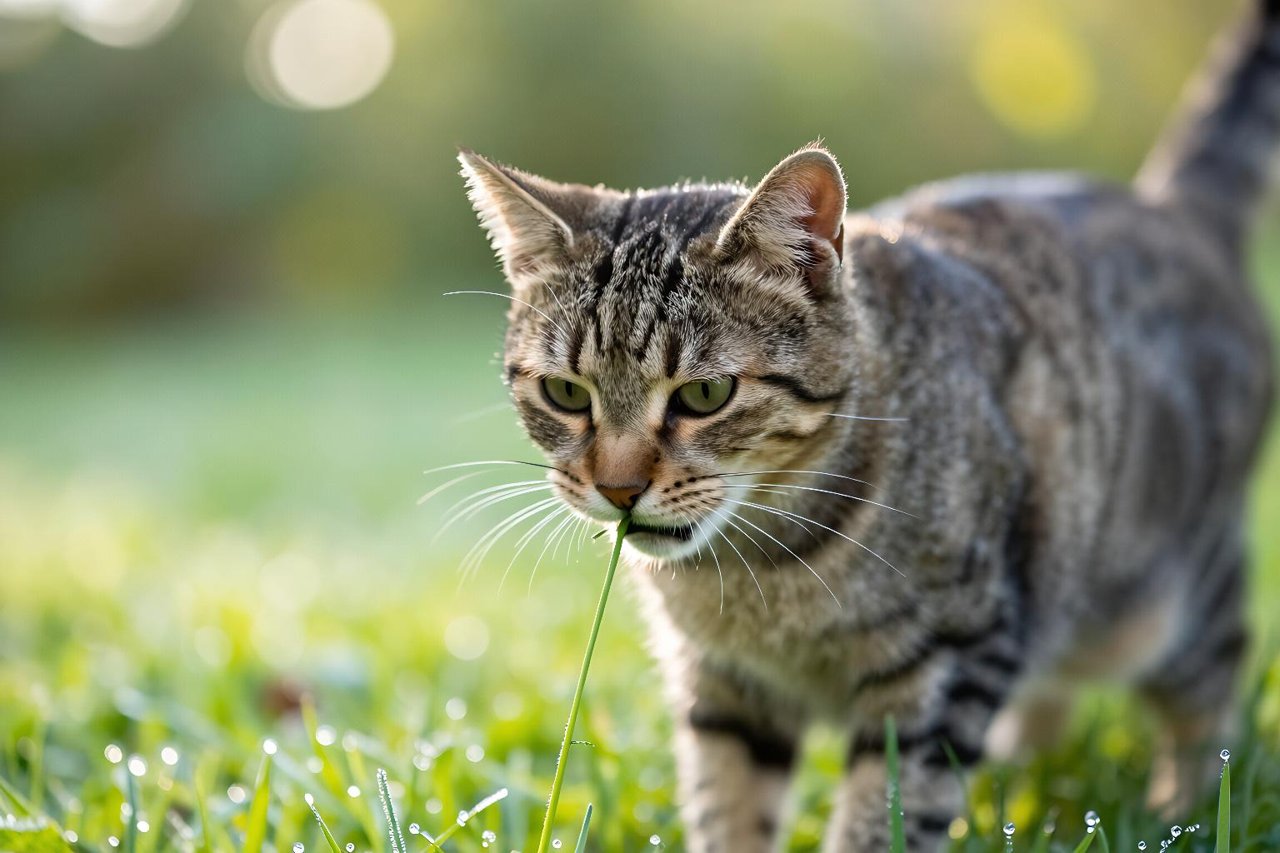
You open the back door, your cat saunters onto the lawn, and within thirty seconds she has her head down and is chewing a tuft of grass like a small, furry goat. Twenty minutes later it reappears on the doormat, slightly warm. If you have ever stood there wondering what on earth possessed her, you are in good company. Grass eating is one of the most common things owners ask vets about, and one of the most misunderstood.
Here is what is actually going on, what the research does and does not support, and how to tell a harmless habit from something that needs a phone call.
An old instinct, not a weird habit
Cats are obligate carnivores. They need taurine, arginine and preformed vitamin A from animal tissue, and they cannot survive on salad. That fact gets repeated so often that people assume plant matter should never pass a cat’s lips. Wild cats disagree. Examinations of stomach contents in lions, leopards and wildcats routinely turn up small amounts of grass and leaves, and a survey of more than 1,000 pet owners published in 2008 found plant eating to be common in both cats and dogs. Fewer than 10% of the cats in that study vomited afterwards, which quietly demolishes the idea that grass is a reliable vomit trigger.
The behaviour is normal, and it is ancient. It probably comes from the same mouth-first curiosity that drives the rest of feline behaviour. Cats investigate the world with their teeth and tongues, which is also why your cat drags mice through the cat flap and why the urge behind why cats bring you dead animals is worth understanding rather than scolding. Grass is just another thing to bite, test and taste.

Fibre, hairballs and what grass does in the gut
Grass blades are mostly cellulose, and cats have no enzymes for digesting it. It travels through the gut essentially intact, which is exactly what makes it useful as roughage.
The hairball theory, and where it falls apart
The popular explanation is that cats eat grass to tickle up the hair they have swallowed while grooming. It sounds tidy, but the evidence is thin. A cat with a genuine hairball problem usually needs grooming help and a high-fibre diet, not a mouthful of lawn. When grass does come back up, it is less a clever self-treatment and more a mechanical accident: long blades scratch the stomach lining, the stomach objects, and everything leaves in a hurry.
The other end of the equation
Fibre also works in the opposite direction. Indigestible plant matter adds bulk and water to stool, which can help small amounts of swallowed hair pass through the bowel instead of collecting. This is the same principle behind the psyllium and beet pulp added to many commercial hairball formulas. Grass is a crude version of the same idea, and a cat who nibbles a few blades after a long grooming session is doing something fairly sensible.
A nutritional gap, or just a decent taste?
Fresh grass contains folate, chlorophyll and small amounts of vitamins A, C and E. One long-standing theory is that cats seek it out to top up nutrients they are missing. There is no solid evidence that a healthy cat on a complete diet is deficient in anything, and most grass-eaters are perfectly well fed on good-quality food.
Where the theory has more traction is in cats with an upset stomach or a poor diet. Some cats seek out plant material when they feel mildly queasy, in the same way people reach for dry crackers. And plenty of cats simply like the taste. Young, tender blades are sweet and juicy, and the crunch is satisfying.
Boredom, chewing and the indoor cat problem
An indoor cat’s world is small. If nothing in it is interesting to bite, a pot of greenery becomes the most compelling object in the room. Chewing is a form of enrichment, and a cat with a full belly and nothing to do will often redirect that energy into your spider plants.
Kittens learn the habit by watching their mothers, so a cat raised by a grass-nibbler is more likely to try it herself. The fix is rarely about the grass. Give an indoor cat something to stalk, pounce on and sink teeth into, and the houseplants get a break. Our guide to the best toys for indoor cats covers how to pick for hunting drive rather than looks, which matters more than most owners realise.
When it is really about something else
There is a line between grazing on grass and eating things that are not food at all. If your cat is chewing wool, plastic bags, rubber bands, cardboard or litter, that is pica, and it deserves a vet visit. Pica can be triggered by gastrointestinal disease, anaemia, hyperthyroidism, dental pain or stress, and some of those conditions are serious.
Watch the behaviour around food too. Cats are particular about what they put in their mouths, and the way they interact with a bowl tells you a lot, in the same way that why cats scratch around their food can point to an issue with the bowl, the food or the cat’s appetite. A sudden, obsessive interest in grass alongside a change in eating is a pattern worth reporting.
The genuine risks of that lawn
Most garden grass is harmless in small amounts, but a few things make it a gamble:
- Herbicides, pesticides and fertiliser. Lawns treated within the last few weeks can carry residues that cause drooling, vomiting and, in bad cases, neurological signs.
- Toxic plants mixed into the grass. Lilies are the big one for cats, including the pollen, and even a small ingestion can cause fatal kidney failure. Sago palm, oleander, foxgloves, azaleas and lily of the valley are all dangerous.
- Grass awns. The barbed seed heads of long, dry grass can work their way into noses, ears, eyes and gums and need removal under anaesthetic.
- Parasites. Grass visited by foxes and other cats can carry roundworm eggs and lungworm larvae.
- Overeating. A cat who gorges on a long patch of fresh spring grass will often bring the whole lot back up within minutes.
Giving your cat grass safely
The solution is to control the supply rather than fight the urge.
- Grow your own from oat, wheat or barley seed. Sold as cat grass, a shallow tray on a windowsill produces a fresh crop in seven to ten days, and it is cheap enough to keep two trays rotating.
- Keep it indoors and away from treated lawns entirely. No pesticides, no risk of awns, no fox traffic.
- Offer it for ten or fifteen minutes at a time rather than leaving the tray down all day, which cuts down on gorging and vomiting.
- Swap the tray out once the blades yellow or the soil starts to smell. Mouldy roots are worse than no grass at all.
- Try catnip, silver vine or a non-toxic houseplant such as a spider plant if your cat wants greenery and you want variety.
- Check every plant in the house against a proper toxicity list before it comes through the door. This takes two minutes and prevents the most common poisoning emergencies vets see.
When a mouthful of grass is worth a vet call
An occasional nibble in an otherwise healthy cat is not a problem. Ring your vet if the vomiting after grass happens repeatedly, if your cat is grazing daily and with real intensity, or if grass-eating comes with weight loss, diarrhoea, drooling, lethargy or a change in appetite. Persistent grass-eating in an older cat is worth mentioning at a check-up, since it can be an early, vague sign of gut discomfort or dental pain.
Also pay attention to how well your cat hides trouble. Cats are famously good at looking fine while something is brewing, and the same instinct that makes dogs hide when they are sick shows up in cats with even more skill. Subtle shifts in routine, appetite and grooming usually mean more than a single odd mouthful of lawn.
For the vast majority of cats, though, the explanation is simple and unglamorous: they like the taste, the texture is interesting, and there is a bit of fibre in it. A cat who chews a few blades and then goes back to napping in a sunbeam is not signalling a crisis. She is doing something cats have done for millions of years.


