
Table of Contents
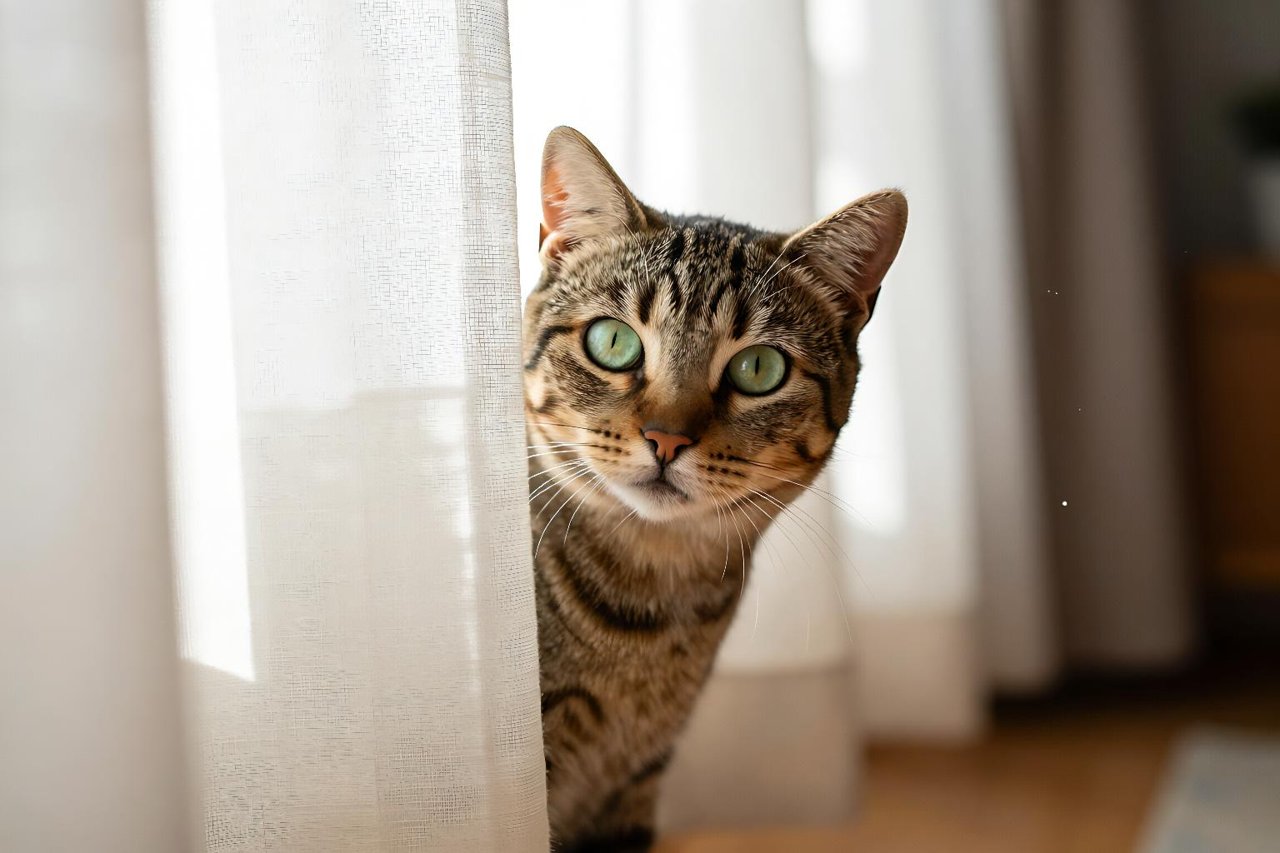
Your doorbell rings and within four seconds your cat has evaporated. One moment she was sprawled along the arm of the sofa; the next there’s nothing but a swaying curtain and the distant click of a wardrobe door. Twenty minutes later your friend is still sitting on the couch, mildly offended, and you’re apologising for an animal currently wedged behind the boiler.
It’s one of the most common behaviour questions vets and cat behaviourists get asked. The answer is almost never “your cat hates your friends.”
Hiding Is a Survival Strategy, Not a Personality Flaw
Cats are one of the few animals built to be both hunter and hunted. A domestic cat weighs somewhere between 3 and 6 kilos. A standing adult human is twenty times that, arrives without warning, and makes unfamiliar noises. From the cat’s point of view, retreating behind the sofa is not drama. It’s basic risk management.
What’s interesting is how quickly it happens. Cats don’t assess a stranger over five minutes the way a dog might. A shy cat typically decides within a second or two of the door opening, then acts on that decision. By the time you’ve said hello, the verdict is already in.

That’s also why dogs and cats handle new people so differently. A dog’s instinct is often to investigate the newcomer, sniff, and get involved. A cat’s default is to watch from a position of safety until the situation proves itself. Neither response is better. They’re just different operating systems.
What Your Visitor Actually Smells and Sounds Like
We underestimate how much information a guest drags through the front door. Cats lean heavily on scent, and a visitor arrives carrying the smell of their own home, their own pets, their car, their laundry detergent, and whatever they had for lunch. To a resident cat, that’s a walking data breach.
Then there’s sound and size. Deep unfamiliar voices. Laughter at a pitch your cat doesn’t associate with you. Bags dumped on the floor. Shoes that squeak on the hallway tiles.
The lean-in problem
Humans greet animals by getting closer, which is the opposite of what most cats want. A guest who crouches down and reaches a hand toward a nervous cat has just broken roughly three feline rules at once: they’ve closed the distance, they’ve raised a limb, and they’ve made direct eye contact. In cat language, a long hard stare is a threat. The polite version is a slow blink and a turned head.
Personality, Upbringing, and Why Some Cats Simply Don’t Do Crowds
Two cats raised in the same house can react completely differently to the same visitor. Behaviourists generally split cats into bolder and shier coping styles. Bold cats approach new objects and recover quickly from surprises. Shy cats freeze, watch, and withdraw. It’s a fairly stable trait, not something you can train out entirely.
Early experience matters enormously. Kittens handled gently by several different people between roughly two and seven weeks of age tend to grow into adults that tolerate strangers. Kittens who met only one or two humans in that window often stay cautious for life. If you’re still in the choosing phase, it’s worth reading about how to pick a cat breed with the temperament that suits your household, because sociability genuinely varies between breeds. Siamese and Burmese types are usually outgoing. Some British Shorthairs and Russian Blues prefer their own company.
The Layout of Your Home Decides a Lot
A cat with nowhere to retreat to will pick the worst possible spot: under the bed, behind the washing machine, inside a cupboard nobody opens for six hours. Give them better options and they’ll use them.
- A high perch near the entrance, so they can observe without being reached
- Two exit routes from any room they’re likely to be cornered in
- A covered bed or box in a quiet room away from the front door
- Something that smells strongly of you, like an unwashed jumper, in that safe spot
Cats who can watch from height often stop hiding entirely. From the top of a bookshelf they have information and distance at the same time, which is all most of them actually want.
Things Guests Do That Make It Worse
Most well-meaning visitors do at least three of these within the first five minutes:
- Staring at the cat and announcing loudly that there’s a cat
- Reaching over the cat’s head instead of offering a hand low and still
- Following the cat when it moves away, which reads as pursuit
- Closing doors, trapping the cat in whichever room it fled into
- Letting children chase, or bringing in a dog without a proper introduction
The single most effective instruction you can give a guest is this: ignore the cat completely. Don’t look, don’t call, don’t offer a hand. The person who ignores a nervous cat is almost always the one it eventually comes to investigate, usually within twenty minutes.
How to Help Without Dragging Them Out
Never pull a hiding cat out from under furniture. It confirms the worst thing the cat already believes about visitors, and it can cost you weeks of trust.
Set up a guest-proof room before anyone arrives
Twenty minutes before your visitors are due, move your cat into a bedroom with a litter tray, fresh water, a covered hiding spot, and something to do. Close the door. This isn’t cruel, it’s a controlled environment. When the guests leave, open the door and let the cat decide when to reappear. Many cats settle faster this way than they ever would in a crowded living room.
Let the cat set the pace
If your cat prefers to stay in the room, let them. Have a guest toss a treat in the cat’s general direction without looking up, then continue the conversation. Repeat every ten minutes or so. That’s slow, but it builds a genuine association rather than a forced one. Synthetic pheromone diffusers can take the edge off for some cats, though the evidence is mixed and it works best alongside these other changes.
Watch the doors
Visitors mean suitcases in the hallway, propped front doors, and deliveries. A nervous cat looking for an exit may take the one you left open. This is especially true during busy periods, which is why it’s worth thinking about keeping your cat safely inside when holiday visitors are coming and going. Check that microchip details are current before the season starts, not after.
When Hiding Stops Being Normal
Guests triggering a disappearing act is one thing. A cat who suddenly hides from you, in a quiet house, with no visitors around, is telling you something different. Cats are excellent at masking pain, and withdrawal is often the first visible sign.
Book a vet visit within a day or two if a normally sociable cat starts hiding persistently and also shows any of the following:
- Reduced appetite or drinking
- Straining in the litter tray, especially in male cats (this is an emergency)
- Grumpiness when touched on a specific area, like the hips or jaw
- Changes in grooming, either neglect or over-grooming
Arthritis is a common culprit in cats over eight, and dental pain in cats of any age. Both look like shyness from the outside.
What Progress Actually Looks Like
Don’t expect a switch to flip. Realistic milestones look more like this: week one, the cat vanishes at the doorbell and reappears an hour after everyone leaves. Week six, the cat stays in the room but watches from the top of the wardrobe. Month three, the cat sniffs a guest’s shoe before retreating. Month six, the cat accepts a treat from a regular visitor’s hand.
That’s a normal curve, and it’s a good one. Regular visitors matter more than unfamiliar ones, so invite the same two or three people over rather than a rotating cast of strangers. Keep arrivals calm, keep your own body language relaxed, and resist the urge to apologise for your cat’s behaviour by hauling them into the open. A cat who is allowed to hide is a cat who will eventually choose, on their own schedule, to come out.


