
Table of Contents
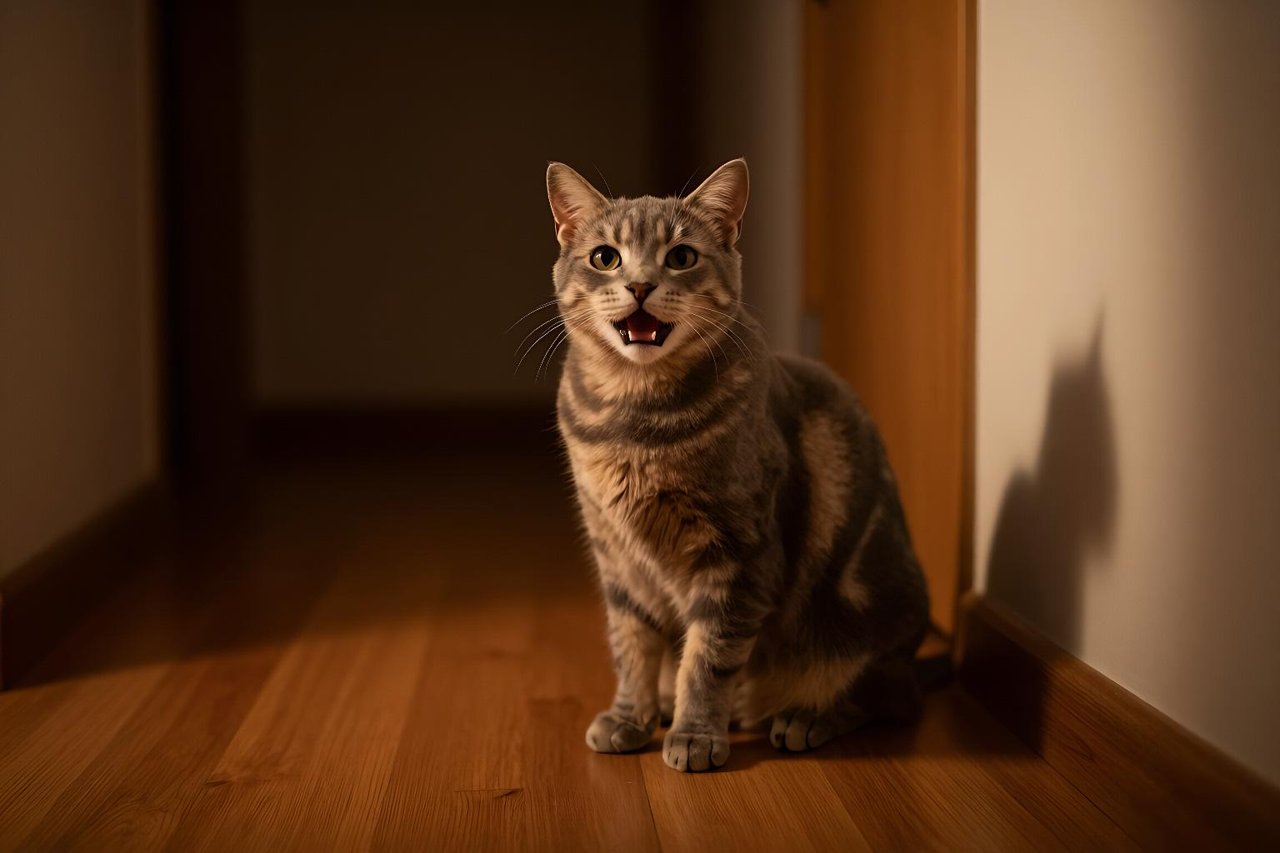
It’s 3:47am and your cat is in the hallway, meowing at a wall. You’ve checked the food, the water, the litter tray. The wall is still a wall. Nothing appears to be wrong, and yet the noise continues.
Night meowing is one of the most common complaints behaviourists and vets hear, and it rarely means your cat is being difficult for the sake of it. Something is driving the noise. Work out what, and the problem usually quietens down faster than any amount of shushing will achieve.
Cats aren’t nocturnal, they’re crepuscular
This is the part most people get slightly wrong. Cats aren’t nocturnal animals that prowl all night. They’re crepuscular, which means their natural activity peaks land around dawn and dusk, roughly 4am to 7am and 6pm to 9pm. In the wild, that’s when rodents and small birds are on the move, so that’s when a hunter needs to be sharp.
A domestic cat with a full bowl and a heated sofa still runs on that same internal clock. The wiring hasn’t changed just because the hunting has. So when your cat starts yowling at 5am, part of what you’re hearing is biology: this is simply the hour their body says go.

What you can change is how much energy is left in the tank when that hour arrives, and that comes down to what happens during the day.
The 4am hunger alarm, and how easily it gets set
Cats are exceptional at cause and effect when food is involved. If meowing at 5am has ever produced a bowl of biscuits, even once, the behaviour is now on the schedule. One accidental reinforcement is usually enough.
Part of the problem is free-feeding. A cat with an always-full bowl never experiences real hunger, but they do experience boredom, and the crunch of dry food is a genuinely interesting sound at 4am. Switching to two or three measured meals at set times, with the last one as late as is practical, often removes the whole reason for the early alarm within a week or so.
Warm food helps too. A splash of warm water over a late meal makes it smell stronger, and scent is most of what tells a cat they’ve eaten.
A bored cat is a loud cat
Indoor cats sleep somewhere between 12 and 16 hours a day. If nothing stimulating happens during the other eight, they arrive at night fully charged. The 11pm sprint up and down the corridor isn’t random madness. It’s a pent-up hunting drive finally getting an outlet.
The fix is unglamorous and effective: a proper play session before bed. Not a half-hearted wave of a toy from the sofa, but 10 to 15 minutes with a wand toy that lets the cat stalk, chase, pounce and finally catch something. End with a small treat or a portion of their dinner, so the sequence mirrors the natural one of hunt, catch, eat, groom, sleep. Cats are very good at following that chain once you give them the chance to complete it, which is the core idea behind meeting your pet’s needs rather than guessing at them.
Daytime matters just as much. A window perch facing a bird feeder, a couple of puzzle feeders, or a paper bag that gets rotated in and out of the room every few days can do a surprising amount of work while you’re out.
Sometimes the meowing works, and the cat knows it
Here’s an uncomfortable fact: adult cats almost never meow at each other. Meowing is a sound they reserve almost entirely for humans. A cat meowing at 3am is not talking to the dark. They’re talking to you.
Any response counts as a response. Shouting, throwing a pillow, getting up to check on them, even a heavy sigh followed by a light switch. From the cat’s side of the door, all of those are the same message: noise produces attention. If the meowing stops the moment you appear, you’ve found your answer.
If you suspect you’re being trained rather than genuinely needed, there’s a useful breakdown of the difference in what your cat is trying to tell you when you can’t sleep. The short version is that an anxious or uncomfortable cat sounds different from a cat running a very successful campaign.
Some cats are simply chatty
Breed and personality both matter. Siamese, Burmese, Tonkinese, Oriental Shorthairs and Maine Coons are famously vocal, and a quiet night was never really on the table. If you share a flat with thin walls, a talkative breed is worth thinking about before you commit; there’s honest guidance on cat breeds that cope well with small flats and thin walls.
Curiosity plays into it as well. The cats who tend to narrate their entire evening are often the same ones who dismantle your kitchen in search of entertainment, and the most intelligent cat breeds generally come with a louder soundtrack. That doesn’t mean you can’t reduce night noise, but it does mean aiming for “quieter” rather than “silent”.
When night meowing is a health signal
This is the part worth taking seriously. A cat who has always slept through and suddenly starts yowling at night is telling you something has changed. The usual suspects:
- Hyperthyroidism. Very common in cats over 10. Look for night vocalisation alongside weight loss despite a ravenous appetite.
- High blood pressure. Often secondary to thyroid or kidney disease, and frequently missed without a vet check.
- Dental pain or arthritis. A sore mouth or stiff hips make it hard to settle, and a restless cat is a noisy one.
- Urinary problems. A cat who needs to toilet more often will wake, get uncomfortable, and complain.
- Hearing or sight loss. A deaf cat can’t hear where you are, so they get loud to locate you.
Senior cats and night confusion
Cats over 11 can develop cognitive dysfunction syndrome, which is essentially feline dementia. The signature symptom is exactly this: a confused, loud, wandering cat between midnight and 4am, often while the house is dark and quiet. It mirrors sundowning in people. Night lights, keeping furniture in the same place, and a consistent evening routine all help, but a vet visit is the right first step because there are other conditions that look identical.
How to shift the routine
The plan is boring, and it works. Pick a version of this and give it two full weeks before deciding it failed:
- Move to fixed meal times, with the final meal as late as you can manage.
- Do a real 10 to 15 minute play session right before bed, ending in food.
- Leave a puzzle feeder with a small portion of the overnight calories.
- Add daytime stimulation: a window perch, a bird feeder, rotating toys.
- Put a night light in the hallway for older cats who get disoriented.
- If you can safely close the bedroom door, do it, and leave water and a litter tray on the other side.
What makes it worse
Yelling doesn’t teach a cat that meowing is wrong, it teaches them that meowing brings a loud, exciting human. Spray bottles create a cat who waits until you’re definitely asleep before starting. Getting up to feed at 3am buys you one quiet night and confirms the schedule for the next six months.
The other mistake is shutting a cat out of the bedroom with no water, no litter tray and no company. That gives you a cat who meows from the other side of the door and, in some cases, a cat who starts toileting in the hall.
What the first two weeks actually look like
Expect it to get briefly worse before it gets better. That’s the extinction burst, and it’s the point where most people give in. A cat whose 4am meowing has worked for two years will try harder for three or four nights before the behaviour starts to fade.
Track it. Note the time of the first meow each night. Most people find it moves later by 20 or 30 minutes every few days, which is exactly what a shifting routine should produce. If nothing changes after two weeks of consistent effort, or if the meowing started suddenly in a cat over eight, book the vet appointment. Sudden night vocalisation in an older cat is one of the more reliable early flags for a health problem, and it’s far easier to treat when it’s caught on the first round rather than the third.


