
Table of Contents
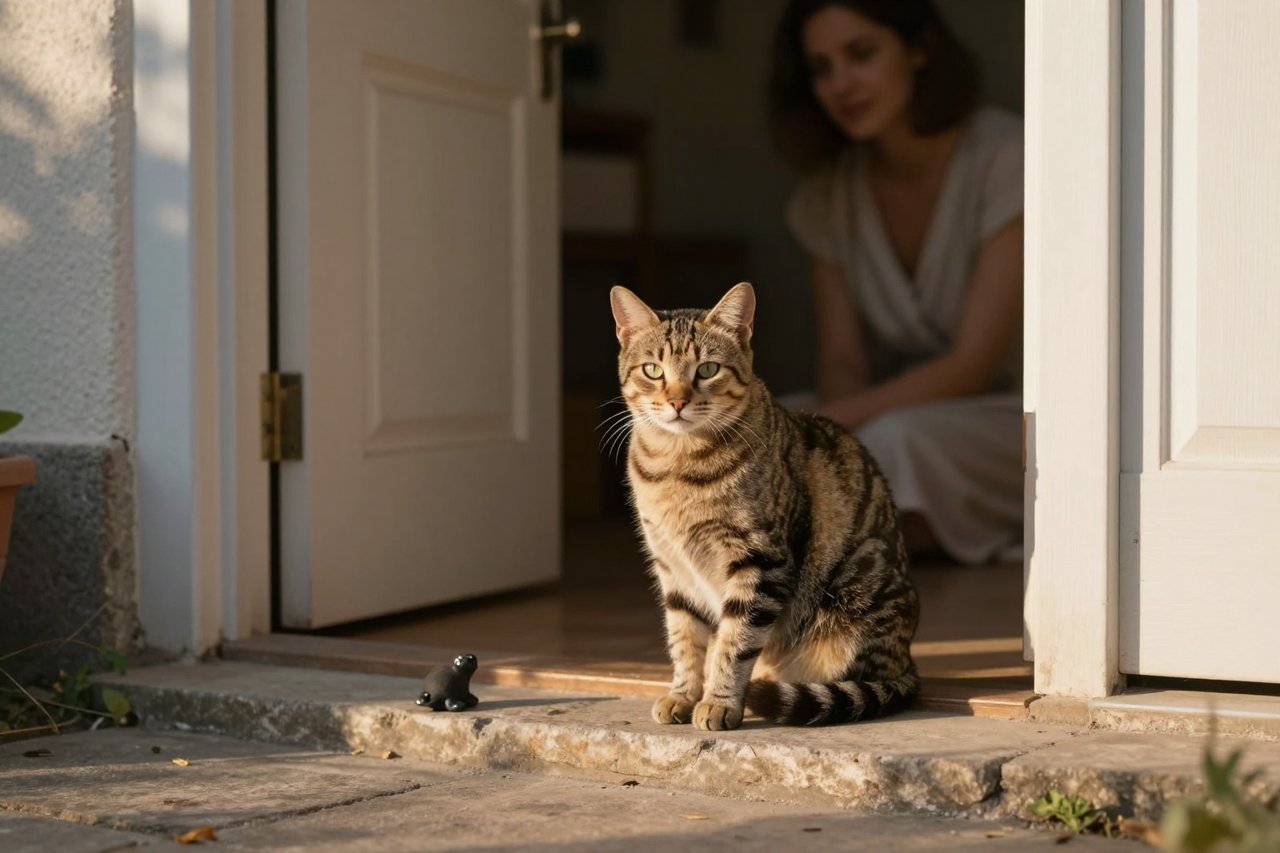
It’s 6:14 on a Tuesday morning. You are barefoot, uncaffeinated, and staring at a field mouse on the doormat that has been arranged with what looks like genuine care. Two feet away sits your cat, tail up, watching you with an expression of pure expectation.
If that scene is familiar, you’re in very good company. Cats bring dead animals home for reasons that are deeply wired, oddly affectionate, and completely at odds with how humans express love. No cat is trying to be gruesome.
The Hunting Instinct Doesn’t Switch Off
Cats are obligate carnivores with a hunting sequence hardwired from nose to tail: stalk, crouch, pounce, bite. None of that depends on hunger. Camera studies of owned outdoor cats have recorded them killing anywhere from two to ten small animals a day in peak season, and eating only a fraction of them. The rest get left where they fall, cached under bushes, or carried inside.
A full bowl of kibble has no effect on any of this. Your cat isn’t hunting because it’s starving. It’s hunting because the switch is on and something in the grass is moving.

The kitten-raising programme
Mother cats bring prey back to the nest and deliver it in a deliberate sequence as their kittens grow. First dead prey is dropped. Then prey that’s been partly disabled. Later, live but injured. Finally, fully intact. Each stage is a lesson in handling, and the kittens learn the whole sequence by practising on it.
That’s the theory most feline behaviourists land on when explaining a mouse on your pillow: your cat is treating you as a slightly underperforming kitten. You’ve been enrolled in a course you never signed up for, and the curriculum has already started.
You Are Family, So You Get a Share
Free-living cats in colonies do share food. Queens with kittens will tolerate other adults eating nearby. Prey sharing is a social act, not a solitary one, and domestic cats kept that wiring.
There’s also the question of what the prey is for. If your cat wanted a snack, it would eat the animal where it caught it, outdoors, immediately. Carrying it thirty metres through a cat flap and dropping it at your feet is a detour with a purpose. The prey has been delivered, not abandoned.
Which is why so many owners describe the same detail: the cat drops the body, sits back, and waits. Some chirp. Some stare. Some rub against your ankle. This is not the behaviour of an animal that has finished eating. It’s the behaviour of one that wants you to notice.
The “Safe Place” Explanation
Cats are secretive when they eat, and they’re picky about where. A cat that has caught something may bring it to the spot it considers safest (the house, a particular rug, the corner behind the sofa) because eating out in the open is risky. Even if the cat has no intention of eating it, the urge to relocate prey somewhere secure is strong.
In this reading, the doormat isn’t a gift at all. It’s your cat’s version of a pantry, and the fact that the pantry is your home tells you something quietly nice about how safe your cat feels in it.
Birds, Mice, and the Meaning We Layer On Top
Most of the time the victim is a mouse or a vole. Sometimes it’s a bird, and that lands differently. A dead bird on the step has a way of feeling like a message rather than a catch, which is why people have read significance into it for centuries. Different traditions have treated a dead bird as a symbol of change, loss, or a visit from someone gone. You don’t have to believe any of that to feel the weight of it at 6am.
That symbolism tends to follow people into sleep, too. If the delivery has stuck with you, it’s not unusual to end up dreaming about a dead bird a night or two later, a small strange echo of something your cat did without a second thought.
When the Gifts Start Suddenly
A cat that has hunted quietly for years and then starts presenting prey daily is usually responding to something. Common triggers include:
- A change in routine: a move, a new job, a baby, a new pet
- Less outdoor time, or a shrunken hunting territory
- Extra energy with nowhere to put it
- Boredom, especially in indoor cats with few outlets
A sudden jump in hunting is worth taking seriously for one more reason: it can signal stress or illness. A vet check is a sensible first step if the behaviour is new, particularly in an older cat.
Indoor cats need an outlet for the instinct regardless. Puzzle feeders, wand toys that mimic a chase, and two short but intense play sessions a day soak up a surprising amount of predatory energy. It’s one of the genuinely bigger differences between caring for dogs versus caring for cats. A dog will tell you what it needs. A cat will quietly redecorate your hallway with a shrew.
What to Do With the Body (and the Cat)
Don’t scold. Your cat has done something entirely natural and, by its own reckoning, generous. Yelling teaches it nothing except that bringing things home is risky, which changes where the next one gets left, usually somewhere harder to find.
- Praise calmly, then remove the prey wearing gloves or using a plastic bag
- Keep worming treatments up to date, since prey can carry parasites
- Wash your hands afterwards, and avoid bare-skin contact where you can
- If the prey is alive and uninjured, release it well away from the house
Toxoplasmosis is the main health concern for owners who handle prey, particularly for pregnant women and anyone immunocompromised. Gloves and soap cover almost all of the risk.
Protecting Wildlife Without Killing the Instinct
Cats are part of why some bird populations are under pressure in suburban areas, and that’s a real cost: a single outdoor cat can account for dozens of kills a year. There are ways to reduce the toll without turning your cat into a houseplant.
- Keep cats in at dawn and dusk, when birds and small mammals are most active
- Fit a quick-release collar with a bell or a brightly coloured cover; studies show these cut bird kills substantially
- Place feeders well away from low shrubs where a cat can lie up
- Neuter, which reduces roaming as well as unwanted litters
None of this removes the instinct. It just shifts the odds.
Why It Still Feels Like Affection
Here’s the part that surprises people who study animal behaviour: the affectionate reading isn’t wrong, even if the mechanism is instinct. Research into the emotional lives of animals has pushed hard against the old idea that instinct and feeling cancel each other out. A cat that brings prey home is acting on wiring it didn’t choose, in a place it feels safe, aimed at a person it lives with. Those three facts don’t have to be sentimental to be meaningful.
So the mouse on the doormat isn’t a thank-you note. It’s something stranger and, honestly, better: a small predator deciding that the safest place to put its catch is wherever you happen to be. Bin the mouse and keep the compliment.


