
Table of Contents
You’re detangling after a shower and hear it: a small, sharp snap. Then another. By the time you’ve worked through the last section, there’s a fuzzy halo of two-inch strands standing up around your crown, and you can’t remember doing anything dramatic to your hair. That’s how breakage usually shows up. Not after one bad bleach job, but after months of small habits that each seemed harmless at the time.
Here are the seven hair care mistakes that cause the most breakage, roughly in order of how much damage they do, along with what to do instead. Fix two or three and you’ll see a difference within a couple of months.
1. Treating Wet Hair Like It’s Indestructible
Wet hair isn’t just dry hair with water on it. Water breaks the hydrogen bonds inside the strand, which makes hair stretchy and far more fragile. A wet strand can stretch around 30% of its length before it snaps, and it doesn’t spring back the way dry hair does.
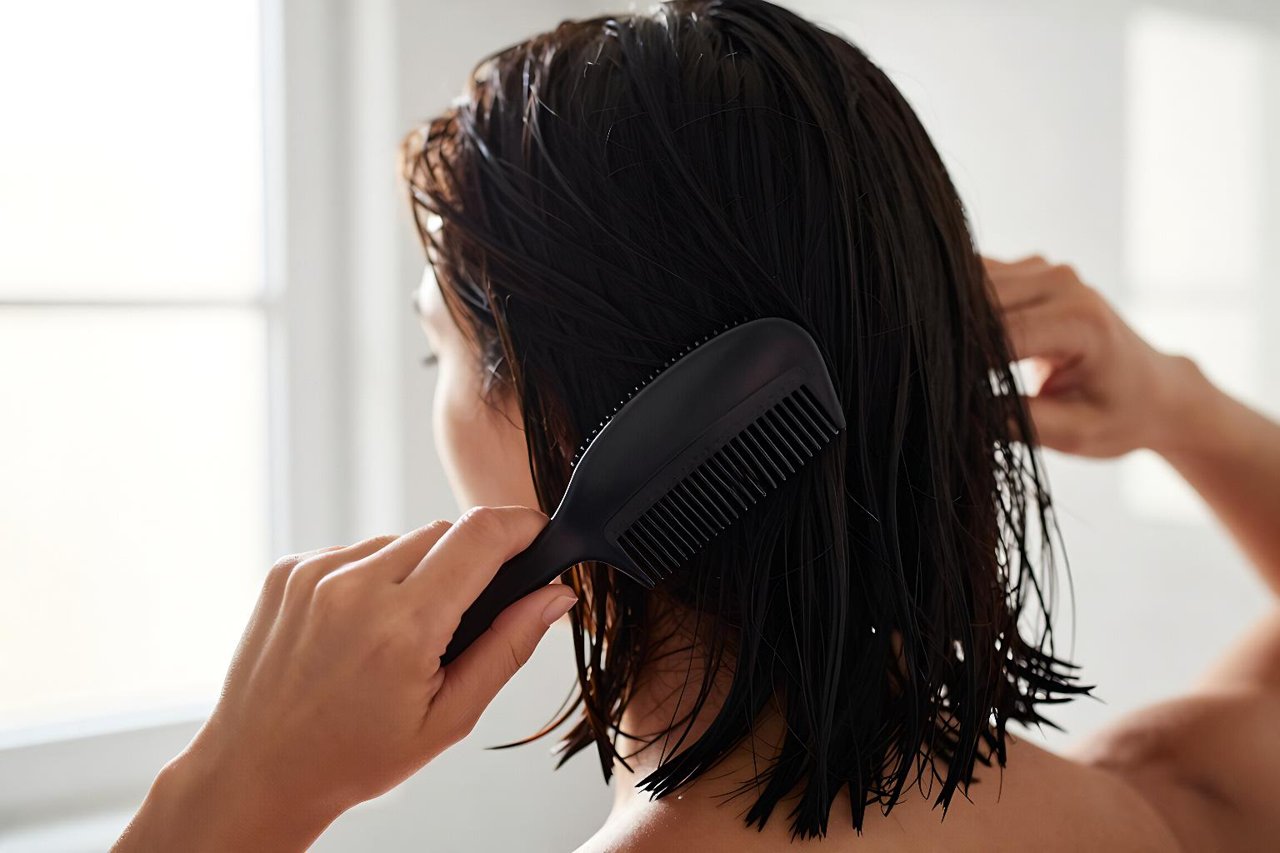
That’s why brushing down from the roots is so destructive straight after a shower. You’re dragging bristles through the tangliest part of the hair when the strand is at its weakest. Same story with a vigorous rub of a terry towel: those loops catch the cuticle and pull.

What to do instead
- Detangle in the shower with conditioner in, using your fingers first, then a wide-tooth comb worked from the ends upward.
- Never brush from the scalp down. Hold the mid-lengths and go in small sections.
- Swap the towel rub for a squeeze-and-blot with a microfiber towel or an old cotton T-shirt, and take the turban off within 10 minutes.
Skip the old 100-brush-strokes-before-bed ritual, too. That advice is about a century out of date, like plenty of other beauty tips that backfire and still refuse to die.
2. Cranking Up the Heat Without Protection
A flat iron set to 450°F is hot enough to vaporise water inside the hair shaft. If there’s moisture left in the strand, that steam expands and creates tiny bubbles inside the cortex, a genuine condition stylists call bubble hair. The strand eventually breaks at the bubble, often weeks later, which is why people blame the wrong product.
Two things prevent most of it. Hair has to be completely dry before any hot tool touches it, and a protectant needs to go on every single time, not just when you remember. There’s a reason heat protectant spray is the one styling step you should never skip: it slows heat transfer and helps the cuticle lie flat instead of lifting.
Keep the iron under 350°F for fine or colour-treated hair, take one clean pass rather than three, and give hair at least two heat-free days a week.
3. Wearing the Same Tight Style Every Single Day
Breakage at the hairline rarely comes from heat. It comes from tension. A taut ponytail, a slicked-back bun, tight braids or heavy extensions pull on the follicle for hours at a stretch, and hair that’s constantly pulled will thin and snap along the front and temples. This is traction damage, and unlike a split end, it can be permanent if you keep it up for years.
Watch for these signs:
- Short broken hairs along the hairline that stick straight up
- Tender spots or a headache shortly after taking your hair down
- A widening part or visible thinning at the temples
- Small bumps along the scalp where a tight braid has been sitting
Rotate your styles, switch to a satin scrunchie instead of a tight elastic, and take everything out the moment you get home. If a style hurts, it’s too tight. That’s the whole test.
4. Sleeping With Hair Loose on a Cotton Pillowcase
You spend seven or eight hours a night dragging your hair across cotton, which grips rather than glides. That adds up to thousands of hours of friction a year on the oldest, most fragile part of the strand: the ends. It also makes tangles worse, so you wake up and attack the knots with a brush while half asleep.
A satin or silk pillowcase solves most of it for roughly the price of a takeaway dinner. If you’d rather not switch, loosely braid your hair before bed or wrap it in a silk scarf. And don’t fall asleep with wet hair. It’s weaker when wet, and it stays damp against your scalp for hours.
5. Playing Favourites With Masks and Oils
Deep conditioning is genuinely useful. Doing it three times a week without thinking about what your hair actually needs is where people go wrong. Hair needs a balance of moisture and protein. Load it with moisture alone and it goes soft, limp and stretchy, snapping when you pull a strand gently because it has lost its internal structure.
The usual mask mistakes:
- Applying it to the scalp and roots, which just leaves hair greasy and flat
- Leaving it on for hours instead of the stated 10 to 20 minutes
- Using a protein mask on hair that’s already brittle and straw-like, which makes it stiffer and more likely to crack
Try the stretch test. Take a shed strand, wet it, and pull gently. If it stretches a long way before breaking, you need protein. If it snaps almost immediately with no give, you need moisture. Applying each one correctly matters more than how often you do it, and this guide on how to get the most out of your hair mask walks through the timing and technique properly.
6. Stacking Chemical Services Too Close Together
Hair can usually handle one chemical process at a time. It struggles with two in a month. Bleaching over fresh bleach, relaxing and then colouring the same week, or putting a box dye over highlights are the fastest routes to what stylists call a chemical cut: hair that snaps off a few centimetres from the root with no tool involved.
If you want to go lighter, plan it across sessions with four to six weeks in between. Ask for a strand test whenever you’re making a big change. And tell your stylist everything that’s been on your hair in the past year, including the henna you bought online and the semi-permanent colour you did yourself in the bathroom.
7. Skipping Trims to ‘Save’ Length
Hair doesn’t heal itself. Once a split end forms, it travels up the shaft, and the strand breaks at the weakest point above it. Waiting an extra six months doesn’t buy you six months of length. It usually leaves you with thin, raggedy ends that make the whole head of hair look sparse.
A trim every eight to twelve weeks, even a quarter-inch, removes the damage before it climbs. If you’re growing your hair out, ask for a dusting rather than a full trim. Between appointments, pinch off individual split ends with proper hair scissors as a stopgap. Never use kitchen scissors, which crush the cuticle and create a fresh split in seconds.
If you only change one thing this month, make it the heat protectant and the wet-hair handling. Those two alone account for a large share of the breakage people bring to a stylist, and both cost almost nothing to fix.


