
Table of Contents
On 7 September 1927, in a rented laboratory at 202 Green Street in San Francisco, a 21-year-old named Philo Farnsworth switched on a receiver and watched a thick black line appear on a glass screen. It was not a picture of anything. It was one horizontal line, wobbling in the dark. It was also the first image ever sent electronically, and every screen you have ever watched descends from it.
Farnsworth got there after four decades of theorising, plenty of dead ends, and one very determined Scotsman who built televisions out of hatboxes and darning needles. The history of television is a story about a machine that took fifty years to invent and then roughly twenty to take over the world.
The Idea Before the Box
The physics came before the gadget. In 1873 an engineer named Willoughby Smith noticed that selenium’s electrical resistance dropped when light fell on it. That one quirk of chemistry gave inventors a way to turn brightness into current and current back into brightness. Sending a picture down a wire suddenly looked possible.
In 1884 a 24-year-old German, Paul Nipkow, patented the Elektrisches Teleskop: a spinning disk punched with a spiral of holes. Each hole swept across one slice of an image, scanning it line by line, the way your eyes read a page. Nipkow never built a working set. He didn’t need to. His disk became the basis for nearly every television experiment for the next forty years, and the idea of scanning lines never left.

Two more pieces slotted in. Boris Rosing in St Petersburg started using a cathode ray tube to display images in 1907, work continued by his student Vladimir Zworykin. And in 1900, at the Paris Exposition, the Russian physicist Constantin Perskyi coined a word for the whole enterprise: télévision.
A Scotsman, a Farmboy, and Two Very Different Machines
John Logie Baird got there first, and he got there with junk. Working in a rented Soho attic in the mid-1920s, he assembled a scanning rig from a hatbox, a bicycle lamp lens, sealing wax, cardboard, knitting needles and a darning needle. On 26 January 1926 he showed it to members of the Royal Institution in a small room off Frith Street. The figures on his screen were grey blobs, roughly five centimetres tall, flickering at around twelve and a half frames per second. It was television, technically.
Baird’s system was mechanical, spinning, clattering and dim. It was also a complete dead end.
Farnsworth’s approach killed it. Growing up on an Idaho farm, he’d watched a horse-drawn plough cut parallel furrows across a field and realised an image could be read the same way, one line at a time, by electrons instead of a spinning disk. He sketched the idea for his chemistry teacher in 1922, aged fourteen. Five years later he transmitted that black line, and in 1929 he demonstrated a live human face, his wife Pem, with the lights deliberately turned up to quieten the rumours that he was faking it.
RCA saw the threat. It had backed Zworykin’s rival iconoscope and poured money into a patent fight, which Farnsworth won in 1935, forcing RCA to license his work. It’s one of those hinge moments that sits alongside the biggest breakthroughs in the revolutions that reshaped the modern world: a single invention that quietly rewired how everyone else worked.
The BBC, the War, and a Seven-Year Blackout
Britain launched the first regular high-definition service from Alexandra Palace on 2 November 1936, alternating between Baird’s 240-line mechanical system and the Marconi-EMI electronic one at 405 lines. The comparison didn’t last long. The mechanical cameras were gone within three months.
Then came the strange part. On 1 September 1939, the service was cut off mid-cartoon, apparently during a Mickey Mouse short, because the transmitter was thought to be a beacon for enemy aircraft. It stayed dark for almost seven years. When it came back on 7 June 1946, the first face on screen was the announcer Jasmine Bligh, who opened with: “Good afternoon everybody. How are you? Do you remember me?”
In those early decades broadcasting was less entertainment than national infrastructure. A single channel, a single voice, a common set of references on the same evening at the same time. That’s a powerful thing for a country, and it’s the same instinct behind the way flags, borders and belonging keep pulling people together.
Television Moves Into the Living Room
America came out of the war with perhaps 8,000 sets in the entire country. By 1960, roughly nine in ten US households had one. The Federal Communications Commission froze new station licences between 1948 and 1952 to sort out frequency interference, and the backlog only made the pent-up demand worse. Sets arrived as furniture: walnut veneer, a 12-inch round tube, rabbit ears wrapped in foil.
Two shows changed the business. I Love Lucy, which premiered on 15 October 1951, was filmed on 35mm with three cameras in front of a live audience because Desi Arnaz wanted to be in Los Angeles with his wife rather than in New York. That decision accidentally invented the rerun and the syndication market. In Britain, the coronation of Elizabeth II on 2 June 1953 pulled an estimated 20 million people to screens, many of them crowded into neighbours’ front rooms or the back of a pub. Set sales jumped, and the living room became the place the country gathered.
News followed. By the early 1960s, surveys in the United States found that more people got their news from television than from print, a shift that finished off a transition already visible in the long history of newspapers.
Colour, the remote, and the shape of the evening
- Colour reached US screens in 1954 when NBC broadcast the Tournament of Roses Parade. Britain waited until BBC Two launched in colour on 1 July 1967. Plenty of households kept watching in black and white until the mid-1970s anyway.
- The remote arrived in 1950 as the Zenith “Lazy Bones”, a wired box that could do little more than mute the adverts. By 1956 Zenith’s wireless “Space Command” used a beam of light. Jangling keys and loose coins could, and did, change channels by accident.
- The debates sold the medium to politics. Roughly 70 million Americans watched the first Kennedy–Nixon debate in 1960; radio listeners thought Nixon had won.
- The scandals tested trust early. The quiz show rigging hearings of 1959 forced networks to put their own names on the programmes they made.
Cable, Cassette, and the End of Three Channels
Home Box Office started sending films down cable in Wilkes-Barre, Pennsylvania, in November 1972. Sony’s Betamax arrived in 1975 and JVC’s VHS the following year, and VHS won for the deeply unglamorous reason that it recorded for two hours instead of one. Being able to record something and watch it later broke the first link between what was broadcast and what you watched.
Then the bandwidth opened up. CNN launched on 1 June 1980, MTV on 1 August 1981, and within a decade the schedule went from three channels to forty. Airtime had to be filled cheaply, which is why the era gave us so many grainy documentaries about the unexplained, the kind of thing you still find in investigations into the Bermuda Triangle and its supposed disappearances.
Cable also rewired disaster coverage. Once there was a channel that didn’t stop, an event like an earthquake or its immediate aftershocks could be reported live, constantly, from the first tremor rather than the evening bulletin.
The Flat Panel That Changed the Room
The first commercial plasma screen went on sale in 1997: 42 inches across, four inches deep, and around £20,000. LCD panels followed, prices collapsed, and by the late 2000s the cathode ray tube was dead. Britain finished switching off its analogue signal in October 2012; the United States had done so three years earlier.
The technology change was invisible compared with the furniture change. A television used to be the biggest object in a room, facing one direction, with a sofa pointed at it. Now it hangs on a wall like a picture, or it’s the slab you carry to the kitchen to watch while making dinner. High definition gave way to 4K, then 8K; OLED panels switch off individual pixels to show true black.
The Schedule Quietly Disappears
Netflix started streaming in 2007 and released House of Cards as a complete first season on 2 February 2013. That release pattern, a whole series at once, did something the VCR never finished: it put the viewer fully in charge of time. Catch-up players, then every network’s own app, then password-sharing crackdowns. Broadcast time stopped being scarce and became irrelevant. Netflix’s later launch of one episode a week confirms the direction: even the streamers now borrow the schedule they helped kill.
The physical television hasn’t gone anywhere, though. There are still more screens per household than people in many homes, and a large share of viewing happens on phones and laptops where nobody is measuring the room. Yet around 120 million people still sit down together for a Super Bowl, the same way families once gathered for a coronation, and for the same reason. Live, unrecorded, everyone at once.
What the Screen Still Does Best
Each stage of the history of television solved the same problem in a different way. Nipkow’s disk turned an image into a signal. Farnsworth turned it into electrons. Baird made it flicker in a Soho attic. Sarnoff sold it, the BBC scheduled it, the VCR let us postpone it and the streamers let us forget the schedule existed entirely. The box got thinner, cheaper and sharper, and the number of people who could make one has shrunk from thousands of firms to a handful of factories in South Korea and China.
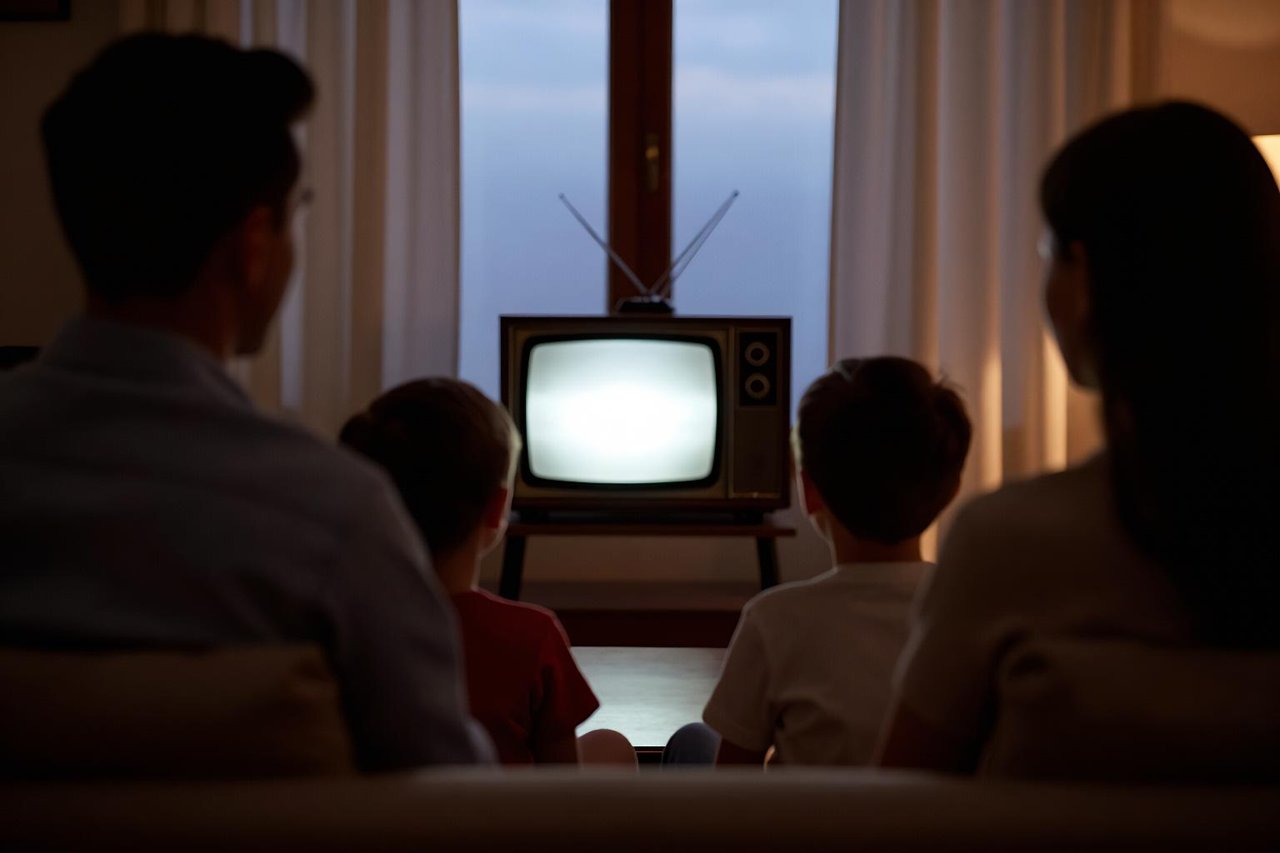
But walk into any living room during a live final, a breaking news alert, or a Eurovision night and the ritual is unchanged. Curtains shut, lamps off, everyone angled towards the same square of light. The screens have changed shape. The pull they have on a room hasn’t moved an inch in ninety years.


