
Table of Contents
Writing feels permanent, almost geological. It isn’t. For roughly 300,000 years people talked, sang, bargained and remembered everything inside their own heads, and the species did fine. Then, somewhere around 3200 BCE, in the mud-brick cities of southern Iraq, someone pressed a cut reed into wet clay and made a mark that stood for something other than itself.
The whole history of writing is about 5,300 years long. That is roughly two per cent of the time humans have existed. Everything from the Iliad to your last text message happened in that sliver at the end.
Before writing, there were beans
The first people to need a writing system were not poets. They were warehouse managers.
From about 8000 BCE, farmers and officials across the Near East used small clay tokens, each shape standing for a quantity of something real: a cone for a measure of grain, a sphere for a jar of oil, a disc for a sheep. You dropped the tokens into a clay envelope, sealed it, and stamped the outside with a picture of what was inside so nobody had to break it open. That stamp was the crack in the door. A picture of a sheep doing the work of a sheep is only one small step from a picture of a sheep doing the work of the word “sheep”.

The habit of recording obligations in clay turned into temple inventories, then into credit, then eventually into coinage, a thread traced properly in the history of money from temple ledgers to Bitcoin.
Knots, notches and coloured strings
Clay was not the only answer. Inca administrators ran an empire of perhaps ten million people using khipu: hanging cords knotted in a decimal code, some carrying over 1,500 strings. Medieval English tax collectors kept tally sticks notched with payments, then split them down the middle so each party held half. In North America, wampum belts encoded treaties in patterns of shell beads. These systems recorded information perfectly well. What they could not do was record a sentence.
Cuneiform: paperwork invents literature
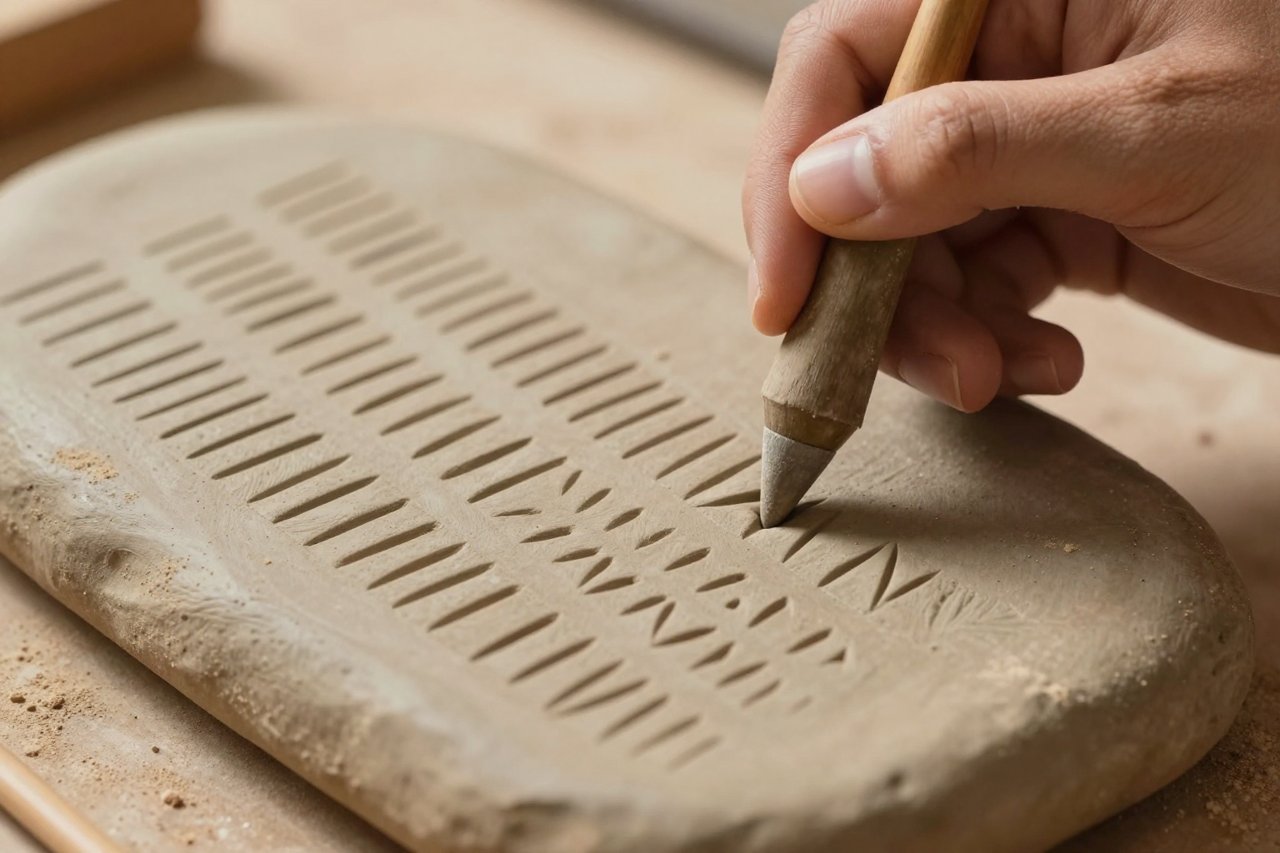
The earliest known true writing comes from Uruk, around 3300 BCE. At first the signs were drawings, scratched with a stylus. Wet clay punishes curves, so scribes switched to pressing the reed flat and dragging it, producing the wedge-shaped strokes that gave cuneiform its name (Latin for “wedge-shaped”). Within a few centuries the signs had stopped looking like anything at all, which is the trade-off every writing system makes: lose the picture, gain the speed.
Sumerian scribes spent years in school learning 600 or so signs. Their school exercises survive, which is how we know they were beaten for sloppy work. And out of all that grain accounting came something nobody had ordered: around 1800 BCE, someone wrote down the story of Gilgamesh on eleven clay tablets. Writing had been invented to track barley. Within 1,500 years it was asking what it means to be mortal.
Hieroglyphs, scribes and the first medical files
Egypt developed its own script around 3100 BCE, at almost exactly the same moment as Sumer, and probably not by coincidence. Trade routes ran the length of the Levant, and ideas travel with cargo. Hieroglyphs kept their pictorial beauty for monuments, while a fast cursive form called hieratic handled everyday business on papyrus.
Scribes sat near the top of the social ladder, exempt from the crushing labour taxes that fell on everyone else. Their output included the Edwin Smith papyrus, a surgical treatise copied around 1600 BCE that describes spinal cord injuries and gives 48 case studies with a verdict for each. It is a sober, careful document, and the story of how that kind of clinical record-keeping grew into modern practice is covered in 5,000 years of medicine, nerve and guesswork.
The alphabet: a 22-letter shortcut
Every system so far needed hundreds of signs. Then, around 1800 BCE, workers in Egypt’s turquoise mines started writing Semitic words in a stripped-down set of signs borrowed from hieroglyphs, each one standing for a single sound rather than a whole word. The Phoenicians, running a trading network out of what is now Lebanon, standardised the idea into 22 letters around 1050 BCE.
This was a genuine revolution in access. A cuneiform scribe needed a decade of training. A Phoenician merchant could teach his son the alphabet in a fortnight. Traders carried it along every sea route they sailed, which is part of why the alphabet spread faster than any empire that tried to impose a script by force; the same commercial machinery is described in the history of global trade from Bronze Age cargo to container ships.
The Greeks added the missing piece around 800 BCE. Semitic scripts wrote consonants only, leaving readers to supply vowels from context. Greek had vowel sounds that needed their own letters, so five Phoenician signs that were useless in Greek got reassigned. That single adjustment produced the first fully phonetic alphabet, and every alphabet from Latin to Cyrillic to Devanagari descends from it.
China: the longest unbroken tradition
Chinese writing appears independently on oracle bones around 1200 BCE, divination questions scratched onto turtle shells. It never became an alphabet, and it did not need to. A script that encodes meaning rather than sound can be read by speakers of mutually unintelligible languages, which helped hold a vast territory together. Around 3,000 characters cover everyday reading; a serious dictionary lists 50,000.
China also gave writing its two great material gifts. Cai Lun is credited with standardising paper around 105 CE, using mulberry bark and rags. And in roughly 1040, Bi Sheng carved movable characters from fired clay and set them in an iron frame. Four centuries later, in Mainz, Johannes Gutenberg would do the same thing with metal.
The Americas, and the scripts nobody can read
Maya scribes developed a full writing system by around 300 BCE, with roughly 800 signs combining phonetic and logographic elements. They wrote on bark paper folded into books; Spanish missionaries burned almost all of them in the 1500s. Four codices survive. We only learned to read Maya glyphs properly in the 1970s and 80s, which means a thousand years of recorded dynastic history sat unreadable for centuries.
Other scripts are still locked. The Indus Valley produced thousands of seal impressions between 2600 and 1900 BCE in a script no one has deciphered, and it may not even be a language. Discoveries like these keep forcing historians to revise the map of who invented what and when, as explored in seven ancient ruins that keep rewriting human history.
Monks, parchment and the price of a Bible
The codex, a stack of leaves bound at one edge, replaced the scroll between the first and fourth centuries CE. It was cheaper, searchable in a crude way, and it let readers flip to a passage instead of unrolling twelve feet of papyrus.
Then Europe’s book trade contracted to a few thousand expert hands. A monastic scriptorium could produce perhaps two Bibles a year, and a large one consumed the skins of 200 animals. Prices ran to the equivalent of a farm or a vineyard. Literacy followed the economics: where books cost a fortune, schooling was for a tiny elite, a dynamic tracked across the history of education from clay tablets to the modern classroom.
Gutenberg and the sudden cheapness of words
Gutenberg’s press in Mainz, working by 1450, combined a wine-press screw, oil-based ink, paper from the mills of Italy, and reusable metal type cast from a lead-tin-antimony alloy. His 42-line Bible ran to roughly 180 copies. Forty-nine survive.
The numbers after that are the real story. By 1500 there were presses in more than 200 European towns and an estimated 20 million books in circulation. A pamphlet that once took a scribe a month now came off the press in a morning. Reformation theology, scientific papers, newspapers and pornographic woodcuts all scaled for the same reason: the marginal cost of one more copy collapsed.
Steam, wires and keys
In 1814 The Times of London printed on a steam-powered press producing 1,100 sheets an hour, up from about 250 by hand. In 1844 Samuel Morse sent “What hath God wrought” from Washington to Baltimore and separated the message from the physical object for the first time. A letter no longer had to travel.
Then came the machine that made writing physical again. Christopher Sholes patented a typewriter in 1868; Remington sold it from 1874 with the QWERTY layout we still use, arranged partly to stop the type bars jamming. Within thirty years, typed documents had become the default in offices and women had entered clerical work in enormous numbers. The word processor and the screen finished the job a century later.
The screen era rewrote the sentence
The first SMS went out on 3 December 1992: “Merry Christmas”, sent by engineer Neil Papworth from a computer. Nobody guessed that a 160-character limit would reshape how a few billion people write.
Shigetaka Kurita designed the first 176 emoji in 1999 for a Japanese mobile service, and Unicode made them universal from the 2000s onward. Autocorrect, predictive text and voice dictation now sit between thought and page. Linguists keep finding that texting did not destroy grammar. It added a second register, informal and fast, which most people switch in and out of with their teachers and their friends.
What 5,000 years of writing actually tells us
Almost every writing revolution has been an infrastructure story, not a literary one. Clay made cuneiform. Papyrus made hieratic. Rag paper from China made the European scriptorium affordable. Metal type made the Reformation possible. The 160-character limit made a whole new dialect. When the medium gets cheaper, more people write, and when more people write, the rules loosen and then re-form somewhere new.
There is a warning buried in there too. The Indus script is unreadable. The Maya codices were burned. Tally sticks were thrown out as rubbish. We have lost most of what was ever written, simply because the carriers decayed or someone decided they were not worth keeping. The clay tablets that survived did so by accident, fired hard in the fires that destroyed the buildings they sat in.
Which makes the current moment worth watching closely. Software now generates competent prose on demand, and the volume of written text is rising faster than at any point since 1500. Whether any of it lasts is a question about formats, backups and institutions, not talent. Writing was invented by accountants keeping track of grain, and the most important thing about it has never been the beauty of the words. It is whether anyone, a thousand years from now, can still read them.


