
Table of Contents
The Search for Life on Mars Heats Up
For centuries, humans have gazed at the red dot in the night sky and wondered: is anyone there? Today, that question has evolved into a rigorous scientific hunt. Robotic rovers, orbiters, and powerful telescopes are combing Mars for any sign of past or present life. While we haven’t found little green men, the evidence we’ve gathered so far is tantalizing—and growing stronger every year.
Mars wasn’t always the cold, dry desert we see today. Billions of years ago, it had a thick atmosphere, liquid water on its surface, and possibly even a magnetic field. These conditions make it one of the best places in the solar system to look for extraterrestrial life. But where exactly are scientists looking, and what have they found?
Why Mars? The Case for a Once-Habitable World
Water, Water Everywhere
Water is the key ingredient for life as we know it. Mars has plenty of it—but mostly in the form of ice. The polar caps contain vast stores of frozen water, and underground aquifers may still hold liquid water today. NASA’s Curiosity and Perseverance rovers have found ancient river deltas, lakebeds, and minerals that only form in the presence of water. In 2018, the European Space Agency’s Mars Express detected a buried lake under the south pole. If liquid water exists there, it could be a refuge for microbial life.
Organic Molecules: The Building Blocks
Organic molecules—carbon-based compounds—are the raw materials for life. Curiosity has detected organic molecules in ancient mudstones at Gale Crater. These molecules don’t prove life existed, but they show that Mars had the necessary ingredients. Combined with water and energy sources like sunlight or chemical reactions, the stage was set for life to emerge.

Key Evidence That Fuels the Debate
- Methane spikes: Curiosity has observed seasonal fluctuations of methane in the Martian atmosphere. On Earth, most methane comes from living organisms, but it can also be produced by geological processes. The source on Mars remains unknown.
- Fossil-like structures: In 1996, scientists claimed that a meteorite from Mars—ALH84001—contained microscopic fossils. That claim remains controversial, but it sparked a new wave of research.
- Ancient habitable environments: The Jezero Crater, where Perseverance is now collecting samples, was once a river delta. If life ever existed on Mars, this is the kind of place where evidence might be preserved.
Current Missions Hunting for Life
NASA’s Perseverance Rover
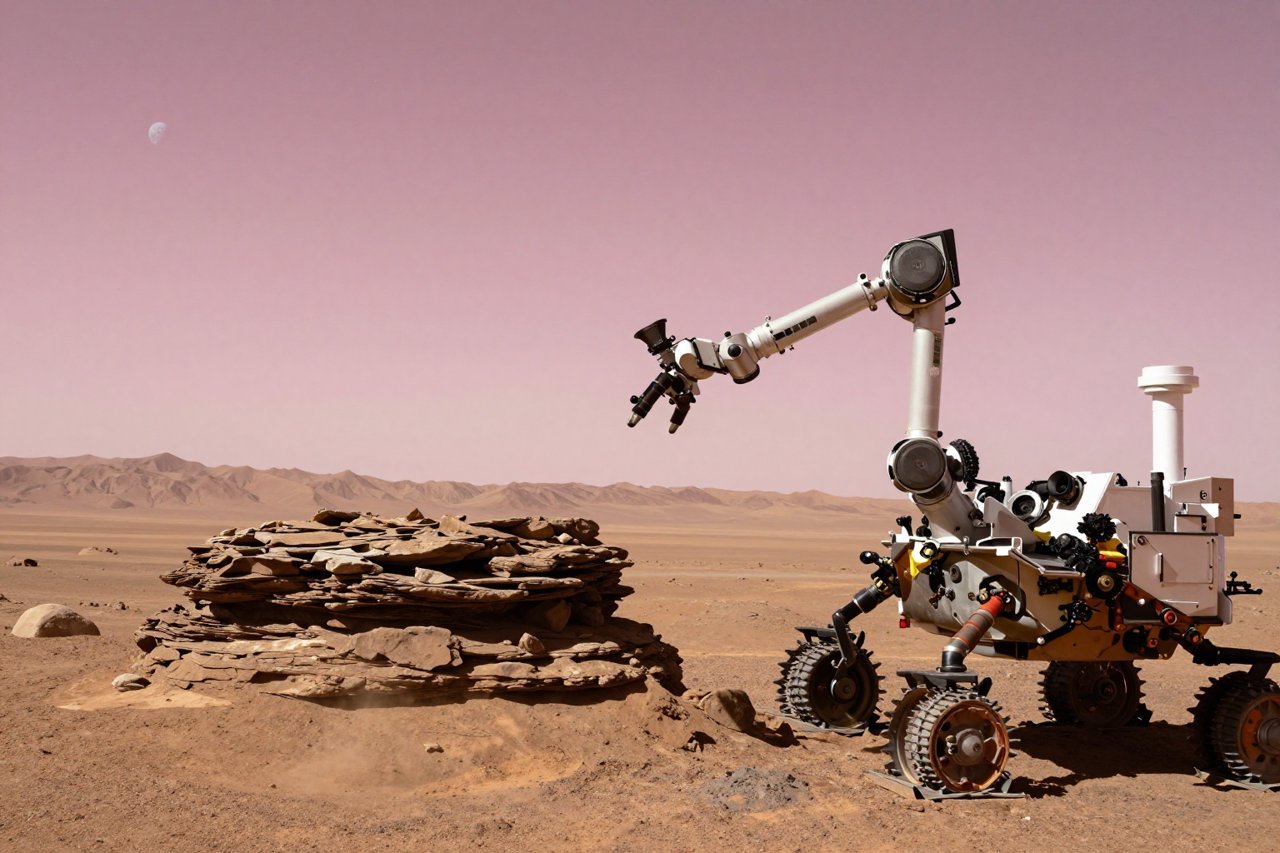
Landing in February 2021, Perseverance is the most advanced astrobiology mission ever sent to Mars. Its job is to collect rock and soil samples that will be returned to Earth by a future mission. The rover is also testing technology for producing oxygen from the Martian atmosphere, a stepping stone for human exploration.
China’s Zhurong Rover
China’s first Mars rover, Zhurong, touched down in 2021 and has been exploring Utopia Planitia. It carries ground-penetrating radar to search for subsurface water and ice. The mission signals China’s growing role in planetary science.
ESA’s ExoMars Rosalind Franklin
Originally scheduled for 2022 but delayed, the Rosalind Franklin rover will drill up to two meters deep—deeper than any previous rover. This is crucial because the Martian surface is bombarded by radiation, which can destroy organic molecules. Below the surface, any signs of life might be better preserved.
The Big Question: Could There Be Life Today?
Most astrobiologists agree that if life ever existed on Mars, it was likely microbial and probably lived during the wetter, warmer Noachian period (about 4.1 to 3.7 billion years ago). But could there be life on Mars right now? Some extremophiles on Earth survive in environments that resemble Mars: dry valleys in Antarctica, deep subsurface aquifers, or salt crystals. It’s possible that Martian microbes adapted to the harsh conditions, perhaps living in underground water pockets or within rocks where radiation can’t reach.
However, the surface of Mars is incredibly hostile. It’s bombarded by ultraviolet radiation, has very low atmospheric pressure, and temperatures can plunge to -100°C at night. Any surface life would have to be dormant or highly protected. The search for extant life focuses on subsurface environments, where conditions are more stable and water might still be liquid.
What Would It Mean If We Found Life?
Finding any form of life on Mars—even extinct microbes—would be one of the most profound discoveries in human history. It would prove that life is not unique to Earth and that the universe could be teeming with biology. On the flip side, it would raise urgent questions about planetary protection: how do we ensure we don’t contaminate Mars with Earth life, or bring Martian life back to Earth safely?
There’s also the philosophical impact. If life arose independently on two planets in one solar system, it suggests that life emerges easily given the right conditions. That would dramatically increase the odds of finding life elsewhere—on Europa, Enceladus, or exoplanets in the habitable zone.
The Road Ahead: Sample Return and Human Missions
The next big step is Mars Sample Return, a joint NASA-ESA campaign to bring Perseverance’s collected samples back to Earth in the early 2030s. Analyzing these samples in laboratories with the most sensitive instruments could reveal definitive evidence of past life. Meanwhile, private companies like SpaceX are developing Starship to send humans to Mars within the next decade.
Human explorers would enable real-time fieldwork, drilling deeper and covering more ground than any rover. But they also bring contamination risks. Strict protocols will be needed to keep Mars pristine for scientific study.
As we gear up for these ambitious missions, the question of life on Mars remains open. Each piece of evidence—a methane spike, a fossil-like texture, an organic molecule—adds a brushstroke to a portrait that is still emerging. Whether we find life or not, the journey is reshaping our understanding of life’s place in the cosmos.


