
[ad_1]
Key Points
- B.E. Meyers & Co. will debut the VSLAP-V1 near-infrared laser system at SOF Week 2026 in Tampa, Florida, May 18-21, at Booth 1153.
- The VSLAP-V1 uses patented DeathStar technology co-aligning six laser diodes to produce up to 1.21 watts of output for air-to-ground targeting and illumination.
B.E. Meyers & Co. is heading to SOF Week 2026 in Tampa, Florida, with a new high-power laser targeting and illumination system in tow. The Redmond, Washington-based defense technology manufacturer will unveil the VSLAP-V1 at Booth 1153 when the special operations community’s premier annual gathering opens May 18, positioning the device as the next generation of a product line that has equipped American and allied special operations forces for more than three decades.
The Redmond, Washington-based defense technology manufacturer has built its reputation on near-infrared laser systems since the 1993 introduction of the IZLID, a high-powered laser pointer and illuminator that became standard equipment for some of the most demanding targeting roles in the U.S. military.
Tactical Air Control Parties, Combat Control Teams, Joint Terminal Attack Controllers, Special Operations Terminal Attack Controllers, Air Naval Gunfire Liaison Companies, and Joint Fires Observers have all relied on IZLID systems for air-to-ground integration and communication, according to B.E. Meyers’ product documentation. That customer list represents the specialists responsible for calling in airstrikes, coordinating close air support, and directing naval gunfire in the most complex and contested environments the military operates in, and the tools they use to mark targets and communicate with aircraft overhead are not a peripheral concern but a critical link in the chain between a ground force and the firepower available to support it.
– ADVERTISEMENT – CONTINUE READING BELOW –
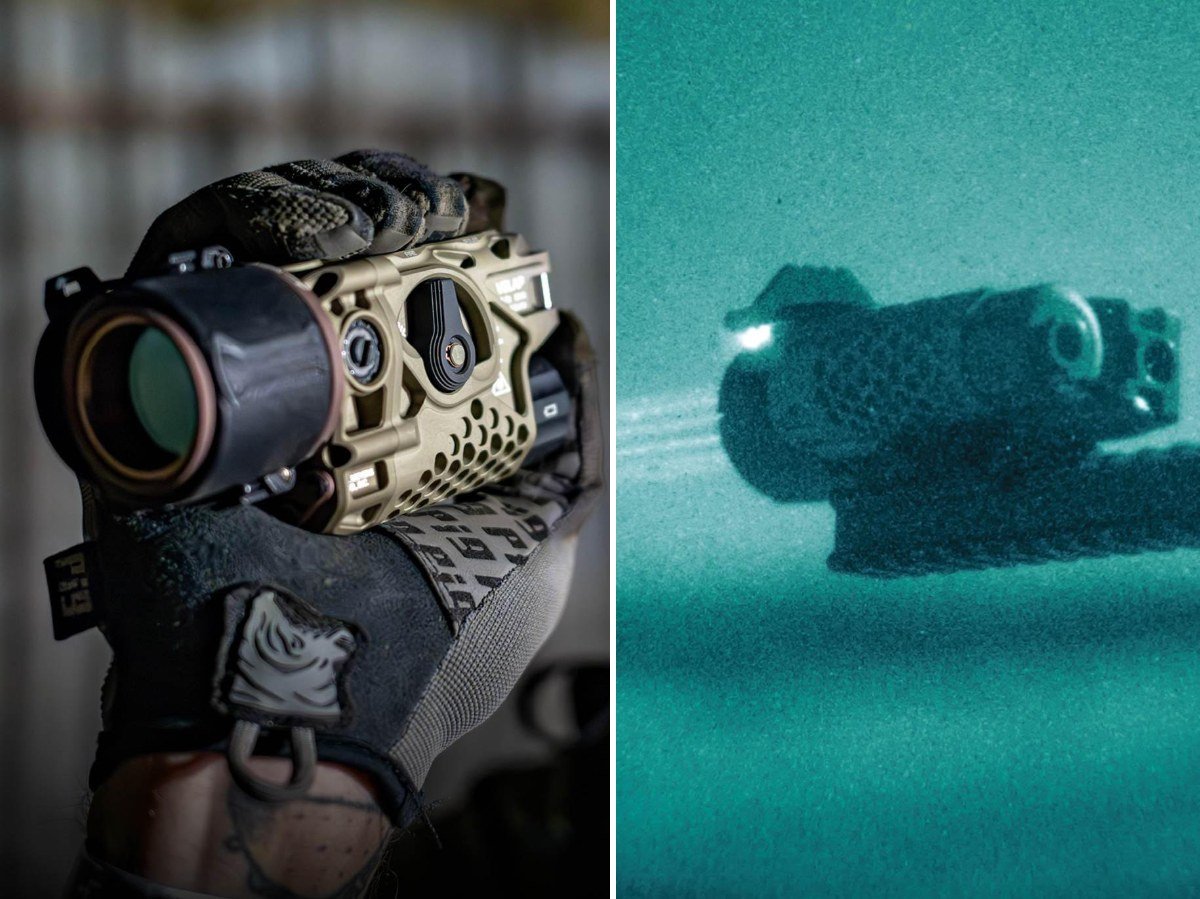
The VSLAP-V1 builds on that legacy through what B.E. Meyers calls DeathStar technology, a patented system that co-aligns six individual laser diodes into a single concentrated beam, producing up to 1.21 watts of near-infrared output, according to the company’s press release. The physics behind the design address a limitation inherent to individual laser diodes: as a single beam travels downrange, its profile remains relatively narrow, which constrains how visible it is to aircraft at high altitude and how evenly it illuminates a target area. By co-aligning six diodes, B.E. Meyers creates a combined beam that diverges over distance in a way that produces a significantly larger profile than a single-source system at equivalent power levels, improving visibility for high-altitude aircraft while simultaneously improving illumination consistency on the target. As the six beams diverge and begin to overlap downrange, they compensate for the inconsistencies inherent in individual edge-emitting laser diodes, producing a more uniform illumination pattern in the system’s 2.5-degree flood mode, per the company’s technical description.
That flood mode is operationally significant in a way that the technical specification alone does not fully convey. When a JTAC or TACP needs to illuminate a target area for an attacking aircraft rather than simply point at a specific spot, the quality and uniformity of the illumination directly affects how clearly the aircrew can identify what they are looking at through their night vision and targeting systems. Inconsistent or hot-spotted illumination can create ambiguity at the exact moment when clarity is most critical, and the DeathStar system’s beam overlap compensation is designed to eliminate that problem, according to B.E. Meyers.
The VSLAP-V1’s ergonomic design reflects lessons accumulated across decades of fielded IZLID use in combat conditions, where even small design compromises in weapon-mounted equipment become significant problems under the physical and cognitive demands of close combat. The device supports single-handed operation, with a power lever positioned for thumb access that cycles through four output settings: off, low, medium, and high. Two fire buttons sit at the top of the device in a natural finger position, one for constant-on operation and one for pulse modes at 2Hz, 5Hz, and 10Hz frequencies, plus an arrhythmic pulse setting. Beam divergence switches between pointer and flood configurations with a one-eighth turn of the front collar, a mechanical simplicity that matters when an operator needs to transition between modes quickly and under stress, per the company’s product description.
Weapon system integration is addressed through azimuth and elevation adjustment capability for crew-served weapons and rotary wing aircraft platforms, alongside a proprietary Wakizashi port that enables simultaneous remote control, power supply, and data transfer. That port allows a single operator to activate the laser while firing a weapon system, removing the coordination problem that arises when a laser device requires dedicated hand operation that cannot be combined with firing controls. Remote setting adjustments through the Wakizashi port extend that integration further, allowing operators to modify the laser’s output and mode without breaking their grip on a weapon system.
The near-infrared spectrum that the VSLAP-V1 operates in is invisible to the naked eye but clearly visible through the night vision devices and targeting systems that modern military aircraft and ground forces use routinely, making it the standard medium for covert target marking, ground-to-air communication, and friend-or-foe identification in low-light operations. An operator pointing a near-infrared laser at a target can communicate its location to an aircraft crew overhead without that signal being visible to anyone without a night vision device, a basic operational security advantage that has made high-power near-infrared lasers indispensable to special operations and conventional forces alike.
[ad_2]
Source link


