
Table of Contents
A 380-square-foot studio can absolutely hold a pet. What it can’t hold is a pet whose needs you underestimated. Most small-space advice obsesses over floor area, and that’s the least useful number in the whole conversation. The ones that actually decide whether it works are hours per week, monthly cost, noise level at 6 a.m., and how much mess the animal creates in a room you also sleep in.
A pair of guinea pigs in a one-bedroom flat with someone who’s home most evenings will be far better off than a border collie in a big house with an owner who’s out twelve hours a day. Square footage is a constraint. Time is the real budget.
Start With the Commitment, Not the Square Metres
Before you look at a single species, be honest about the shape of your week. A hamster needs 20 minutes of handling most days and a cage clean once a week. A cat needs litter scooped daily, play sessions, and vet visits. A dog needs walks in the rain whether you feel like it or not.
If your schedule is genuinely tight, it’s worth reading up on pets that suit a busy schedule before you fall in love with a breed photo. The overlap between “small” and “low-maintenance” is smaller than most people assume. A betta fish is both. A dachshund is neither.

Small-Space Pets That Genuinely Thrive Indoors
Guinea pigs
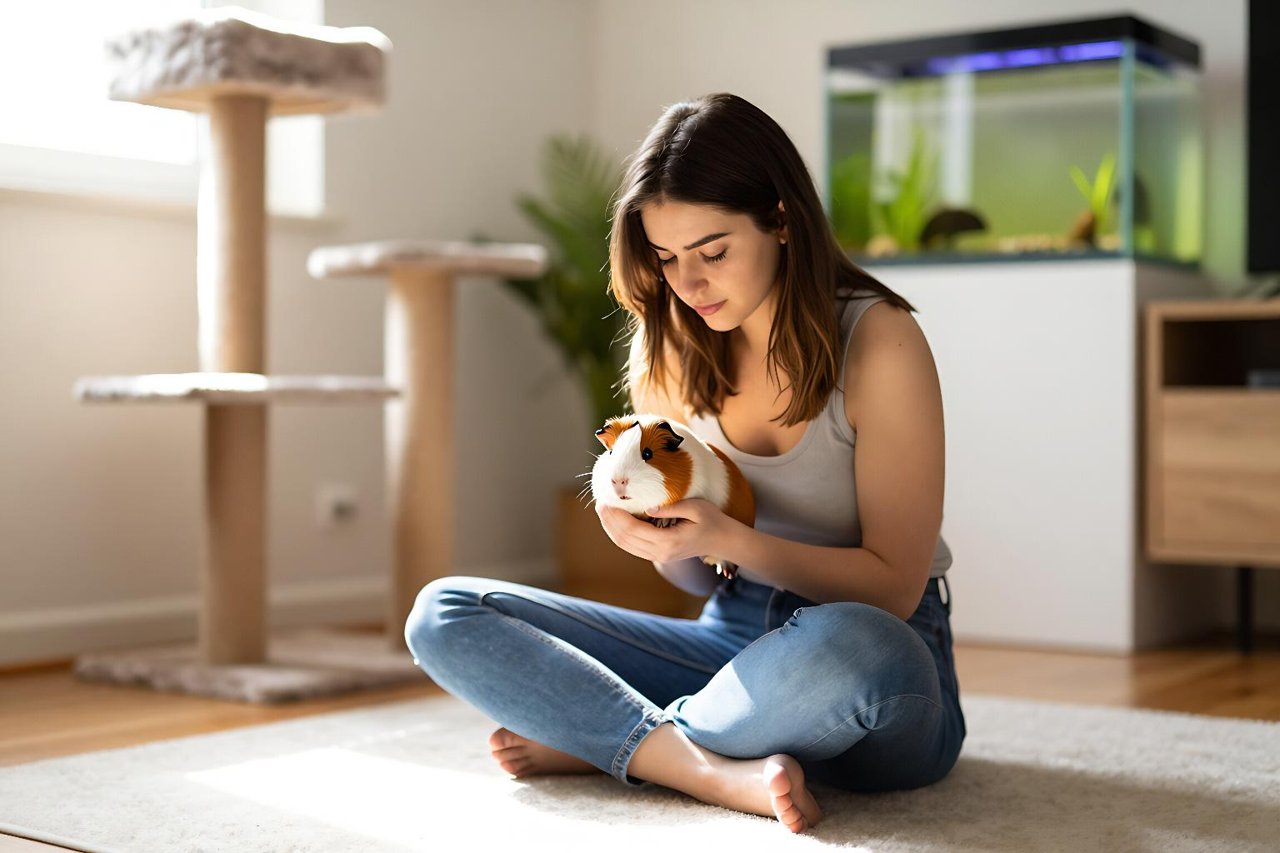
Two guinea pigs need roughly 7.5 square feet of unbroken floor space, which is a 2×4 grid cage rather than anything you’ll find in a pet shop aisle. They’re herd animals, so a single guinea pig is a stressed guinea pig. Budget five to seven years of commitment, an exotic-trained vet, and a noise level that’s surprisingly loud for something so small. They wheek at the sound of the fridge opening. Every time.
Hamsters
The classic beginner mistake is the colourful cage with tubes. A Syrian hamster wants at least 600 square inches of continuous floor space and 8 to 10 inches of bedding to burrow in. They’re solitary, so no companion needed, and they’re nocturnal, which means a wheel spinning at 2 a.m. if the cage is in your bedroom. Lifespan is short at two to three years, which is either a mercy or a heartbreak depending on how you look at it.
Bettas and other small fish
A betta needs five gallons minimum, a heater holding 78 to 80°F, a filter, and a 25% water change each week. Bowls are a myth that refuses to die. Do it properly and you get a three-to-five-year pet that takes up less counter space than a microwave and never makes a sound.
Leopard geckos
A 20-gallon long tank sits neatly on a sideboard and holds one adult gecko comfortably. They’re docile, don’t need UV lighting if supplemented correctly, and live 15 to 20 years, which is a genuinely long relationship for something the size of a marker pen. The catch is live crickets in your kitchen and a thermostat you can’t cheap out on.
Fancy rats deserve a mention too: brilliant, trainable, and affectionate, but they need a tall cage and most of them only live two to three years.
Cats: The Obvious Answer, With Caveats
Cats are the default small-home pet for good reason. They use vertical space, so a couple of wall shelves and a tall scratching post effectively double the room. Two cats in a studio works if you follow the rule of one litter box per cat plus one, and if you actually scoop them daily. Skip that and the whole flat smells like it within a week.
The part people underestimate is stimulation. An under-stimulated indoor cat will redecorate your curtains and start yowling at 4 a.m. Ten minutes of wand-toy play twice a day prevents most of it. If you’re living solo and worried about the animal being lonely while you work, there’s a solid case for a bonded pair, and pets for people who live alone covers that trade-off in more depth.
Small Dogs That Don’t Treat a Studio Like a Sprint Track
A small dog is not automatically a small-space dog. Terriers bark. Herding breeds pace. What you want is a dog that settles, and settling is trained rather than bred, though some breeds get there faster.
Cavalier King Charles spaniels, shih tzus, Boston terriers and miniature poodles all handle apartment life well. They’re in the 10 to 18 pound range, which means a 25-minute walk twice a day genuinely tires them out. A tired dog is a quiet dog; that single principle solves most neighbour complaints. French bulldogs are popular for flats but come with breathing issues and insurance bills that reflect it.
If there are children in the household, temperament matters more than floor area, so it’s worth checking which dog breeds suit family life before choosing on size alone. And plan the holidays early. A dog in a small flat still needs care when you travel, and finding a dog sitter you actually trust takes longer than most people expect.
Exotic Options and the Paperwork Nobody Mentions
Some of the smallest pets come with the largest administrative footprint. Certain reptiles, amphibians and invertebrates need permits at state level, and the rules vary wildly depending on where you live. If you’re drawn to something unusual, read what owning an exotic pet really involves first. Enclosure requirements, live-food supply chains and specialised vet bills are the parts the internet skips.
What Small Spaces Punish You For
Every pet has a hidden cost that a small home amplifies. Guinea pig shavings travel. Reptile heat lamps warm the whole room in July. Aquarium filters hum. Hamster wheels squeak. None of these are dealbreakers, but in 400 square feet you can’t escape any of them, so pick the mess you can live with rather than the animal you like most in a photo.
Noise is the one that gets people evicted. Parakeets, for all their charm, are loud and messy in a way that carries through walls. A single betta is silent. That’s a genuine lifestyle difference, not a small detail.
Questions Worth Answering Before You Bring Anything Home
- Where does this animal live at 2 a.m.? If the answer is “next to my pillow,” sleep through a recording of its noise first.
- Where does the enclosure go? Measure the actual footprint, including the space you need to open the lid and clean it.
- Who covers the vet bill? Exotics vets often charge more than a standard clinic, and not every practice takes reptiles or small mammals.
- What happens in a heatwave, a move, or a holiday? Small pets still need a plan, and fish tanks don’t travel well.
- Can you commit for the full lifespan? Three years for a hamster, 20 for a gecko, and up to 18 for a cat.
The honest test is simple. Imagine the worst week of your year, the one where you’re ill, working late and behind on everything. Whatever you’re considering, ask whether you’d still manage its basic care on day four of that week. If the answer is yes, you’ve found the pet that fits your space, not just the one that fits your floor plan.


