
[ad_1]

Daddy longlegs are actually bloodthirsty killers—of frogs
The wobbly, lanky arachnids known as harvestmen or daddy longlegs may be overlooked as predators of small vertebrates such as frogs, researchers say
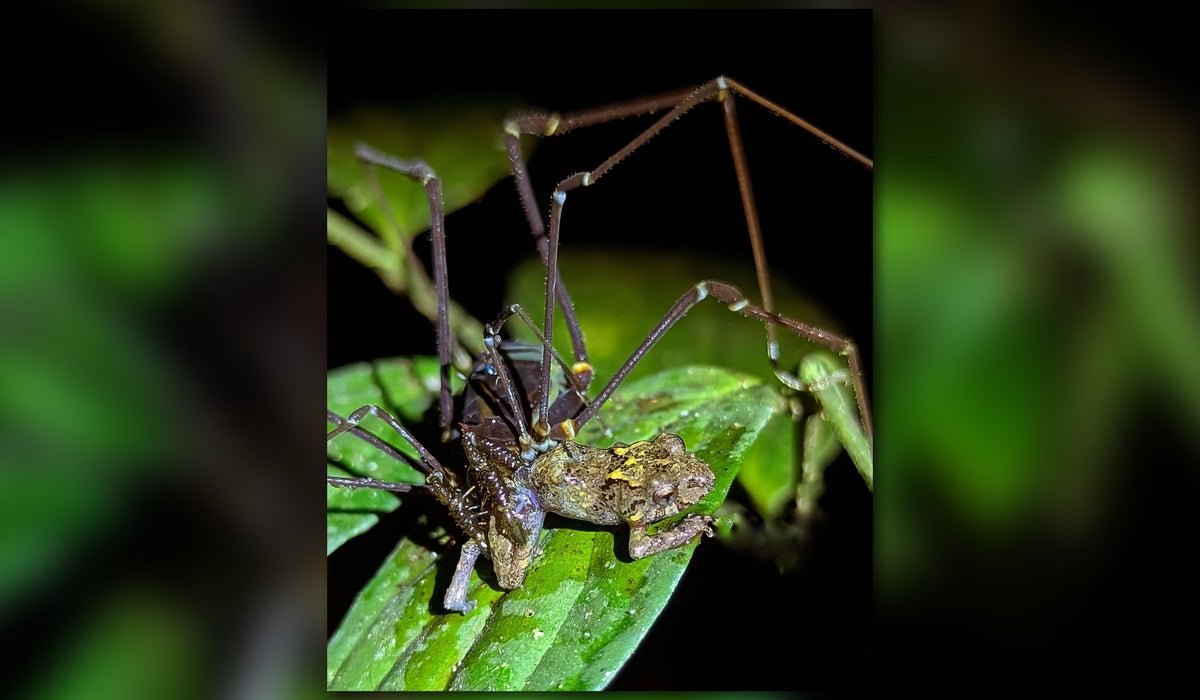
A species of Phareicranaus harvestman consuming a Pristimantis frog.
Daddy longlegs haven’t been considered predators of much of anything, let alone vertebrates. But a new study published recently in Ecology and Evolution has compiled observations showing that the gangly arachnids (also called harvestmen) have an appetite for flesh—or at least for frog legs.
“We were shocked,” says study co-author Luís Fernando García, an arachnologist at the University of the Republic in Uruguay. “The literature often says that harvestmen are omnivores, that they are slow, they are weak.”
Some of the earliest evidence challenging that idea came in 2008, when García’s co-author Osvaldo Villarreal—an arachnologist at the Venezuelan Institute for Scientific Research—and other researchers reported a harvestman chowing down on a rain frog in a Venezuelan national park. Seeing the photos and videos of a harvestman pinning down a struggling frog was “a real wow moment,” Villarreal says.
On supporting science journalism
If you’re enjoying this article, consider supporting our award-winning journalism by subscribing. By purchasing a subscription you are helping to ensure the future of impactful stories about the discoveries and ideas shaping our world today.
About a decade later, another research team in Brazil encountered a harvestman eating a frog. Then, other co-authors on the new study found multiple harvestmen species feeding on frogs in Ecuador and Colombia between 2020 and 2025. “We found that it might be not so occasional that harvestmen could prey upon frogs,” García says.
The team compiled known sightings of frog-eating harvestmen and found that many of these events involved frogs that were still alive, which hints that the daddy longlegs might be hunting rather than scavenging, García says.
It’s still unclear how the somewhat unathletic arachnids are capturing strong, leaping prey, particularly because they don’t have venom like their spider and scorpion relatives do. Their primarily pinching mouthparts are typically used to nibble at very small insects, fungi and plants, says Jose Valdez of the German Center for Integrative Biodiversity Research, who was not involved with the new paper.
Many tropical harvestman species like those in the study are larger and burlier than their temperate kin, which makes the occasional amphibian feast more feasible. And the study authors suggest that some harvestmen species may rely on their armored exoskeleton and spined appendages for restraining struggling frogs. But they are relatively understudied.
“There is so much we don’t know about them despite them being in so many backyards and forests all over the world,” Valdez says.
For García, the findings hint that our understanding of harvestmen behavior may be biased towards species living in temperate latitudes. In the tropics, food webs are less unidirectional—vertebrates that normally eat invertebrates such as insects and arachnids can easily find the tables turned.
It’s Time to Stand Up for Science
If you enjoyed this article, I’d like to ask for your support. Scientific American has served as an advocate for science and industry for 180 years, and right now may be the most critical moment in that two-century history.
I’ve been a Scientific American subscriber since I was 12 years old, and it helped shape the way I look at the world. SciAm always educates and delights me, and inspires a sense of awe for our vast, beautiful universe. I hope it does that for you, too.
If you subscribe to Scientific American, you help ensure that our coverage is centered on meaningful research and discovery; that we have the resources to report on the decisions that threaten labs across the U.S.; and that we support both budding and working scientists at a time when the value of science itself too often goes unrecognized.
In return, you get essential news, captivating podcasts, brilliant infographics, can’t-miss newsletters, must-watch videos, challenging games, and the science world’s best writing and reporting. You can even gift someone a subscription.
There has never been a more important time for us to stand up and show why science matters. I hope you’ll support us in that mission.
[ad_2]
Source link


