
Table of Contents
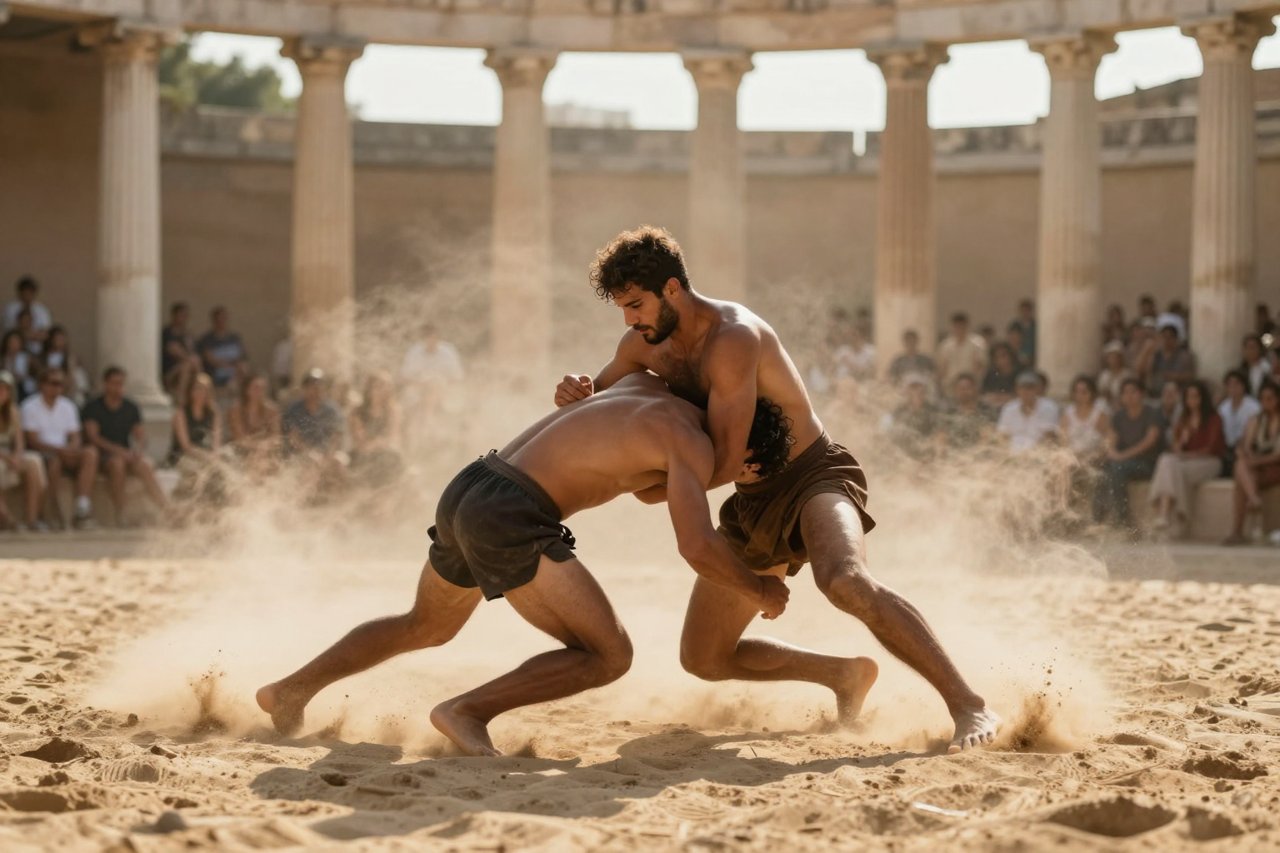
A crowd packed the sanctuary at Olympia in 648 BC to watch two men try to maim each other with their bare hands. The event was pankration, and its rulebook was almost insultingly short. Biting and eye-gouging were forbidden. Nearly everything else was fair game, including joint breaks, strangulation, and kicking a man on the ground in the head.
Pankration is one of many fighting systems designed for something far grimmer than a title belt. Tracing the deadliest martial arts in history means looking past the dojo and the scorecard, back to a time when a fighting style survived because the people who used it lived and the people who didn’t were buried.
Deadly by whose standard?
The word “deadly” is slippery. A world-class wrestler is helpless against a man with a spear at ten paces. A boxer with 50 knockouts is helpless in a dark alley against someone holding a broken bottle. So the ranking depends on context: on the battlefield, the ring, or the street.
Three things separate a lethal system from a sportive one. Weight classes, rules that forbid the most damaging techniques, and the invention of safety equipment have all softened combat over the last 150 years. The arts below existed before most of those guardrails. Some still do without them.

Pankration: the closest the ancient world got to no rules
The name comes from the Greek pan (all) and kratos (power). Pankratiasts trained in a combination of boxing and wrestling, with an added menu of chokeholds, elbow strikes, knee strikes, and standing joint locks that could cripple an arm for life. There were no weight divisions and no time limits. A match ended when one man raised a finger in surrender or could not get up.
The most famous bout has no winner in the ordinary sense. In the 564 BC Olympic final, the older Arrhichion of Phigalia was caught in a hold that was killing him. Before he died, he twisted his opponent’s foot hard enough to break it. The other man submitted. Arrhichion’s body was crowned victor posthumously.
Sparta produced excellent pankratiasts but famously avoided the Olympic combat events. Surrender was considered unacceptable in Spartan society, which meant a Spartan fighter either won or died in the sand.
Kalaripayattu and the whip-sword of Kerala
In Kerala, India, training takes place in a kalari, a rectangular pit dug roughly a metre deep and filled with red laterite soil that is ritually maintained. Written references to the art appear around the 3rd century BCE, and its oral tradition claims an origin far older.
What makes kalaripayattu remarkable is the progression. Students learn unarmed strikes and grappling first, then a wooden staff, then blades, and finally the urumi: a flexible sword made of thin steel strips that coils like a belt and can be worn against the body. A blade with no rigid spine is nearly impossible to anticipate, and its users reportedly wrapped one around their own neck and shoulders in close quarters. It is among the most difficult weapons in the world to wield and to defend against.
The Japanese battlefield arts before karate
The katana gets the film roles, but on a Japanese battlefield the yari (spear) and the bow did most of the killing. Sojutsu trained men in massed formations, while kyujutsu was the mounted archer’s discipline. Swordsmanship (kenjutsu) was a sidearm skill, and jujutsu emerged because armored men could not punch through plate. Instead they threw, locked joints, and stabbed at the gaps in the armor with a tantō.
Firearms rewrote the rules. At Nagashino in 1575, roughly 3,000 arquebusiers firing in rotating volleys broke a cavalry charge that had been considered unstoppable. Two centuries of peace under the Tokugawa shogunate then turned warriors into administrators, pushing swordsmanship into duels and formal schools. The killing arts became a philosophy, and the sharpest edges were deliberately blunted.
Filipino blade arts: Kali, Eskrima, Arnis
When Ferdinand Magellan landed in the Philippines in 1521, he was killed at Mactan by warriors led by Lapulapu. The fighting systems behind that resistance were built around blades and sticks from the very first lesson.
Kali, eskrima, and arnis are related terms for a family of systems that teach knife and machete work before empty hands. Footwork is angular, cutting off the attacker’s line while delivering counter-strikes to the wrist, forearm, and throat. When Spanish authorities restricted bladed weapons, practitioners moved their training into wooden sticks, which is why so many escrima drills today are stick drills. On Mindanao, Moro fighters held out against colonial armies for more than three centuries, and their close-quarters blade work was a large part of the reason.
Muay Boran and Lethwei: Southeast Asia’s striking arts
Muay boran is the ancestor of modern Muay Thai. Fighters in the older era bound their hands in hemp rope, sometimes dipped in resin and ground glass, and fought without weight classes or modern padding. The legendary fighter Nai Khanom Tom is said to have defeated ten Burmese opponents in a row in 1774 after being captured in war.
Myanmar’s Lethwei is the direct modern descendant of that world, and it remains one of the most dangerous competitive arts on earth. Fighters wear only tape and gauze on their hands. Headbutts are legal. Elbows, knees, and throws are all on the table. Traditional Lethwei had no point scoring at all, so the only reliable way to win was to knock the other person unconscious. Boxing, kickboxing, and MMA all banned the headbutt long ago. Lethwei kept it.
Dambe and the Nguni stick fighters
In northern Nigeria, Hausa men have fought dambe at harvest festivals for centuries. The dominant hand is wrapped in tightly bound rope and cloth, forming what fighters call the spear; the other hand serves as the shield. Historically the wrapping could include broken glass or nails. Knockouts in the first three rounds are common, and a fighter who drops his guard for half a second usually learns why the hard way. Modern dambe has weight classes and a proper ring, yet it remains brutally raw.
Further south, Nguni stick fighting paired a knobkerrie and a small shield. Shaka Zulu turned related skills into a military revolution by replacing the throwing spear with a short, heavy stabbing spear called an iklwa and drilling troops in the bull-horn formation. Nguni stick fighting is still practiced across southern Africa as both sport and rite of passage.
What actually made these systems lethal
- Weapon-first training. The hand-to-hand work existed to buy time until a blade, stick, or spear could be reached.
- No weight classes. A 60 kg fighter might face a 100 kg opponent, so techniques had to target eyes, throat, groin, and knees rather than rely on power.
- Pressure testing that cost something. Sparring happened, but it happened hard and often without the safety gear that lets modern athletes train five days a week.
- Real consequences. A system that failed its user was not refined over generations; it was buried with him.
- Terrain and clothing shaped everything. Armor, robes, sandals, mud, and narrow streets produced techniques that make no sense on a padded mat.
What survives, and what got dropped
Modern MMA rebuilt a rough approximation of pankration: minimal rules, multiple ranges, and real resistance. Lethwei has grown a genuine international following in the last decade, largely because it kept the techniques everyone else removed. Filipino blade systems are now standard instruction in military combatives programs across several countries, and kalaripayattu still draws students to Kerala’s pits.
What disappeared is the part that made these arts lethal in the first place: the assumption that the other person wants you dead and has a weapon. A modern practitioner can learn the mechanics of a pankration choke or an escrima disarm in a safe gym, but the mechanics were never the hard part. The hard part was training under conditions where the technique had to work once, immediately, against someone who was willing to break you to win. That is the gap no modern sport has fully closed.


