
Table of Contents
Every vet clinic has a version of the same phone call: a dog just ate something it shouldn’t have and the owner wants to know whether to panic. The honest answer depends on three things — what the food was, how much went down, and how big the dog is. A chocolate truffle is a stomach ache for a 40 kg labrador and a genuine emergency for a 3 kg chihuahua.
So rather than a vague “keep human food away from dogs”, here is the real list, with the reasons behind each entry and the numbers that actually matter.
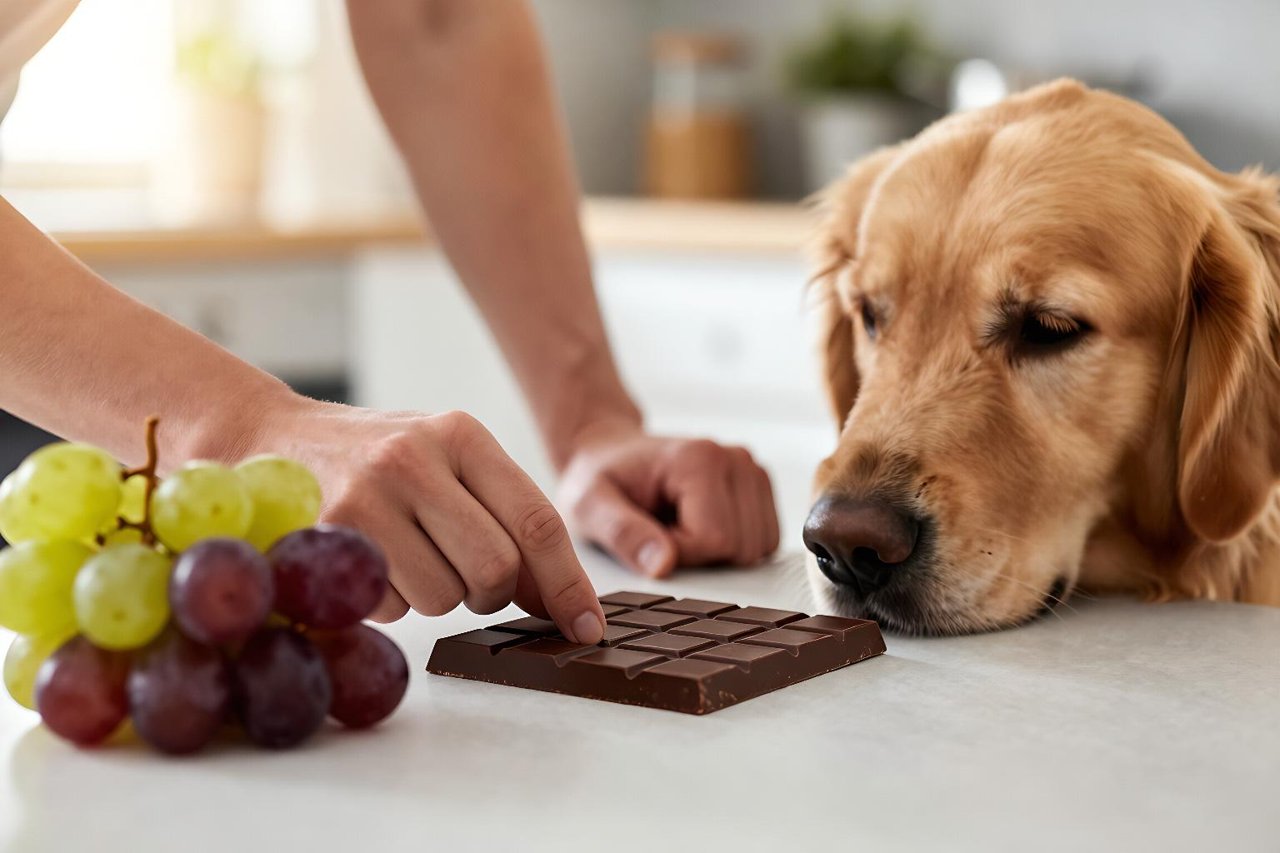
Chocolate: darker means more dangerous
Theobromine and caffeine are the problem, and dogs clear both from their system far more slowly than we do. Roughly speaking, mild signs (vomiting, restlessness, a racing heart) start at around 20 mg of theobromine per kilogram of body weight. Seizures and heart arrhythmias tend to appear above 40–50 mg/kg.
White chocolate is mostly cocoa butter and barely registers. Milk chocolate runs about 45–60 mg per ounce. Dark and semisweet sit nearer 150 mg per ounce. Unsweetened baking chocolate jumps to roughly 400 mg per ounce, and cocoa powder is more concentrated still.

What that looks like in practice: for a 10 kg dog, about 100 g of milk chocolate is where you pick up the phone. That same dog only needs 40 g of dark chocolate, or a couple of squares of baker’s chocolate, to land in the danger zone. Remember the cocoa mulch in the garden too — it hits harder than most sweets.
Xylitol: the one that surprises people most
This sugar alcohol is in chewing gum, mints, sugar-free sweets, some toothpastes, gummy vitamins and a growing number of “low sugar” peanut butters. In dogs it triggers a massive insulin release. Blood sugar can crash within 20 to 30 minutes, and at higher doses it causes liver failure.
Rough thresholds: about 0.1 g per kg causes hypoglycaemia, and around 0.5 g per kg is where liver injury becomes likely. A single piece of gum can hold anywhere from 0.2 g to over 1 g of xylitol, so for a small dog one or two pieces is a genuine emergency.
Check the ingredient list on any nut butter before you stuff a pill in it. Brands marketed as sugar-free or low-carb are exactly the ones to be wary of. If the label says xylitol, birch sugar, or E967, it doesn’t go near the dog bowl.
Grapes and raisins
There is no known safe dose. The toxic principle is thought to be tartaric acid, and reactions are wildly inconsistent — some dogs eat a handful of grapes and are fine, while others go into acute kidney failure after three raisins. Raisins, sultanas and currants are worse by weight because drying concentrates them. Trail mix, fruit cake, hot cross buns and cereal bars are all common culprits.
Kidney damage often doesn’t show up for 24 to 72 hours. Vets typically start intravenous fluids immediately even when the dog looks perfectly normal, because by the time symptoms appear the kidneys have already taken a hit.
Onions, garlic, leeks and chives
All members of the allium family damage red blood cells and can cause haemolytic anaemia. Signs — pale gums, weakness, dark urine — usually appear one to five days later, which makes the connection easy to miss.
Powder is the sneaky version. A teaspoon of onion powder is far more concentrated than a slice of raw onion, and it turns up in stock cubes, gravy granules, soups and leftover takeaway. Garlic deserves a special mention because it’s still pushed online as a natural flea treatment. The toxic dose is high, so a scrap of garlic in a stew is unlikely to hurt a healthy labrador, but if your dog is already anaemic, on certain medication, or very small, it’s a risk you don’t need to take.
Macadamia nuts
As few as two or three nuts can cause hind-limb weakness, tremors and vomiting in a small dog — the toxic dose is around 2.4 g per kg. The good news is that most dogs recover within 48 hours with supportive care. The bad news is that macadamias are usually eaten as part of a mixed nut selection, so chocolate and raisins often come along for the ride.
Alcohol, raw dough and mouldy food
Beer, wine, spirits and boozy desserts hit dogs harder because of their body size. Raw bread dough is a double problem: it expands in the warm stomach and produces ethanol as the yeast ferments, so a dog that eats a bowl of proving dough can end up bloated, drunk and in surgery.
Compost is another one people forget. Mouldy food and grass clippings can harbour tremorgenic mycotoxins, which cause violent whole-body tremors within hours. Keep the bin lid locked and fence off the compost heap.
Caffeine and the everyday extras
Used coffee grounds, tea bags, energy drinks and pre-workout powders all carry enough caffeine to cause vomiting, a racing heart and tremors. A couple of spoonfuls of spent grounds is not a small amount. Energy drinks combine caffeine with sugar and, in some cases, guarana, which compounds the effect.
Then there are the items that are less about toxicity and more about harm:
- Cooked bones — they splinter and can perforate the gut. Raw bones carry their own bacterial risks, so match the bone to the dog and supervise.
- Corn cobs — one of the most common surgical obstructions vets see in late summer.
- Avocado pits — the flesh is mild for most dogs, but the stone is a perfect obstruction shape.
- Fatty trimmings — a plate of roast fat can trigger pancreatitis, which means a hospital stay and a very bland diet afterwards.
- Salty cured meat and crisps — a serious sodium load for a small dog, and a poor idea for any dog with a heart murmur. If your dog has been diagnosed with a heart valve condition, keep salt firmly off the menu.
If your dog eats something on this list
Don’t wait for symptoms. Gather the packaging, estimate how much was eaten, and weigh the dog if you don’t know the number. Then ring your vet or a pet poison helpline. In the US that’s the ASPCA line on 888-426-4435; in the UK, Animal PoisonLine.
Never induce vomiting on your own initiative. It’s the wrong move for sharp objects, petroleum products and anything caustic, and it’s dangerous for a dog that is already lethargic or seizing. Salt water as an emetic has killed dogs. Leave that decision to the professional on the other end of the phone.
Foods that get blamed unfairly
Not everything on a human plate is off limits. Plain cooked chicken, scrambled egg, tinned fish in spring water, carrots, green beans, blueberries and plain yoghurt in small amounts are all fine for most dogs. There’s a decent starting point in this guide to whole foods you can add to your dog’s bowl.
For older dogs or those managing joint pain and inflammation, some ingredients do more than just fill a bowl — this piece on natural anti-inflammatory foods for dogs with chronic conditions covers that ground properly.
Treats, labels and the ten percent rule
Treats should make up no more than about 10% of a dog’s daily calories. A handful of cheese here and a bit of sausage there adds up fast, and the extra weight is what eventually lands dogs at the vet with sore joints and laboured breathing. If your dog has a history of gunky ears or itchy skin, sugary biscuits and heavy carbohydrate treats are worth a second look — there’s a useful explanation of the yeast connection behind recurrent ear infections.
When it comes to the main meal, you don’t need a nutrition degree. Look for a named meat source first on the ingredient list, a guaranteed analysis with a stated protein percentage, and an AAFCO or FEDIAF statement on the pack. This breakdown of how to choose the right pet food walks through the label line by line if you want a shortcut.
Kitchen habits that stop the phone call happening
Most poisonings aren’t dramatic. They happen because a handbag was left on the floor, a child dropped a raisin on the carpet, or a dog counter-surfed a cooling cake. A few small changes close most of those gaps.
Keep chocolate, gum and mints in a closed cupboard rather than a low shelf or a handbag. Put a lidded bin in the kitchen and make sure the compost caddy isn’t reachable. Train the household, not just the dog — visitors are usually the weak link, so tell guests not to feed from the table before they sit down, not after. And keep a note in your phone with your vet’s number, the nearest out-of-hours clinic and the weight of each dog. In an emergency you will not want to be working any of that out from scratch.
It also helps to know what your dog is likely to go for. A Labrador will eat anything that hits the floor; a fussy terrier might turn its nose up at a dropped grape but happily chew a stick of gum. Learn your dog’s particular weakness and treat that one item as the thing that never sits within reach.


