
Table of Contents
In 2008, Donnie Yen pulled on a grey cotton jacket, chain-smoked his way through a Foshan teahouse, and turned a sixty-something Wing Chun teacher into a global action icon. That teacher was Ip Man. Wilson Yip’s film made a fortune across Asia, spawned three sequels and a spin-off, and helped push Wing Chun class enrolments up in Hong Kong, London and Los Angeles. It also invented a Japanese general who never existed.
That’s the bargain with martial arts movies based on real fighters. The good ones capture something true about a person’s style, temperament or era, then bend the timeline until it snaps. Knowing where the seams are makes the films more enjoyable, not less. Here’s a tour through the best of them, and a look at what each one does with the record.
Ip Man and the Wing Chun Myth Machine
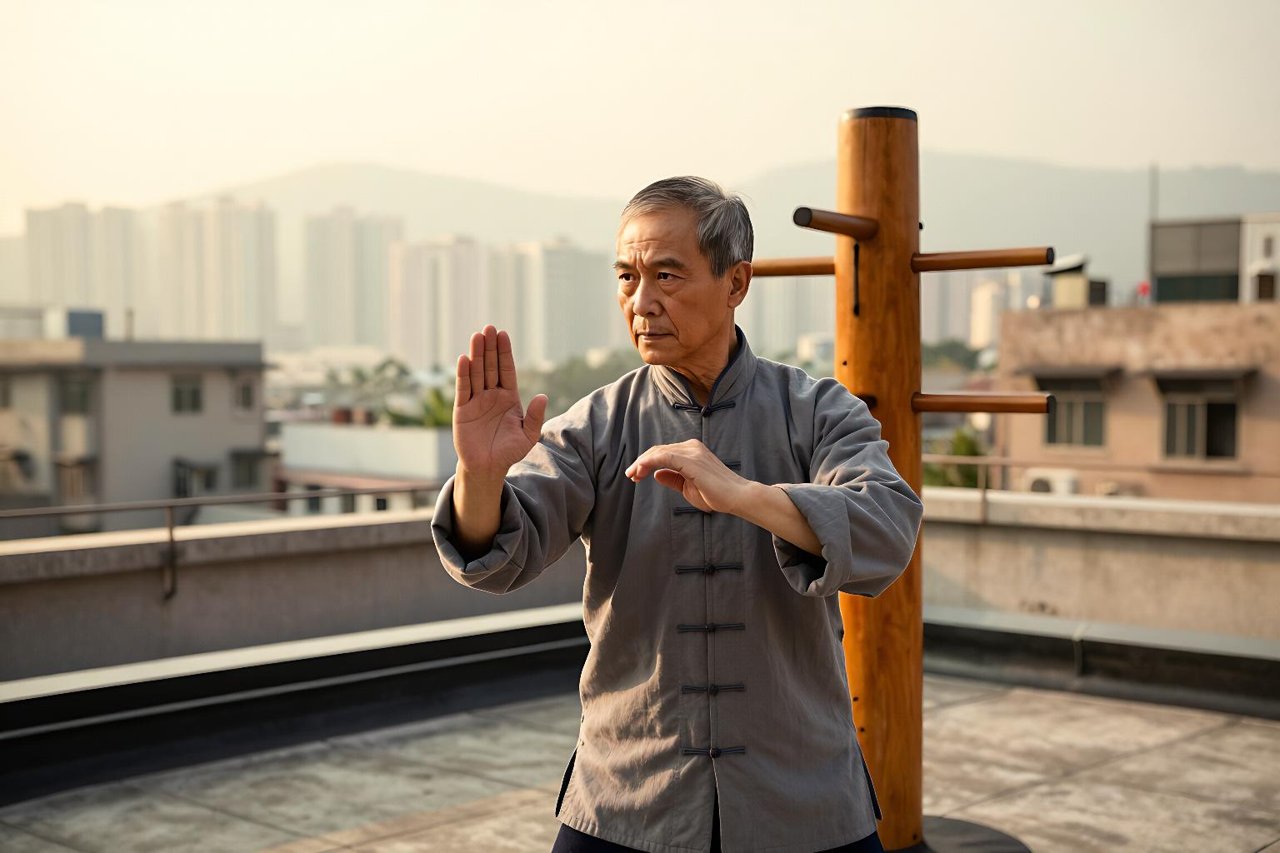
The real Ip Man was born in Foshan in 1893, worked as a police officer, lived through the Japanese occupation, and fled to Hong Kong in 1949 with almost nothing. He opened a rooftop school in Kowloon, taught a teenager named Bruce Lee, and died of throat cancer in 1972. Biographers describe a sharp, pragmatic man who also carried an opium habit during his early Hong Kong years, a detail the films mostly skip.
What the 2008 film adds is a full invented plot: a Japanese colonel who wants to watch Chinese fighters brawl for sport, and a climactic public beating that turns Ip Man into a symbol of resistance. No such contest is recorded. What the film does get right is the humiliation of occupied Foshan and the hunger students had for a hero who represented something.

The Grandmaster (2013)
Wong Kar-wai spent the better part of a decade researching and shooting. The result is less a biography than a meditation on lineage and loss. Tony Leung trained for years to manage the signature chain-punch sequences. The rain-soaked opening fight is pure invention, and Zhang Ziyi’s Gong Er is a composite character built from the daughters of northern grandmasters.
Ip Man: The Final Fight (2013)
Herman Yau’s version stars Anthony Wong as the older, widowed Ip Man in 1950s Hong Kong. It’s quieter, seedier and closer in spirit to the memoir accounts, showing a man teaching out of a cramped flat and struggling with family obligations. For viewers who want the least fantastical of the four, start here.
Fearless and the Death of Huo Yuanjia
Huo Yuanjia (1868 to 1910) founded the Chin Woo Athletic Association in Shanghai, an organisation that broke with tradition by teaching martial arts publicly to paying students from all backgrounds. He died at forty-two under circumstances historians still argue about; illness, overtraining and poisoning have all been proposed.
Ronny Yu’s Fearless (2006) invented almost every dramatic beat, including a young Huo’s murderous grudge and the farming-village exile that never happened. Jet Li called it his last wuxia project and shot it that way, with a stillness in the middle act that none of his earlier films have. The film’s own closing text concedes the story has been dramatised, which is more honesty than most biopics manage.
Mas Oyama Gets a Korean Biopic
Choi Yeong-eui was born in Korea in 1923, moved to Japan, and took the name Mas Oyama. He founded Kyokushin karate in 1964 and became famous for fighting bulls, a spectacle documented in grainy newsreels and endlessly exaggerated in retelling. He also completed a hundred-man kumite, fighting one opponent after another, which sounds like a special-effect scene and actually happened.
Fighter in the Wind (2004) tells his story from a Korean perspective, following the young Oyama as he fights American military police in post-war Seoul and trains in the mountains. Yang Dong-geun’s performance sells the obsessive isolation. The bull fights are dramatised, but the man’s training habits were genuinely that extreme.
Beautiful Boxer and Muay Thai’s Strangest True Story
Nong Toom, born Parinya Charoenphol in 1981, fought at Bangkok’s Lumpinee Stadium with a pink mouthguard and grew her hair long between weigh-ins. She had gender-affirming surgery in 1999 and later returned to the ring as a woman. It’s the sort of story a screenwriter would be told to tone down.
Beautiful Boxer (2003) leans into director Ekachai Uekrongtham’s background in theatre, but the fight scenes are handled by real Muay Thai performer Asanee Suwan, himself a professional fighter. It’s the rare martial arts biopic where the correct decision was to keep the embellishment understated.
Bruce Lee, Twice Removed
Dragon: The Bruce Lee Story (1993) is based on Linda Lee Cadwell’s memoir, which is a decent source, and then throws a literal demon into the mix. The recurring nightmare figure that stalks Bruce is pure invention. The 1964 challenge match with Wong Jack Man in Oakland, a messy fifteen-minute scrap behind closed doors, becomes a rooftop chase across Chinatown. Jason Scott Lee is magnetic anyway.
Bruce Lee, My Brother (2010) takes the opposite approach, built from brother Robert Lee’s recollections and set mostly in 1950s Hong Kong. There’s dancing, street gangs and a young Bruce in a cha-cha contest. The martial arts are beside the point, and that’s what makes it useful.
Wong Fei-hung, the Folk Hero With the Longest Filmography
Wong Fei-hung (1847 to 1925) was a doctor and Hung Gar practitioner who ran the Po Chi Lam clinic in Foshan. He has appeared in well over a hundred films, a run that put the character in the record books. Tsui Hark’s Once Upon a Time in China (1991) turned him into a prototype nineteenth-century intellectual, tangling with foreign gunboats and steam engines.
The 2014 reboot, Rise of the Legend, made a tattooed, brooding Eddie Peng the young Wong. Neither film resembles the doctor with the long fingernails who treated patients in Foshan. The figure has drifted so far from the man that scholars treat him as folklore rather than biography.
Real Fighters in the Ring and the Cage
Not every martial arts biopic involves a sword or a sash. Combat sports have produced some of the most respected films in the genre.
- Raging Bull (1980): Jake LaMotta co-operated with the production and admitted the film captured the emotional truth while compressing four fights into montage.
- Ali (2001): Will Smith trained for a year, and Michael Mann shot the fights from the inside rather than the commentary booth.
- The Fighter (2010): Micky Ward’s corner is played as documentary farce, and Christian Bale’s Dicky Eklund is the film’s centre of gravity.
- Cinderella Man (2005): James J. Braddock’s 1935 title win is retold faithfully enough that his grandchildren acted as consultants.
- The Smashing Machine (2025): Benny Safdie’s take on MMA heavyweight Mark Kerr and his painkiller dependency, built on the 2002 documentary of the same name.
Where These Films Quietly Bend the Record
- Compressed timelines. Years of training collapse into a montage, which makes skill look like a decision rather than a habit.
- Invented antagonists. A real fighter’s opponents are often less dramatic than the era they lived through, so films manufacture enemies with faces.
- Nationalist framing. The Ip Man series turns a teacher into a resistance figure; the Huo Yuanjia films turn a sports administrator into an avenger.
- Selective biography. Addictions, political misjudgements and family abandonment tend to go missing.
Pair Each Biopic With a Primary Source
Treat the films as trailers for the real material. Matthew Polly’s 2018 biography Bruce Lee: A Life is the corrective to Dragon and reads like a thriller. For Mas Oyama, the surviving footage of the hundred-man kumite is more gripping than anything a stunt team could stage. Wong Fei-hung fans should read the 1930s serialised stories that inspired the first wave of Cantonese films.
For Mark Kerr, watch the 2002 documentary first, then Safdie’s dramatisation; the pair work far better as a double bill than either does alone. And if you only have time for one film that walks the line between myth and fact most gracefully, take Ip Man: The Final Fight and then read up on what the rooftops of Kowloon were really like. The truth is scruffier, and more interesting, than the jacket with the creases pressed into it.


