
Table of Contents
A single root has been dug from mountainside forests, traded for more than its weight in silver in seventeenth-century China, and now sits in gas-station energy shots alongside $80 tubs of powdered supplement. That range says a lot about how ginseng is understood, and how much of that understanding is commercially convenient.
The short version: ginseng means a small group of plants in the genus Panax, not one ingredient. Different species do different things, the way the root is processed changes its chemistry, and the evidence base is thinner than the packaging implies — though it is not empty.
What counts as ginseng, and what doesn’t
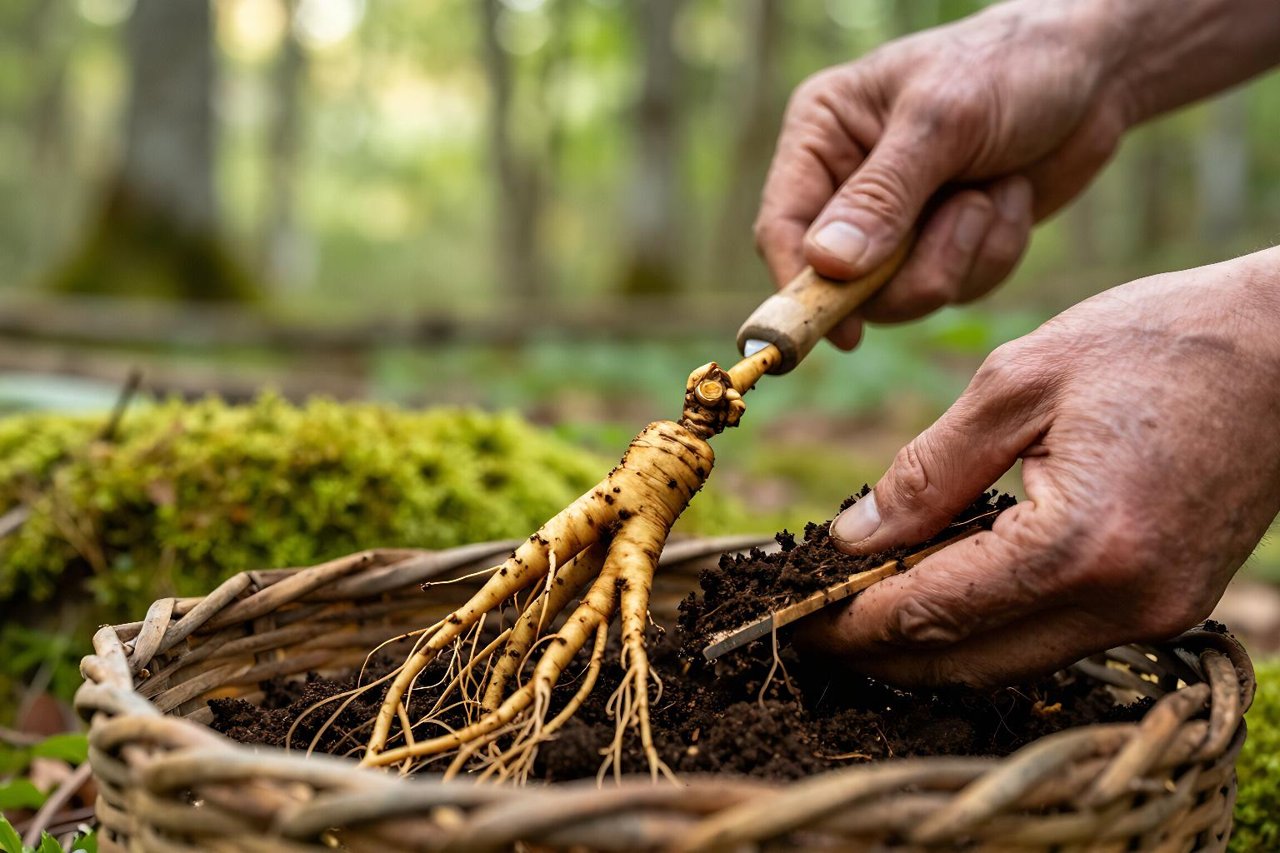
True ginsengs belong to Panax, a genus of slow-growing perennials in the ivy family. The name comes from the Greek pan-akeia, roughly “all-healing.” Wild plants take four to six years to reach a harvestable root, grow in the shade of deciduous forests, and produce a single cluster of red berries. The forked root often looks vaguely human, which is how it acquired the Chinese name rénshēn, or “person root.”
That resemblance drove a lot of the mythology. It also drives a lot of the marketing, because dozens of unrelated plants now carry the word on their labels.

The main types of ginseng
Asian ginseng (Panax ginseng)
Native to the forests of northeast China, Korea, and the Russian Far East, this is the species at the center of most traditional use and most clinical research. In traditional Chinese medicine it is classified as warming and is used to build qi, the vital energy. Wild roots are now rare and expensive; almost everything sold is cultivated, usually under shade cloth for four to six years.
Red ginseng versus white ginseng
This is a processing distinction, not a species one. White ginseng is peeled and air-dried. Red ginseng is steamed at around 100°C and then dried, a step that darkens the root to amber-brown and converts some of its ginsenosides (notably Rb1, Rb2, and Rc) into Rg3, Rk1, and Rk3. Because Rg3 is better absorbed and has been the focus of a lot of laboratory work, red ginseng commands a premium and is described in traditional terms as more strongly warming.
American ginseng (Panax quinquefolius)
This species grows wild in the hardwood forests of eastern North America and was being shipped to Chinese ports by the early 1700s. Its ginsenoside profile is different, with higher levels of Rb1 relative to Rg1, and traditional practice treats it as cooling and moistening rather than warming. Several Native American nations, including the Cherokee, used the root long before any of it was exported.
Notoginseng (Panax notoginseng)
Grown mostly in Yunnan and Guangxi, this one is used quite differently: traditional practice turns to it for bleeding, bruising, and circulation rather than for energy. Its main compounds are notoginsenosides. Powdered sanchi is still applied to cuts and taken internally after injuries.
The ones that aren’t ginseng at all
Siberian ginseng is Eleutherococcus senticosus, a different genus entirely, standardised to compounds called eleutherosides. It is legally restricted from being sold as “ginseng” in the United States. Prince ginseng, five-finger ginseng, and Indian ginseng (which is ashwagandha) fall into the same marketing grey zone. They may be useful plants. They are not Panax.
- Panax ginseng: warming, stimulating, the most studied species
- Panax quinquefolius: cooling, gentler, popular in summer formulas
- Panax notoginseng: focused on bleeding and circulation
- Panax vietnamensis: Ngoc Linh ginseng, high in majonoside-R2, rare and costly
- Eleutherococcus: an adaptogen, but not a ginseng
Traditional uses across cultures
The earliest written record of ginseng sits in the Shennong Bencao Jing, a Chinese materia medica compiled around 100 CE from older oral material. It was listed among the superior herbs, those taken over long periods rather than for acute illness. Later texts describe it for fatigue, weak digestion, shortness of breath, and recovery from illness, usually in combination with other herbs rather than alone.
Korean practice gave us samgyetang, a whole young chicken stuffed with glutinous rice, jujube, garlic, and a four-year root, eaten during the hottest days of summer. Ginseng tea with honey, and ginseng liquor, followed the same root into daily life. In North America, European colonists learned about American ginseng from Indigenous communities and largely ignored its medicinal use themselves in favor of selling it abroad.
What the research actually shows
Most of the pharmacological attention goes to ginsenosides, a family of more than 100 triterpenoid saponins. They are poorly absorbed in the gut, which is one reason researchers suspect the gut microbiome matters: bacteria convert the parent compounds into metabolites that enter the bloodstream. That detail complicates any simple “take X milligrams, get Y effect” story.
Fatigue and physical performance
Trials here are small and results are mixed. Some studies of Korean red ginseng at 1 to 3 grams daily report reduced fatigue scores over four to eight weeks; other well-designed trials find nothing beyond placebo. A much-publicized program of research on American ginseng for cancer-related fatigue produced encouraging early results that a larger follow-up trial did not confirm.
Memory and mood
Short-term studies in healthy adults, often using 200 to 400 mg of standardised extract, have shown modest improvements on working memory and reaction-time tasks. Effects tend to fade with longer use, and several trials are simply too small to generalize from.
Blood sugar and cardiovascular markers
Several meta-analyses suggest small reductions in fasting glucose, particularly in people with type 2 diabetes. The effect size is modest and inconsistent across preparations, which matters because it also raises the risk of hypoglycemia when combined with medication.
Sexual health
Small placebo-controlled trials of red ginseng in men with erectile dysfunction, typically 900 mg taken three times daily for eight weeks, have reported improvements. Sample sizes hovered around 40 to 60 participants, so the findings are suggestive rather than settled.
Reading a label without getting fooled
Ginseng is one of the most adulterated botanicals on the market. DNA barcoding surveys have repeatedly found products containing fillers, other Panax species than the one named, or no ginseng at all. A few things are worth checking before you buy:
- Species name in Latin, not just “ginseng”
- Ginsenoside content as a percentage (common extracts are standardised to 4 to 7%)
- Part used, since root, leaf, and berry have different profiles
- Extraction ratio, such as 4:1, telling you how much raw root went in
- Third-party testing from a named lab, not a generic seal
Typical daily doses in trials run from 200 to 400 mg of standardised extract or 1 to 2 grams of dried root. Taking it in the morning avoids the sleep disruption some people notice, which is a real complaint rather than a theoretical one.
Safety and interactions worth knowing
Ginseng is generally well tolerated. The most common complaints are insomnia, headache, nervousness, and stomach upset, and they usually show up at higher doses or in people who are already anxious. Case reports have linked very large doses to mania and elevated blood pressure.
The interaction list is where caution pays off. Ginseng can reduce the anticoagulant effect of warfarin, which has been documented in controlled studies, so anyone on it should talk to their prescriber before starting. It may lower blood glucose enough to matter alongside insulin or sulfonylureas. Laboratory work shows effects on CYP3A4 and P-glycoprotein, meaning it can shift blood levels of other drugs. People with hormone-sensitive conditions are usually advised to avoid it out of caution, and data on pregnancy and breastfeeding is too thin to call it safe.
None of this makes ginseng dangerous. It makes it a plant with real activity, which is precisely why the dose, the species, and the medication list should be settled before the first capsule rather than after.


