
Table of Contents
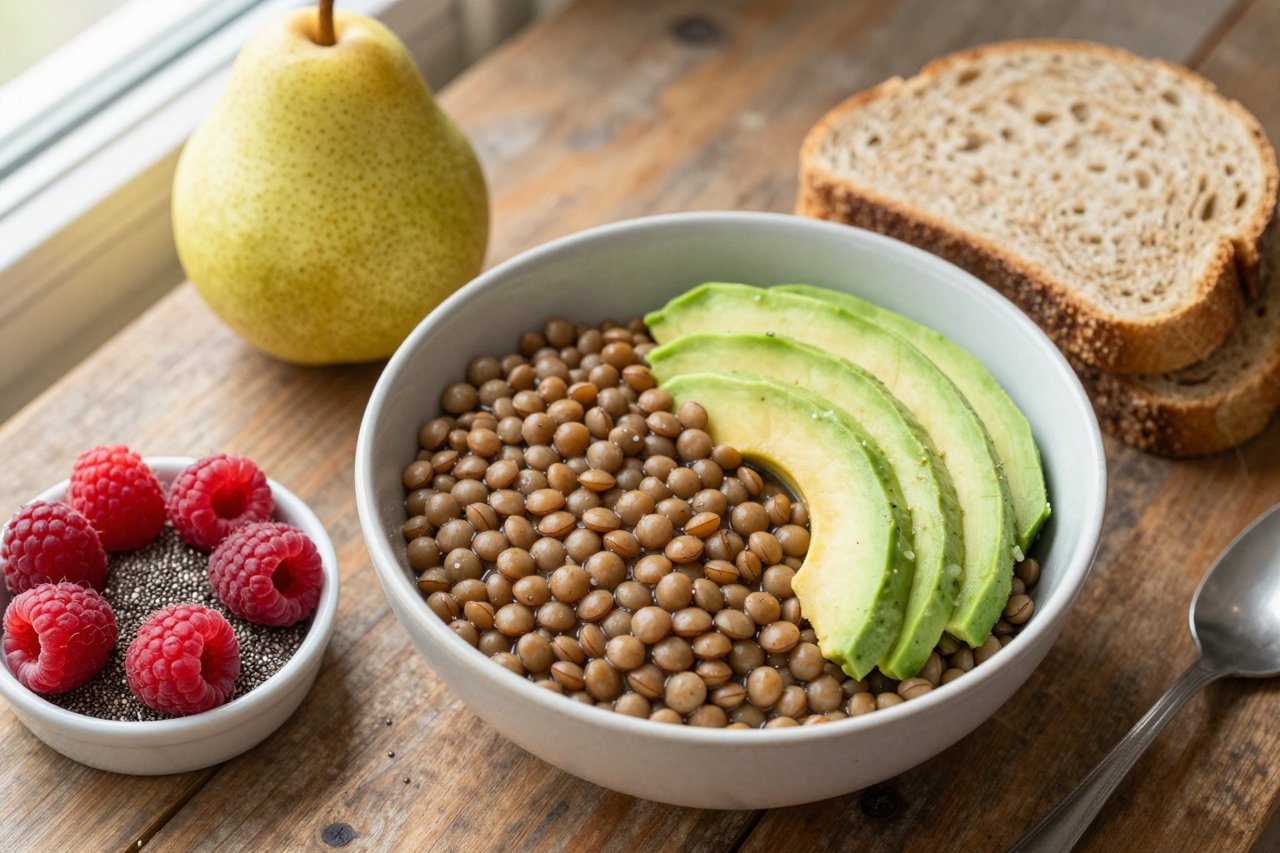
Breakfast is usually where fiber goes missing. A bagel and a coffee lands somewhere around 2 grams. Swap that for a bowl of oats with a spoonful of chia and a handful of raspberries and you’re at 12 before you’ve left the kitchen. That’s the whole game: small, repeatable trades rather than a new personality.
Adding more fiber to your diet has a reputation for being boring, or for meaning endless salads. It doesn’t. It mostly means choosing the version of a food that still has its structure intact, and getting beans into places where nobody notices them.
What the target actually looks like in food
Official guidance puts fiber at 25 grams a day for women and 38 for men under 50, with slightly lower numbers after that. The average adult gets around 15 grams. So you’re not climbing a mountain, you’re closing a gap roughly the size of one bowl of beans.
Here’s what portions actually deliver, because most people wildly overestimate:

- 1 cup cooked lentils: about 15 g
- 1 cup cooked black beans: about 15 g
- 1 medium avocado: about 10 g
- 1 cup raspberries: 8 g
- 1 medium pear, skin on: 5.5 g
- 1 cup cooked quinoa: 5 g
- 1 cup cooked broccoli: 5 g
- 1 ounce almonds (about 23 nuts): 3.5 g
Notice what’s absent from that list: nothing exotic, nothing requiring a speciality shop. If you want a shorter starting point, this list of everyday foods that do most of the nutritional heavy lifting covers the same territory from a different angle.
Change the grain, keep the meal
The least disruptive way to raise your fiber intake is to stop changing meals and start changing the starch underneath them. Same stir-fry, same curry, same bowl.
- White rice to brown rice adds roughly 2 g per cup. To barley or farro, closer to 6 g.
- Regular pasta to whole wheat pasta is about 3 g extra per two-ounce dry portion. Lentil pasta runs higher, around 5 to 7 g.
- White bread to a dense whole-grain loaf can triple the fiber in a sandwich, from about 1 g to 3 or 4 g per slice.
- Instant oats to steel-cut oats adds around 1 g per serving, plus a much slower morning rise in blood sugar.
None of those require a new shopping list, just a different bag on the same shelf. Give it two weeks and white rice starts tasting like nothing much.
Five additions that take under a minute
Stir chia or ground flax into something wet
One tablespoon of chia is about 5 grams of fiber. It disappears into yogurt, oatmeal, smoothies, or a jar of overnight oats with no texture penalty. Ground flax behaves the same way and adds a nutty edge to a bowl of soup.
Put a can of beans in whatever is already simmering
Chili, pasta sauce, soup, a tray of roasted vegetables. Rinse them first if the salt bugs you. Half a can is around 7 grams and nobody at the table will identify it as a health move.
Keep frozen edamame in the freezer
A cup of shelled edamame has about 8 grams of fiber and roughly 18 grams of protein. Boil for four minutes, salt, done. It fills the gap that crisps usually fill.
Leave the skins on
Potatoes, apples, pears, cucumbers, carrots. Peeling an apple costs you about 2 grams. That’s a lot for five seconds of work.
Snack on nuts instead of crackers
An ounce of almonds gives 3.5 grams; the same weight of wheat crackers gives under 1. The swap also keeps you full past 3 p.m., which is why so many of the nutrition mistakes that quietly drain your energy trace back to a morning that started with almost no fiber at all.
Go slowly, and drink more than you think
This is the part people skip, and then they blame the beans. Jumping from 15 grams to 38 overnight will produce gas, bloating, and a strong urge to give up by Thursday. Add about 5 grams a week instead, and let your gut bacteria adjust. They genuinely do, usually within two to three weeks.
Water matters more than most people realise. Fiber bulks up in the digestive tract and needs fluid to move through it. If you increase fiber without increasing water, you can end up constipated, which is the exact opposite of the goal. Aim for an extra glass or two across the day, not all at once.
There’s a reasonable case that fiber is the closest thing to a cleanse your body actually runs on its own, since it feeds the bacteria that handle a good chunk of your waste processing. If the whole science-backed approach to supporting your body’s natural cleanse interests you, fiber is the least glamorous and most effective chapter of it.
An ordinary weekday that lands near 32 grams
No powders, no measuring cups, no meal prep Sunday.
- Breakfast: Oats with a tablespoon of chia, half a cup of raspberries, and a spoon of peanut butter. Roughly 11 g.
- Lunch: Leftover chicken and rice, except the rice is now half rice and half black beans. Roughly 9 g.
- Afternoon: A pear and a small handful of almonds. Roughly 7 g.
- Dinner: Salmon, roasted broccoli, and potatoes with the skin left on. Roughly 5 g.
That’s 32 grams and it doesn’t look like a diet. Swap the pear for a second coffee and you drop to 25, which is still fine. Consistency beats precision here.
Supplements: a useful tool with a weak foundation
Psyllium husk is the best-studied fiber supplement, and a tablespoon delivers around 5 grams. It works, it’s cheap, and it’s genuinely helpful if you’re travelling or recovering from a week of restaurant food. Inulin and chicory root powders are popular but can be fiercely gas-producing in people who aren’t used to them, so start with a third of the suggested scoop.
What supplements can’t do is replace whole foods. Beans, berries, oats, and vegetables bring polyphenols, vitamins, and fermentable fibers in combinations that a powder doesn’t replicate. Treat the tub as a top-up, not a strategy.
Eating out without losing the thread
Restaurant food trends low on fiber for a simple reason: refined starch is cheap, fast, and universally liked. You can still find it without interrogating the waiter.
Look for the dish that comes with beans, lentils, or a whole grain as the base rather than a side. Order the hummus. Take the side salad instead of fries once in a while, or get both and eat the salad first. At a pizza place, a vegetable-topped pizza eaten with a starter of white beans is a completely different fiber profile from four slices of cheese pizza on an empty stomach.
One more thing worth knowing: very low-carb eating patterns, including strict keto, tend to sit well below 20 grams of fiber a day because the biggest fiber sources are grains and legumes. That’s not automatically a problem, but it’s a real trade-off. If you’re weighing up how Mediterranean, keto, and AIP approaches compare, fiber intake is one of the clearest differences between them, and it’s worth deciding deliberately rather than by accident.
Whatever pattern you land on, the anti-inflammatory eating habits that actually stick tend to be the ones built around plants by default, with fiber arriving as a side effect rather than a target. Berries, beans, greens, and whole grains show up in almost every version of that advice, which is a decent hint about where to put your effort. The rest is repetition, and repetition is much easier when the food tastes good.


