
Table of Contents
A food scale taught me more about what I eat than any diet book. It also turned a bowl of pasta into a small maths problem I didn’t want to solve at 8pm. If you’ve ever dropped a meal plan because logging every gram felt like a second job, you already know the weak point in calorie counting. Portion control, luckily, doesn’t require arithmetic. It needs a handful of habits and a decent sense of what a normal serving actually looks like.
The numbers drift, and they always will
Logging works while the novelty lasts. Somewhere around week four, the measuring cups go back in the drawer and the eyeballing starts. That isn’t a character flaw. It’s how attention behaves.
The numbers themselves are shakier than they look. Regulators in most countries allow packaged food labels to be off by up to 20% on calories, and that’s before you account for how much of a meal you actually absorb. Restaurant portions swing wildly: the same chicken curry can land anywhere between 500 and 1,200 calories depending on which kitchen made it. Chasing precision through that fog is exhausting, and it quietly teaches you to trust a label more than your own appetite.
What you’re really after is a repeatable way to eat roughly the right amount on most days. That’s a skill, not a spreadsheet.

Your hand is already a measuring cup
Hand portions scale with your body, travel with you, and never need charging. A rough guide:
- Palm (flat, no fingers) for protein: roughly 85–115g of cooked meat, fish, or tofu.
- Fist for vegetables: about a cup of cooked greens, broccoli, or carrots.
- Cupped hand for carbs: half to one cup of rice, pasta, potatoes, or oats.
- Thumb for fats: a tablespoon of oil, butter, or nut butter, or a small handful of nuts.
Someone 5’2″ and someone 6’3″ get different portions from the same method. That’s the entire point, and it’s the thing a 200-calorie snack pack can never do for you.
Build the plate before you sit down
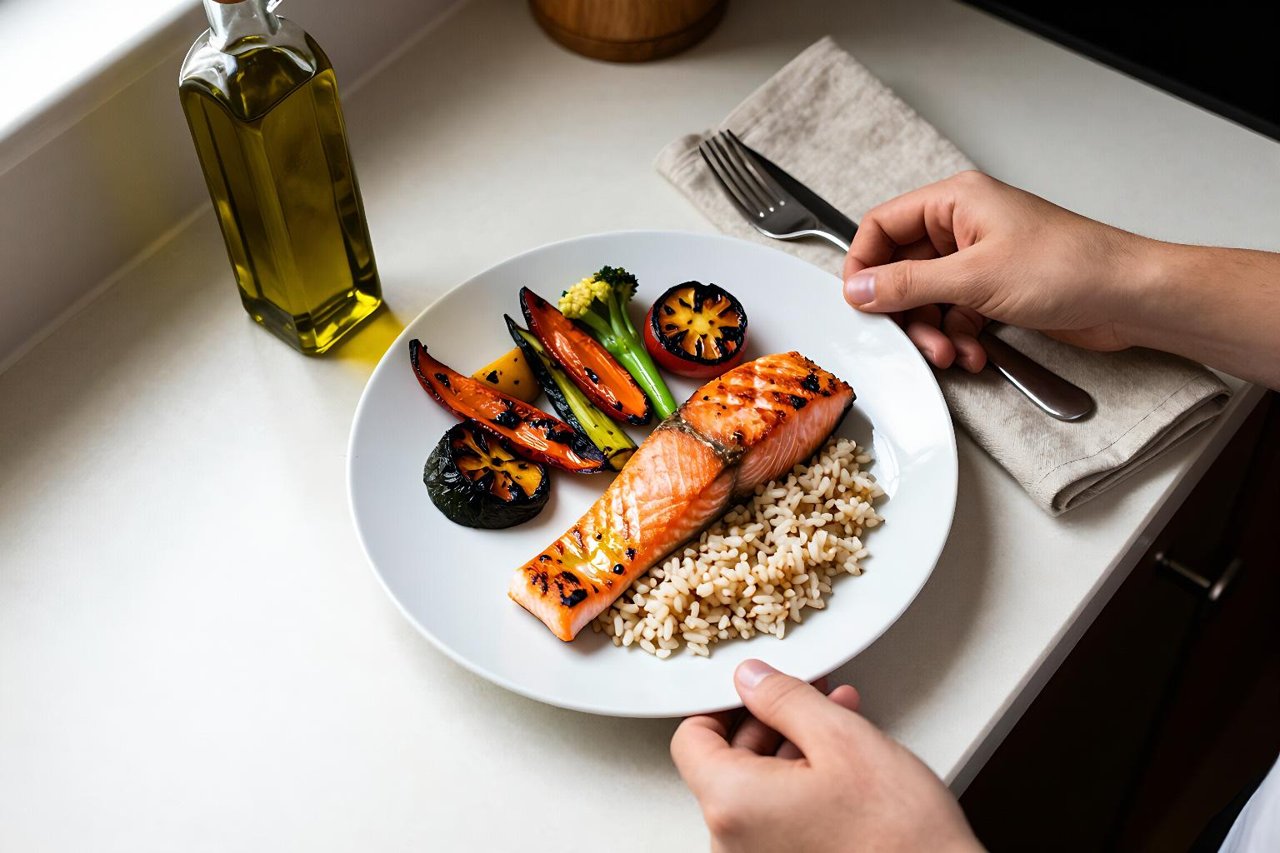
Plate geometry does a lot of quiet work. Aim for half the plate as vegetables, a quarter as protein, and a quarter as starch, on a plate about 9 inches across. It’s the same principle behind any sensible balanced diet built without a spreadsheet, just applied to volume rather than food groups.
The 9-inch detail matters more than it sounds. Dinner plates were closer to 8.5 inches in the 1970s; plenty of modern ones are 11 or 12. A fixed amount of food on a bigger plate looks like a starter, and you eat with your eyes long before your stomach gets a vote.
Front-load the foods that fill you
Protein and fibre do more for fullness per bite than anything else on the table. Two eggs and a slice of wholegrain toast keeps most people steady until lunch. A croissant and a juice doesn’t, even when the calories are broadly similar. Starting with the protein and vegetables, then moving to the rice or bread, tends to leave you satisfied on less.
Practical version: eat the chicken and the green beans first. If you’re still hungry afterwards, go back for more starch. Quite often you won’t.
Give your gut twenty minutes
Stretch receptors in your stomach and the hormones that signal fullness need time to reach your brain. Most people finish a main course in eight to ten minutes, well before that message lands. Then they go back for seconds because the signal hasn’t arrived yet.
You don’t need to chew meditatively. Try three things:
- Put the fork down between every few bites for the first five minutes.
- Drink water between mouthfuls rather than gulping it all at the start.
- Leave something on the plate for two minutes before deciding on seconds.
That last one alone changes how much most people eat at dinner, and it costs nothing.
Put the serving dish out of reach
Serve from the counter rather than the table and second helpings get rarer, for one simple reason: you have to stand up and walk. Plate your portion, put the rest away, then sit down.
The same trick works for snacks. A bag of crisps on the sofa gets finished. A bowl of crisps gets finished too, but it’s a smaller bowl. Glassware is worth a mention as well, since people pour roughly 30% more wine into a short, wide glass than a tall, narrow one without noticing. Your crockery is quietly negotiating on your behalf all evening.
Learn what a portion looks like in real life
Numbers are forgettable. Objects stick. A few anchors worth memorising:
- Cooked chicken or fish: a deck of cards.
- Cooked rice or pasta: a tennis ball, roughly half a cup.
- Cheese: two dice.
- Nut butter: a golf ball is generous, a thumb is closer.
- Fresh fruit: a baseball for an apple or orange, a tennis ball for a plum.
Check these against your usual servings once, and you’ll notice within a week which foods you’ve been over-pouring without realising it. Olive oil and cereal are the two that catch most people out.
Restaurants and other people’s kitchens
You can’t control how much oil goes into someone else’s risotto. You can control the shape of the meal. Ordering a starter and a main instead of a main and a dessert, or asking for dressing on the side, keeps things roughly in range without making a scene. Takeaway containers help too: box half the portion before you start eating, while you’re still thinking clearly rather than after you’re full.
When portion rules stop helping
Any system that makes you anxious before a birthday dinner has stopped being useful. Portion awareness should make eating feel easier, not narrower. If you find yourself turning down meals you genuinely want, or feeling guilty about a larger-than-usual lunch, it’s worth stepping back and looking at the bigger picture.
The weight loss science that actually holds up points the same way: adherence beats precision. A moderately sensible plate you can live with outperforms a perfect one you abandon in a fortnight. There’s a longer game here too, where consistent daily habits matter far more than any single day’s portions.
If you want a test, try this. Eat one meal a week with no portion rules at all and notice how you feel an hour later. Most people find their instincts are better than they expected. Hand portions are a training tool for that instinct, and embracing a balanced approach is the only version of this that survives a real calendar.


