
Table of Contents
You bought the serum. It has niacinamide, ceramides and a review section full of people calling it life-changing. You want it on your face tonight. Don’t.
A patch test costs you five days and a two-centimetre square of skin on your forearm. Skipping it can cost you a fortnight of redness and flaking, plus an expensive bottle sitting unused on the shelf. The maths isn’t close.
Why Patch Testing Matters More Than Reviews Do
Reactions to skincare fall into two broad camps. Irritation builds up over repeated exposure and depends on dose, so a 10% niacinamide serum might sting where a 5% one was fine. Allergy works differently: your immune system gets sensitised, which means a reaction can appear on the first use or the fiftieth. “I’ve used this formula for years” is not a safety guarantee.
Fragrance mixes, preservatives such as methylisothiazolinone, essential oils and certain UV filters are repeat offenders in contact dermatitis clinics. If your skin already runs reactive, testing matters twice as much, and there’s solid background in these tips for choosing sensitive skin products and building a routine around them.

Where to Put the Test Patch
Not all skin behaves the same way, and testing on the wrong spot gives you false confidence.
- Inner forearm: the standard site. Thin-ish skin, plenty of surface, and a breakout there is unlikely to be confused with a reaction.
- Jawline or behind the ear: closer in behaviour to facial skin, which makes it a useful second site for anything going on your face.
- Side of the neck: a good option if your face is much more reactive than your arms.
- Skip the palm: the outer layer there is thick and rarely reacts, so a clear palm test proves very little.
The Five-Day Patch Test, Step by Step
Day 0: apply and leave it alone
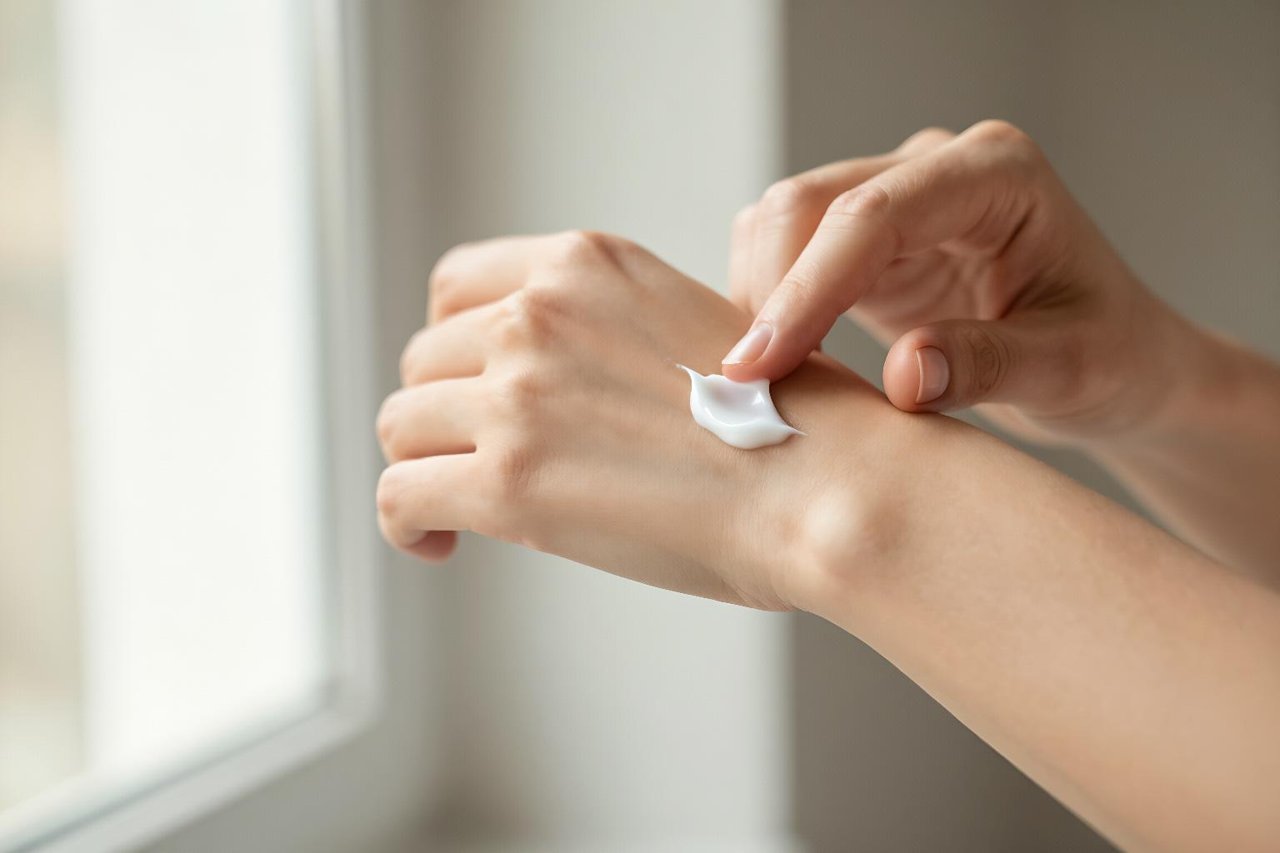
Wash the site with plain water and pat it dry. Use a grain-of-rice amount for a serum, a pea for a cream, spread over a 2–3 cm square. Leave it uncovered and note the time. Avoid broken skin, moles and fresh shaving nicks, and don’t apply it over an exfoliating acid, because that tests the combination rather than the product.
Days 1 and 2: look, don’t prod
Check at 24 and 48 hours. Redness, swelling, itching or a raised bumpy patch confined to the test square counts as a positive result. A brief tingle in the first few minutes that fades is usually the vehicle, such as a low-pH acid, doing its job.
Days 3 to 5: the repeat exposure
If nothing happened, reapply to the same spot once a day for three more days. Plenty of reactions are cumulative and only show up on the third or fourth contact. After that, move to a small patch of jawline for two or three days before you consider going full-face.
Telling a Real Reaction From Ordinary Skin Noise
Timing is the biggest clue, and it’s often more useful than the appearance of the rash itself.
- Stinging within a minute that lingers: usually irritation from acids, alcohol or fragrance rather than an allergy.
- Itching and a spreading rash at 24 to 72 hours: the pattern of allergic contact dermatitis. Stop and don’t retest.
- Clustered whiteheads exactly inside the square: treat it as a fail. If it’s a retinoid, it may be purging, but purging confined to a two-centimetre patch is not worth gambling on.
- Nothing at all, twice, over five days: a clear green light for the face.
Adjusting the Test for Actives, Acids and SPF
Retinoids deserve a slower ramp than most products. Test on the forearm as above, then use it twice a week on the jawline for a fortnight before increasing. Don’t dilute an acid to test it, since diluting changes the pH and tells you nothing useful about the real formula. Rinse-off cleansers can be tested by applying, waiting five minutes, then rinsing.
Sunscreen needs its own approach because it goes on in amounts far larger than a serum, and a tiny dab won’t reflect that. This step-by-step sunscreen patch-test method for sensitive skin walks through applying at real-world thickness and re-testing on the face.
One New Product at a Time
Start three products in the same weekend and break out on Tuesday, and you’ve learned nothing except that something in your routine disagrees with you. Space introductions at least a week apart, ideally two. If you’re rebuilding a routine from scratch, the six-step approach to building your personal best skincare products list keeps the sequence manageable instead of overwhelming.
Acne routines are the trickiest case, because purging muddles every signal you’re trying to read. Testing each new acne treatment separately, with a fortnight between additions, is the same discipline described in this guide to testing, comparing and committing to acne products.
Keep a Log. Three Lines Is Enough.
Product name, date applied, test site, and what you saw at 24, 48 and 72 hours. A photo on your phone takes four seconds and is worth more than your memory in six months, when the same serum reappears in a sale and you can’t quite recall why you stopped using it. Layer-heavy routines make this even more valuable: if you’re adding essences and ampoules in the glass-skin style, the sequencing discipline behind Korean skincare routines and product layering only works if you know what each step is actually doing.
If Your Patch Test Goes Wrong
Stop using the product. Wash the area with lukewarm water and a plain, fragrance-free cleanser, then apply a bland moisturiser. Skip actives on that patch for several days and don’t scrub at it. A cool compress helps with itch, and a thin layer of over-the-counter hydrocortisone 1% can settle a mild localised reaction, though it’s worth checking with a pharmacist first, particularly if the test site was your face.
Swelling that spreads well beyond the patch, hives, or any trouble breathing means medical care right away. Otherwise, photograph the reaction while it’s visible and write down the full ingredient list, not just the headline actives. Reactions to preservatives and fragrance are common and easy to miss, and having the list means you can compare it against everything else on your shelf. If a second product produces the same response, book a dermatologist and ask about formal patch testing with a standard series. That’s the version with 30-plus allergens taped to your back for 48 hours, and it’s the only reliable way to find out exactly what your skin objects to.


