
Table of Contents
You just bought the sunscreen your friend swore by. You put it on, and within twenty minutes, your cheeks turn red. You wash it off and wonder what’s wrong with your skin.
Nothing is wrong with you. The problem is that you’re picking products without a method. The best sunscreen for sensitive skin isn’t the one with the highest SPF or the most expensive formula. It’s the one your skin tolerates every day, and finding it requires a practical step-by-step approach. This article walks you through that process, with concrete examples and numbers you can apply immediately.
Step 1: Define Your Own Sensitivity
‘Sensitive skin’ is an umbrella term. You could have rosacea, eczema, or acne-prone skin that reacts to heavy creams. You might be allergic to fragrance, preservatives, or a specific UV filter. That’s why you need a baseline. For a week, write down what happens when you use your current sunscreen. Do you feel tingling? Do you see red patches? Do you develop small bumps? Those symptoms are your triggers.
Take two people with sensitive skin. Sarah has rosacea and reacts to preservatives like phenoxyethanol. Mike has a compromised skin barrier and reacts to fragrance. They’ll both say they have sensitive skin, but the same sunscreen could be fine for one and terrible for the other. Know your specific pattern before you start testing.

Step 2: Read the Ingredient Label Like a Pro
Chemical sunscreens contain filters like avobenzone, oxybenzone, and octinoxate. These absorb into the skin, and they’re common triggers for stinging. Mineral sunscreens contain zinc oxide or titanium dioxide, which sit on the surface and scatter UV rays. That’s why mineral formulas are usually the starting point for sensitive skin. If you’re new to reading labels, this no-nonsense guide on the best sunscreen for sensitive skin explains why certain filters sting.
But not all mineral sunscreens are equal. Check the active ingredient percentage. Zinc oxide at 10% is okay for short periods, but 20% gives you significantly better UVA and UVB protection. Also scan for hidden irritants: fragrance, denatured alcohol, essential oils, and methylisothiazolinone (a strong preservative). If a product says ‘for sensitive skin’ but lists lavender oil near the top, put it back. See our best sunscreen for face and sensitive skin article for a roundup of formulas that work.
Step 3: Patch Test on Your Jawline, Not Just Your Arm
Most people test sunscreen on their inner arm, then assume it’s safe for their face. But skin on the arm is thicker than skin on the face. A more reliable spot is the two-centimeter area just below your ear along your jawline. The skin there is similar in thickness to your cheek and easily hidden if it flushes.
Do this:
- Cleanse your face and wait ten minutes.
- Apply a dime-sized amount of sunscreen to the two-centimeter strip along your jawline.
- Leave it on for 24 hours. Don’t cover it with makeup.
- Check for redness, bumps, or a burning sensation after 15 minutes, then again at 6 and 24 hours.
If you don’t react, place a two-centimeter patch on your cheek and leave it overnight. If you still get no reaction, you can trial it on your entire face. This two-stage method cuts down the risk of a full-face allergic reaction. And if you do end up with red, irritated skin, a soothing aloe vera step-by-step routine can help calm it down while you wait.
Step 4: Apply the Correct Amount or You’ll Discard a Good Formula
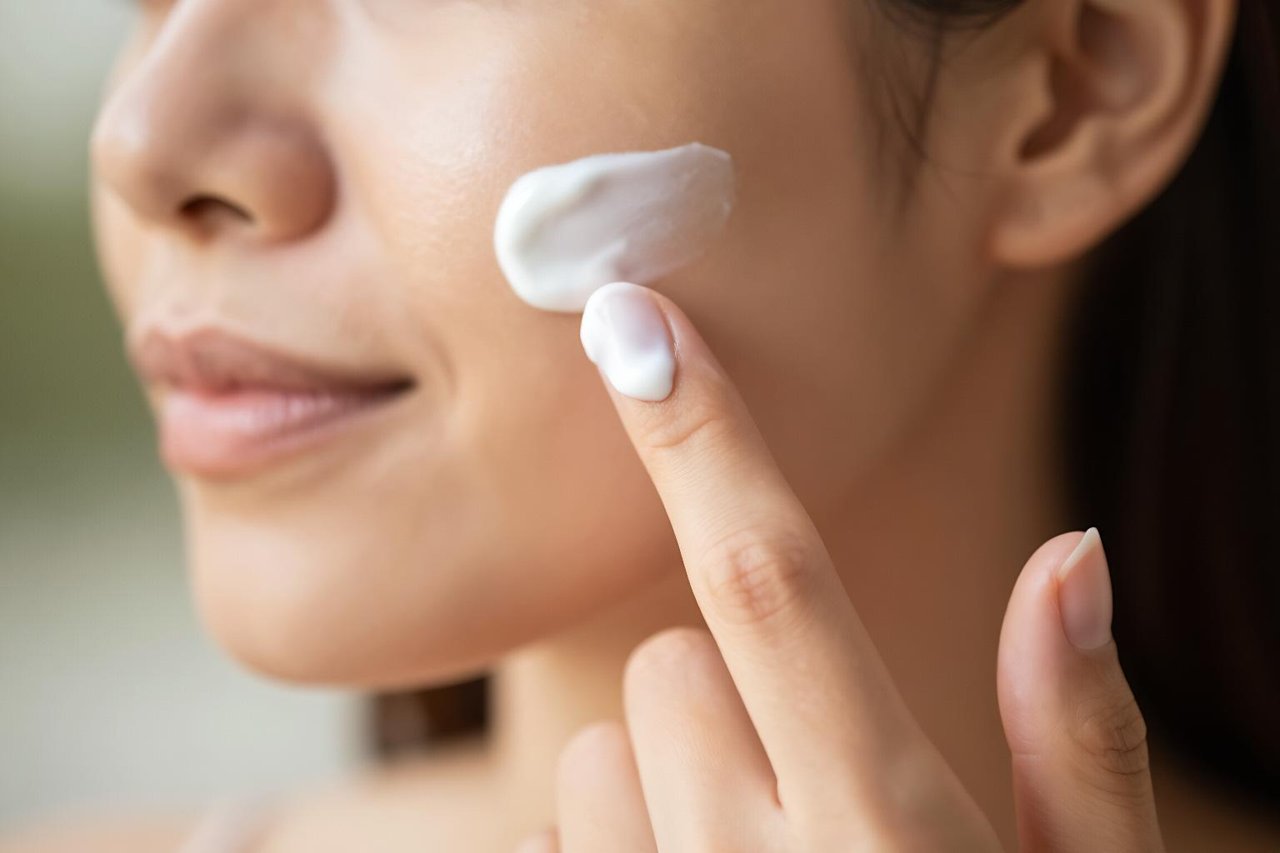
Your patch test can be misleading if you apply a thin layer. The face needs about 1/4 teaspoon, or roughly 1.25 grams. A practical way to measure is the two-finger rule: squeeze sunscreen along the full length of your index and middle fingers from palm to tip. That’s one layer.
Apply it to your entire face, including your eyelids. If you use a moisturizer first, wait two minutes between layers so they don’t blend. Too little sunscreen changes the product’s behavior; you might think it’s causing dryness or clogging when you actually applied half the intended amount. If you’re layering sunscreen with skincare, order matters. Apply your most functional products first, then sunscreen last. For a quick tutorial on that order, check this guide on finding an anti-aging cream, which covers the correct sequence.
Step 5: Evaluate It in Real-World Conditions
A patch test only tells you if the product causes immediate irritation. It won’t tell you how it feels after five hours in a warm office, or whether it stings when you sweat. To really assess a sunscreen, run a three-day trial with a simple rating system:
- Apply the full recommended amount in the morning.
- After one hour, rate stinging on a scale of 0 to 10.
- After five hours, note any redness or white cast.
- At night, wash your face and check for new breakouts or texture changes.
Take a photo in the same room, at the same time each day. Compare it to yesterday’s photo. Subtle morning or evening flushing can be easy to miss without photos.
Here’s a real example: a 27-year-old woman with combination skin and a history of eczema tested a 20% zinc oxide cream. On day one, she rated stinging a 3 out of 10. On day two, it was a 1. By day three, it was zero. Had she stuck with only the first impression, she would have given up on a formula that eventually became her regular sunscreen.
Step 6: Consider Texture, White Cast, and Eye Irritation
The best sunscreen for sensitive skin must not only be non-irritating. It also has to be wearable. Many mineral formulas leave a heavy white cast, which can be worse than the burning sensation for some people. If you have medium to deep skin tones, look for tinted mineral sunscreens with iron oxides. The tint doesn’t reduce sun protection, and it blends more naturally.
Also, test around your eyes. Some sunscreens are fine on your cheeks but sting your eyes when you blink. If that happens, it may carry avobenzone or octocrylene. You can either apply a lower amount around the orbital bone or choose a dedicated eye sunscreen. But if it stings your eyes on day one, it will sting on day ten. Don’t fight through it.
Texture matters too. If the sunscreen pills under your makeup or leaves a greasy film, you’re less likely to use it consistently. That’s a practical reason to skip a product, even if it passes every irritation test.
A Final Checklist Before You Commit
Once you’ve tested a sunscreen for three days, go through this checklist:
- Does it contain at least 10% zinc oxide or titanium dioxide?
- Is it free of fragrance and essential oils?
- Did your 24-hour jawline patch test pass?
- Did you use the full two-finger amount?
- Does the white cast blend into your skin tone?
- Can you wear it for at least six hours without a reaction?
- Does it make your eyes water?
If you can answer yes to the positive questions, you’ve found a keeper. If not, choose a different product and repeat the process. Over two or three rounds, you’ll build a shortlist of sunscreens that actually work, and more importantly, you’ll know exactly why they work for your skin.


