
Table of Contents
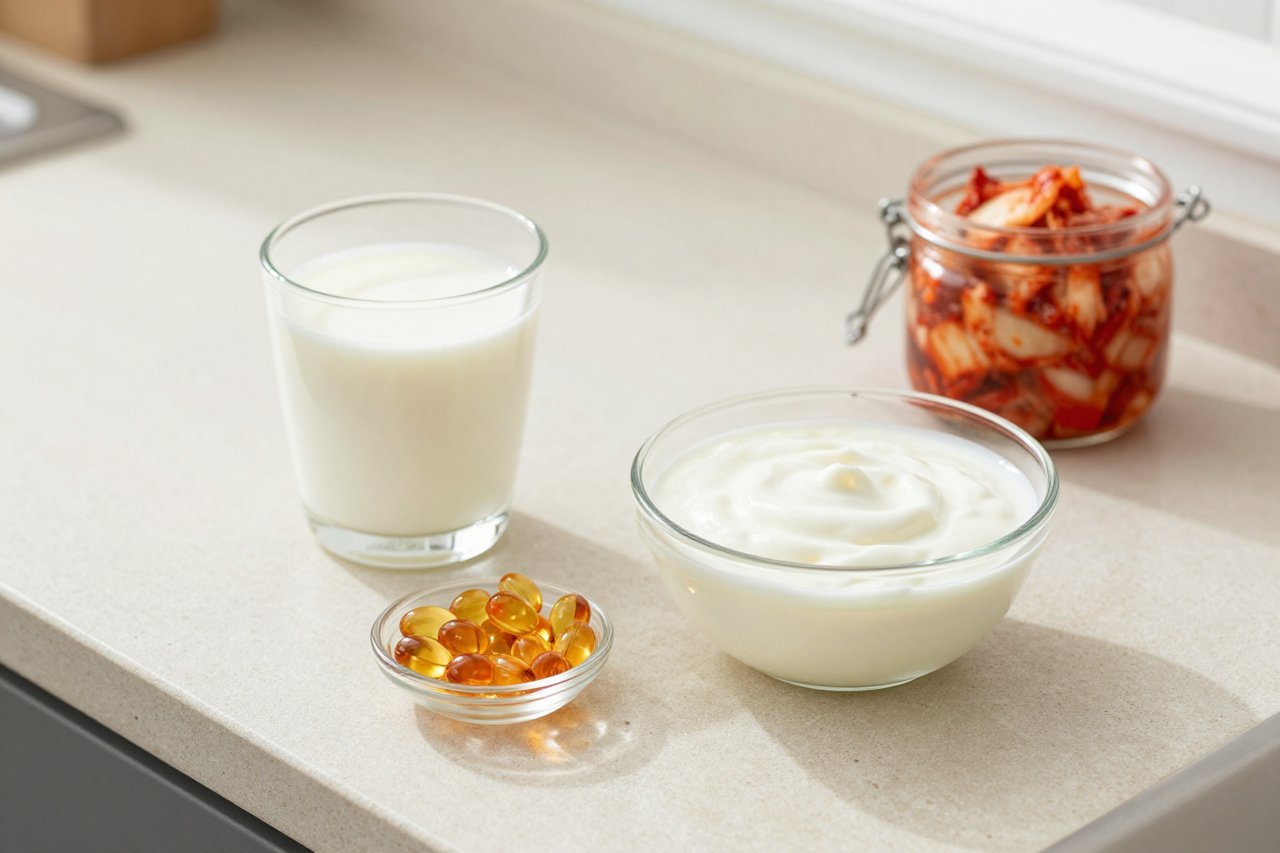
Walk into any pharmacy and you’ll see a $1.20 supermarket yogurt sitting three shelves away from a $45 bottle of capsules promising 50 billion CFU, a $5 chilled kefir, a $4 kombucha with 8 grams of sugar per bottle, and a tub of inulin powder that contains no bacteria at all. Every one of them is sold as a route to the benefits of probiotics. The cost per serving differs by a factor of forty.
The awkward part is that probiotic benefits aren’t a single switch you either flip or don’t. They belong to a specific strain, at a specific dose, still alive when it reaches your gut. What the science really says about good bacteria comes down to that distinction: Lactobacillus rhamnosus GG has solid evidence behind it for antibiotic-associated diarrhoea, while an unnamed blend in a fruit-flavoured drink has almost none.
So the useful question isn’t whether probiotics work. It’s which format gives you the best odds of the outcome you want, at a price you’ll keep paying past February.
Capsules and powders: precision, at a cost
The main advantage of a capsule is control. If the label is honest, you know the strain, the dose, and the count at the end of shelf life rather than at the moment of manufacture. That lets you match the product to a job: Saccharomyces boulardii or L. rhamnosus GG for antibiotic-related diarrhoea, Bifidobacterium infantis 35624 for IBS symptoms in some trials.

What you gain:
- Precise strain and CFU, usually printed clearly
- No dairy, no added sugar, no histamine load
- Travel-friendly, and some formats are shelf-stable
- Easy to run a four-week test at a consistent dose
What you give up is mostly money. A 30-capsule bottle at $40 works out around $1.33 a day, five to ten times a supermarket yogurt. Capsules also arrive naked: no food matrix, no fermentation by-products such as lactic acid that appear to help some strains survive stomach acid. Viability is fragile too, and a bottle left in a hot car in July may be mostly filler powder by August. Ten minutes with a science-backed guide to strains and CFUs before you spend anything is a good trade.
Fermented foods: cheap, messy, and the longest track record
Yogurt, kefir, kimchi, sauerkraut, tempeh, miso. This is where most people’s probiotic benefits actually come from, and it’s the format with the fewest unknowns in daily life, because people have eaten it for centuries rather than for one marketing cycle.
Pros
- A few cents to about a dollar per serving
- Live microbes plus their metabolites, the whole package rather than one isolated strain
- Real nutrition alongside: protein, calcium, B vitamins in some ferments
- Built into meals, so the habit tends to survive
Cons
- Strain identity is usually vague or undisclosed, so you can’t target a specific condition
- Counts vary wildly between brands and batches
- Dairy versions are out if you’re lactose intolerant or vegan
- Kimchi and sauerkraut carry sodium; kombucha and aged ferments can bother histamine-sensitive people
Kefir is the quiet overachiever here. A decent one carries dozens of microbial species rather than the two or three in most commercial yogurt, and it’s drinkable, which makes a daily 200 ml easy to maintain.
Where fermented dairy punches above its weight
The gut isn’t the only system in play. The calcium, protein and phosphorus in fermented dairy, combined with live cultures that appear to support calcium absorption, have made it a subject of genuine interest in bone health. There’s a readable summary in this piece on how probiotics in fermented dairy help manage osteoporosis, a useful reminder that a yogurt habit is doing more than one job.
Probiotic drinks: convenience with a sugar problem
Kombucha, water kefir, drinkable yogurts and the small shots sold near the checkout. These are the easiest formats to consume and the hardest to evaluate.
Two things to check before buying. First, is it pasteurised? Many kombuchas and juice-based drinks are heat-treated for shelf stability, which kills the cultures you’re paying for. Second, what’s the sugar? A typical 330 ml kombucha carries 6 to 12 g, and flavoured shots can run higher than a can of soft drink.
Then run the arithmetic. A 60 ml shot with 1 billion CFU at $3 works out at roughly $3 per billion live cells. A $30 capsule with 25 billion per dose works out at about four cents per billion. The marketing loses some of its shine once you do that.
Prebiotics and synbiotics: feeding what you already have
Prebiotics contain no live bacteria at all. They’re fibres and compounds your existing microbes ferment: inulin and oligofructose from chicory root, GOS, resistant starch from cooled potatoes and green bananas, plus polyphenols from berries and cocoa. They’re cheap, food-based, and genuinely useful for people whose guts already host a decent community.
The limits are real. Prebiotics can’t replace strains you don’t have, and ramping up fast is a reliable way to spend an evening bloated. Ten to twenty grams of inulin in one sitting causes gas and cramping in plenty of people, and high-FODMAP fibres can set off IBS symptoms rather than calm them. Synbiotics pair the two, a live strain plus the fibre that feeds it, which is a sensible idea that many products execute poorly.
Which format fits which goal
- Recovering from antibiotics: a capsule with a documented strain, started within 48 hours and continued for a couple of weeks
- Everyday digestion and regularity: a daily fermented food, kefir or plain yogurt first
- Travel, no fridge access: a shelf-stable capsule you’ve already tested at home
- IBS: strain-specific products rather than generic blends, and go carefully with prebiotic fibre
- Under $20 a month: plain yogurt and kefir beat almost everything on cost per live cell
There’s no universal winner in that list. A $50 capsule is the right answer for one row and an expensive mistake for two others.
The trade-offs nobody prints on the label
Cost per billion cells is the number that matters and it’s almost never shown. Neither is the fact that most trial benefits appear within two to four weeks and tend to fade when you stop. Labels also often quote CFU at manufacture, a figure that can drop by a log or more before the expiry date. And refrigeration is doing real work on chilled products, while the warm shelf at the back of a delivery van is not.
If the choice between two similar capsules is what’s stalling you, a step-by-step walkthrough for choosing the best probiotics for your gut is a better use of twenty minutes than another hour of review reading.
A hedge that works for most people
Rather than picking a side, the format that wins in most households is one of each: a fermented food every day as the base, plus a targeted capsule for a specific job or a specific window, such as during and after antibiotics or a bout of travel.
Then treat it as a four-week experiment with a written baseline. Note your bloating, bowel habits and energy before you start, then again at week two and week four. If nothing changes, you’ve saved yourself a subscription. If something does, you know it’s worth the money. That’s roughly the structure in this step-by-step plan for getting real results from probiotics.
The cheapest option is also the most underrated. A tub of plain yogurt and a bottle of kefir cost less than one bottle of capsules, cover more microbial ground, and come with protein and calcium attached. If you’ve been circling the supplement aisle without buying anything, start in the dairy section and give it four weeks. You can always add the capsule later, once you have a baseline to compare it against.


