
[ad_1]
Key Points
- Certo Aerospace demonstrated CAPSTONE VTOL anti-submarine tracking capabilities for the Royal Navy at Keevil Airfield on February 23, 2026.
- The 600kg-class aircraft carried sonobuoys for more than two hours and transmitted acoustic tracking data through Starlink SATCOM.
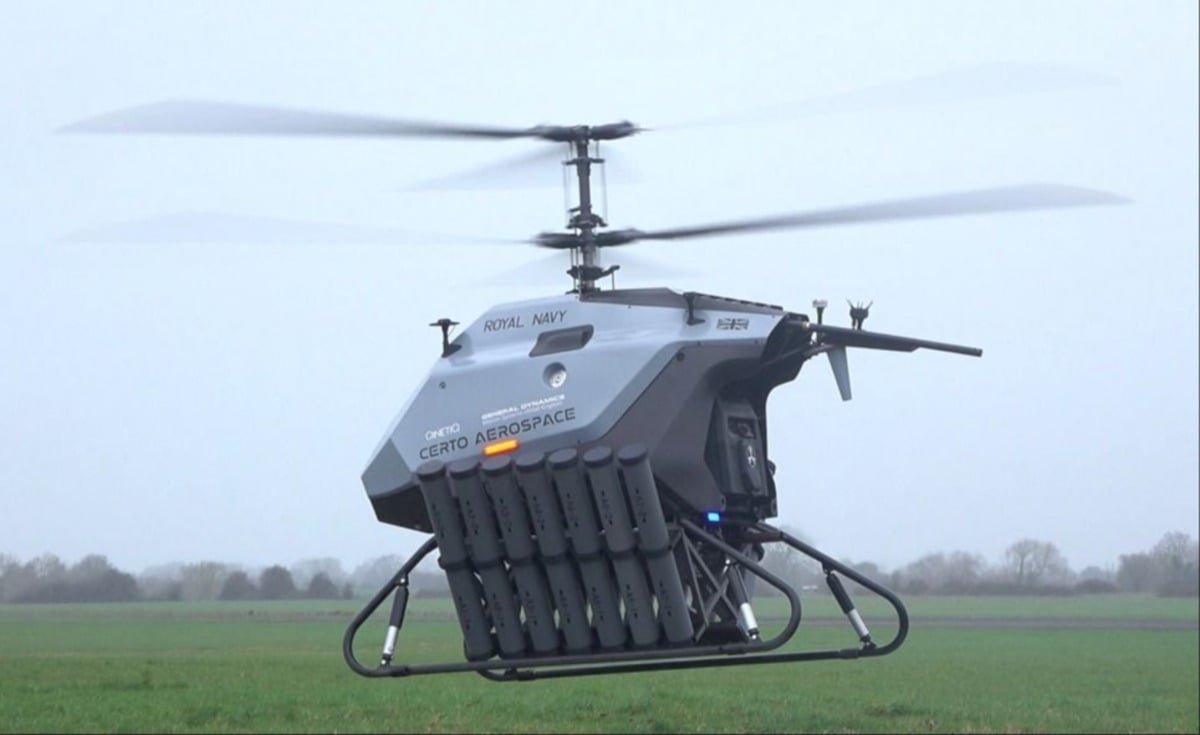
Certo Aerospace has demonstrated a new anti-submarine warfare capability for the Royal Navy, using its CAPSTONE vertical take-off and landing drone in a flight test at Keevil Airfield on Feb. 23.
The trial, conducted under the Navy’s ATLANTIC BASTION technology demonstration program, focused on the aircraft’s ability to detect, locate, and track underwater targets using sonobuoys — floating sensors that listen for submarine activity beneath the surface.
At the center of the test was Certo’s 600-kilogram-class CAPSTONE unmanned aircraft, which the company said flew for more than two hours while carrying a representative mix of sonobuoys. During the flight, the aircraft also operated with General Dynamics Mission Systems (UK) Ltd.’s UYS-506 acoustic processor, marking a key step in integrating submarine-hunting sensors onto an uncrewed platform.
– ADVERTISEMENT – CONTINUE READING BELOW –
Data gathered from the sonobuoys was transmitted from the aircraft to CAPSTONE’s ground control station and then routed to the UYS-506 control system, where operators were able to monitor the underwater picture, including acoustic signatures, target location, and track data.
The information fed into the demonstration was supplied by QinetiQ through its Sonobuoy Data Creator, a tool already used to support the Royal Navy’s Merlin helicopter anti-submarine warfare system. The test also included transatlantic command-and-control using Starlink satellite communications, allowing acoustic data and system control to be transmitted over long distances.
For the Royal Navy, the significance of the test lies in how it could expand the reach of its existing anti-submarine fleet. Crewed helicopters such as the Merlin remain central to the mission, but an unmanned aircraft able to stay airborne for extended periods offers another layer of coverage while reducing the risk to personnel.
Justin Tooth, chief executive officer of Certo Aerospace and a former Navy Lynx pilot, said, “As a former Navy Lynx pilot, I was delighted that Certo was selected by the Royal Navy and even more pleased that we successfully demonstrated Capstone’s new ASW capabilities. This flight test showed that we can provide a vital new component into the Navy’s planned mix of crewed and uncrewed air systems for delivery of the ASW capabilities of the future. Using Capstone for ASW will improve operational effectiveness, whilst reducing both costs and risks to personnel.”
He added, “The selection of Certo for the ATLANTIC BASTION technology demonstration within 4 months of our payload systems flight tests for Project MORRIGHAN indicated real confidence at the MOD in our aircraft. The big advantages of Capstone’s coaxial rotor system and modular payload system are that this aircraft can operate from single-spot naval ships in real-world maritime conditions, while carrying operationally significant payloads out to useful ranges.”
CAPSTONE’s vertical take-off and landing design means it does not require a runway, making it suitable for use from ships and austere sites closer to the front line of maritime operations. Its coaxial rotor layout also keeps the aircraft compact enough for single-spot deck operations aboard naval vessels.
Sonobuoys are disposable sensors dropped into the sea to listen for sounds underwater, such as submarine engines or propellers. By placing several of them in a search area, operators can build a picture of where a submarine may be moving. Mounting that capability on an unmanned aircraft could allow the Navy to keep watch over larger areas for longer periods.
That is particularly relevant as navies place greater emphasis on persistent surveillance and distributed maritime operations. Rather than using crewed aircraft for every search mission, an uncrewed platform can remain on station longer and free up helicopters for other tasks.
Captain Christopher Hill MBE, the Royal Navy’s BASTION ASW Programme Director, said the demonstration had exceeded expectations.
“With a focus on automation this Technology Demonstration Programme has been pivotal in providing the RN with a focused understanding of cutting-edge developments across the Anti-Submarine Warfare landscape, ASW aviation capabilities key amongst them, and as important, their respective readiness to deliver at pace, CERTO AEROSPACE has played a full part in the industry support for this programme, far surpassing our expectations and leaving those of us developing Atlantic Bastion and wider Hybrid Navy capabilities with a wealth of exploitable knowledge,” Hill said.
[ad_2]
Source link


