
[ad_1]
Key Points
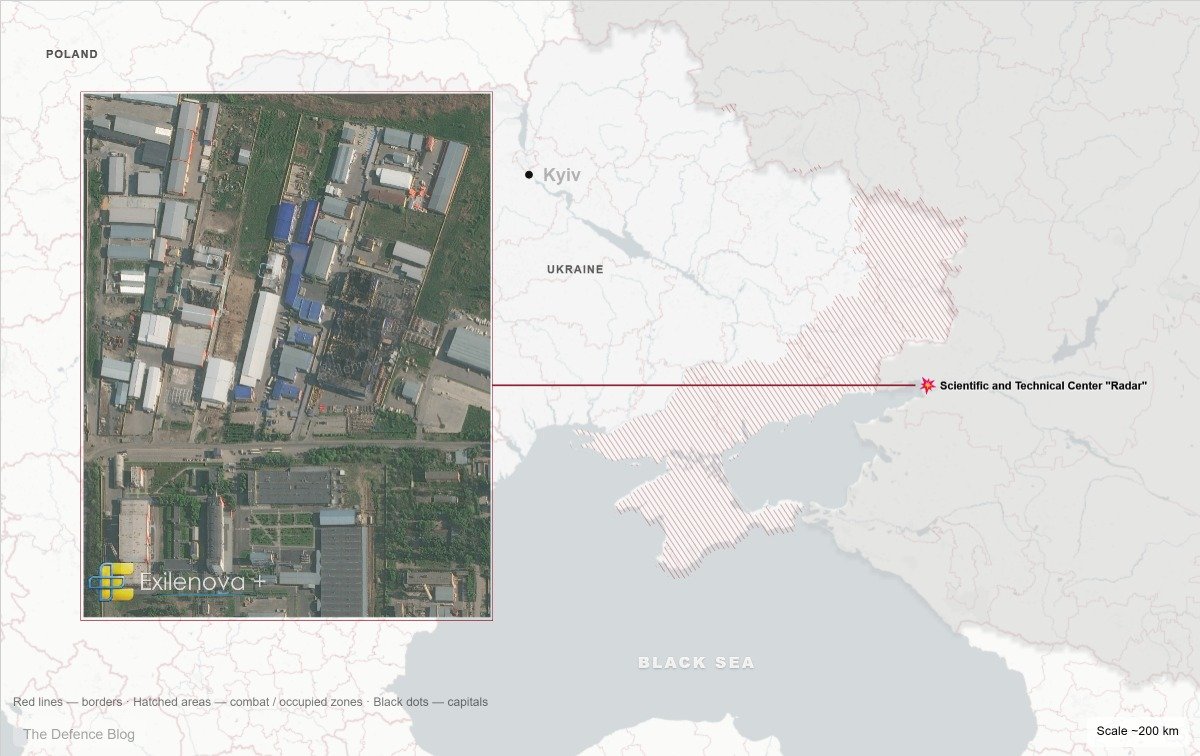
- Satellite imagery confirmed at least four hits on NTC Radar’s Rostov branch overnight between May 7 and 8, with the main building completely destroyed.
- Two additional UAVs penetrated rooftops of adjacent buildings, likely causing internal fires, per Exilenova+ analysis of commercial satellite imagery.
Satellite imagery published by the open-source intelligence community Exilenova+ has confirmed a successful Ukrainian strike on the research and production branch of the NTC Radar scientific center in Rostov, struck overnight between May 7 and 8.
According to Exilenova+, the main building was completely destroyed, while a second structure partially burned out. Two additional drone strikes hit rooftops, penetrating them and likely causing fires inside adjacent buildings whose function has not been publicly identified.
“The main building is completely destroyed, another one partially burned. Also, 2 UAVs hit the roof, piercing it and likely causing a fire inside unknown buildings nearby,” Exilenova+ stated in its published assessment. “Intelligence knows better. Targets hit. Objectives achieved.”
– ADVERTISEMENT – CONTINUE READING BELOW –
NTC Radar, formally the Scientific and Technical Center Radar, is a Russian defense research and production enterprise. Its Rostov branch represents the kind of facility that sits at the intersection of military electronics development and production — the institutional infrastructure that translates radar and electronic systems research into fielded military hardware. Strikes against facilities of this type target Russia’s defense industrial capacity at the research and development layer rather than the manufacturing floor, with the goal of disrupting the pipeline through which new and upgraded military systems reach the front. The complete destruction of the main building, if confirmed by subsequent imagery analysis, represents a significant blow to whatever programs that structure housed.
The strike fits within a broader Ukrainian campaign to reach deep into Russian territory and hit the defense industrial and military infrastructure that sustains Russia’s war effort. Ukrainian long-range drone operations have expanded steadily in geographic reach and operational ambition since 2022, with strikes recorded across multiple Russian oblasts including facilities in the Moscow region, the Urals, and now confirmed damage in Rostov. Each successful strike against a defense research or production facility forces Russia to divert resources toward reconstruction, relocate sensitive programs, or accept degraded capacity in whatever domain the targeted facility supported.
Rostov Oblast sits in southern Russia, bordering Ukraine’s Donetsk region and serving as a major logistics and command hub for Russian forces operating in the southern axis of the war. The presence of a defense research facility of NTC Radar’s profile in the region is consistent with the broader pattern of Russian military-industrial infrastructure distributed across major cities throughout the country. Striking it requires drones capable of navigating hundreds of kilometers of Russian airspace and defeating the layered air defense coverage that Russia has been progressively strengthening around its interior since Ukrainian strike capabilities began reaching deeper into Russian territory.
Ukraine has been hitting Russian radar and electronic warfare research infrastructure with increasing precision and persistence. Whether NTC Radar’s Rostov branch was working on systems actively deployed against Ukrainian forces, systems in development for future deployment, or both, the satellite imagery published by Exilenova+ shows that it is no longer working on anything at all in its main building.
[ad_2]
Source link


