
Table of Contents
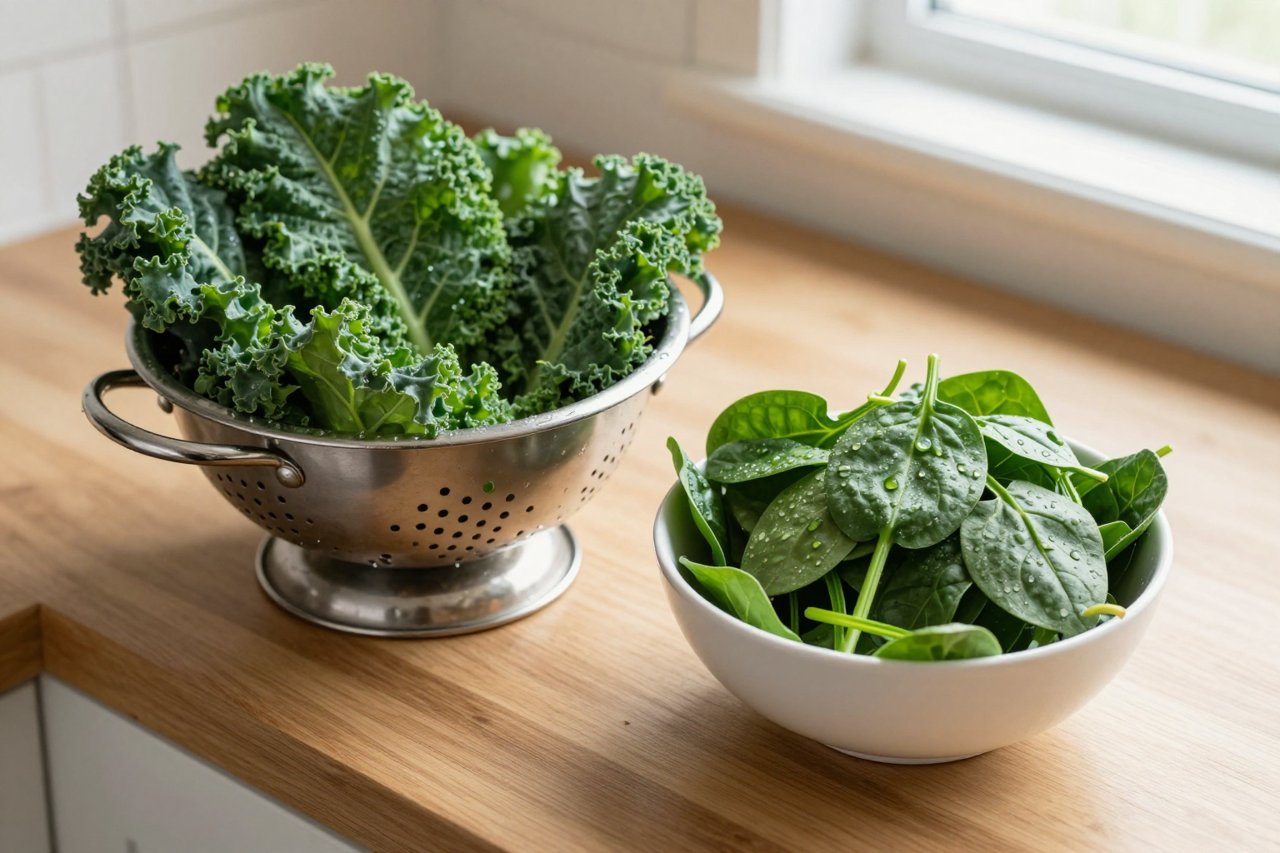
Spinach and kale occupy the same shelf in the supermarket and the same reputation in most people’s heads, but they are not interchangeable. One is soft, cheap and mild enough to disappear into a curry. The other is tough, bitter and built like a leaf that has something to prove. The nutritional differences between them are just as real, and they only matter once you stop thinking of greens as a generic health food and start caring about specific nutrients.
Here is how they actually compare, gram for gram, and what that means for the way you cook and eat them.
A 100-gram head-to-head, raw and unsalted
USDA figures for raw greens are the cleanest starting point, even if nobody eats exactly 100 grams of either one at a sitting. The pattern that emerges is fairly consistent.
- Calories: spinach 23 kcal, kale 49 kcal
- Protein: spinach 2.9 g, kale 4.3 g
- Fibre: spinach 2.2 g, kale 3.6 g
- Vitamin K: spinach 483 µg, kale 705 µg
- Vitamin C: spinach 28 mg, kale 120 mg
- Folate: spinach 58 µg, kale 141 µg
- Calcium: spinach 99 mg, kale 150 mg
- Iron: spinach 2.7 mg, kale 1.5 mg
- Potassium: spinach 558 mg, kale 491 mg
Kale takes most of the categories, sometimes by a wide margin. Spinach wins on calories, potassium and iron. But raw numbers only tell half the story, and in a couple of cases they tell a misleading one.

Calories, protein and fibre: kale is simply the denser food
A 100-gram serving of kale delivers roughly double the calories of the same weight of spinach, along with 50% more protein and 60% more fibre. That sounds like an easy win until you remember what a portion looks like. Kale is thick and dry, so 100 grams is a decent pile of leaves. Spinach is mostly water, so 100 grams is a small handful that cooks down to almost nothing.
In practice, a bowl of sautéed spinach probably contains closer to 200 grams of the raw stuff, which puts the two greens much nearer to each other than the table suggests. Fibre is the one gap that holds up: kale genuinely gives you more per realistic serving, at around 3.6 grams per 100 grams against 2.2 for spinach.
Iron: spinach wins on paper, kale wins in your body
Spinach is famous for iron, and it does contain more of it, at 2.7 mg per 100 grams versus 1.5 mg for kale. That headline has been oversold for a century. Spinach is also loaded with oxalic acid, which binds iron in the gut and drags absorption down to somewhere around 2%.
Kale has less iron but far fewer oxalates and roughly four times the vitamin C, which actively improves non-heme iron uptake. The practical consequence is that the two greens may end up delivering similar amounts of usable iron despite a 44% gap in the label figure. If you are cooking spinach and want to get more out of it, add something acidic or a source of vitamin C at the same meal: lemon on wilted spinach, tomatoes in the pan, peppers in the salad.
Calcium and bone health: kale’s quiet advantage
This is where kale pulls clearly ahead. It has more calcium to begin with (150 mg versus 99 mg per 100 grams) and, more importantly, the calcium is far more available. Absorption from kale runs at roughly 40 to 50%, comparable to milk. From spinach, it is closer to 5%, again thanks to oxalates locking the mineral up.
For anyone who avoids dairy, that difference is substantial. A cup of cooked kale contributes meaningfully to daily calcium needs; the same volume of spinach contributes almost nothing usable. Vitamin K, which both greens supply in enormous quantities, supports the bone-building process too, though kale’s 705 µg per 100 grams is one of the highest figures in the produce aisle.
Vitamin C, folate and the antioxidants that protect your eyes
Kale’s vitamin C content, at 120 mg per 100 grams raw, is higher than an orange’s. Spinach’s 28 mg is respectable but not in the same league. Both figures collapse with prolonged cooking, so if vitamin C is the goal, keep the heat brief or eat the greens raw.
Folate follows the same pattern: 141 µg for kale against 58 µg for spinach. Both are good sources, but kale is the stronger one by a wide margin, which matters during pregnancy in particular.
Lutein and zeaxanthin
Both leaves are dense with these two carotenoids, which concentrate in the retina and are linked to lower risk of age-related macular degeneration. Kale generally carries more, at somewhere between 11 and 22 mg per 100 grams depending on variety and growing conditions, while spinach sits around 12 mg. Either way, a single serving of either green covers a day’s worth comfortably. Add a little fat, olive oil or butter, to improve absorption.
Oxalates: the reason spinach gets a bad rap
Raw spinach contains somewhere between 600 and 1,000 mg of oxalate per 100 grams. Kale contains around 20 mg. That is a fifty-fold difference, and it is the single most important distinction between the two.
Oxalate is the main constituent of the most common type of kidney stone, calcium oxalate, which accounts for roughly 80% of cases. Anyone with a history of stones is usually advised to limit high-oxalate foods, and spinach sits near the top of that list while kale sits near the bottom. Oxalates also interfere with magnesium and iron absorption, which is part of why spinach’s mineral content flatters itself on paper.
Boiling helps. Cooking spinach in a large volume of water and discarding the water removes 30 to 50% of the oxalate. Steaming or sautéing does very little. If you are stone-prone, don’t tip the cooking water into the soup.
Kale’s own caveat: goitrogens and the thyroid
Kale belongs to the brassica family, which produces glucosinolates. When the leaves are chopped or chewed, these break down into compounds that can compete with iodine for uptake by the thyroid. It sounds alarming until you look at the dose. The effect shows up mainly in people eating very large amounts of raw cruciferous vegetables alongside a low iodine intake, and cooking deactivates the enzyme responsible.
For most people eating a portion or two a day, this is a non-issue. If you have an underactive thyroid, take thyroid medication, or eat kale by the bowlful in smoothies every morning, it is worth mentioning to your doctor and rotating in spinach or other greens some days.
Texture, taste and what happens in the pan
Spinach collapses. A 450-gram bag wilts into roughly a cup, which makes it ideal for folding into pasta, eggs, dal or a sauce in the last minute of cooking. Its flavour is mild and slightly sweet, with a faint chalky edge raw. Baby spinach is tender enough to eat straight from the bag; mature bunch spinach has thicker stems worth stripping.
Kale holds its shape. Curly kale needs 20 to 40 minutes in a soup before it softens properly, and it makes a sturdy salad once you massage it with oil and salt for a minute or two, which breaks down the cell walls and tames the bitterness. Lacinato, sometimes sold as cavolo nero or dinosaur kale, is sweeter and less chewy. Roasted at 200°C with a little oil, torn pieces turn crisp in 12 to 15 minutes.
Buying, storing and choosing between them
Spinach is the better buy when you want volume without a fight: it goes into everything, it’s cheaper per bag, and frozen spinach is one of the best value items in the freezer aisle, retaining most of its folate and vitamin K. Kale is the better buy when you want a green that survives a week in the fridge, stands up to heat, and gives you real calcium and vitamin C.
Storage differs too. Spinach lasts three to five days wrapped in a damp paper towel in a sealed container, and wilts fast at room temperature. Kale keeps for a week or more in a loose bag, and longer with the stems stood in an inch of water like flowers. Both freeze well once blanched, though the texture turns soft, which suits soups and stews rather than salads.
A week that includes both greens covers what each one lacks: spinach for potassium, iron volume and cheap bulk in cooked dishes, kale for calcium, vitamin C, folate and a negligible oxalate load. Two bunches, two jobs, no need to pick a side.


