
Table of Contents
[ad_1]
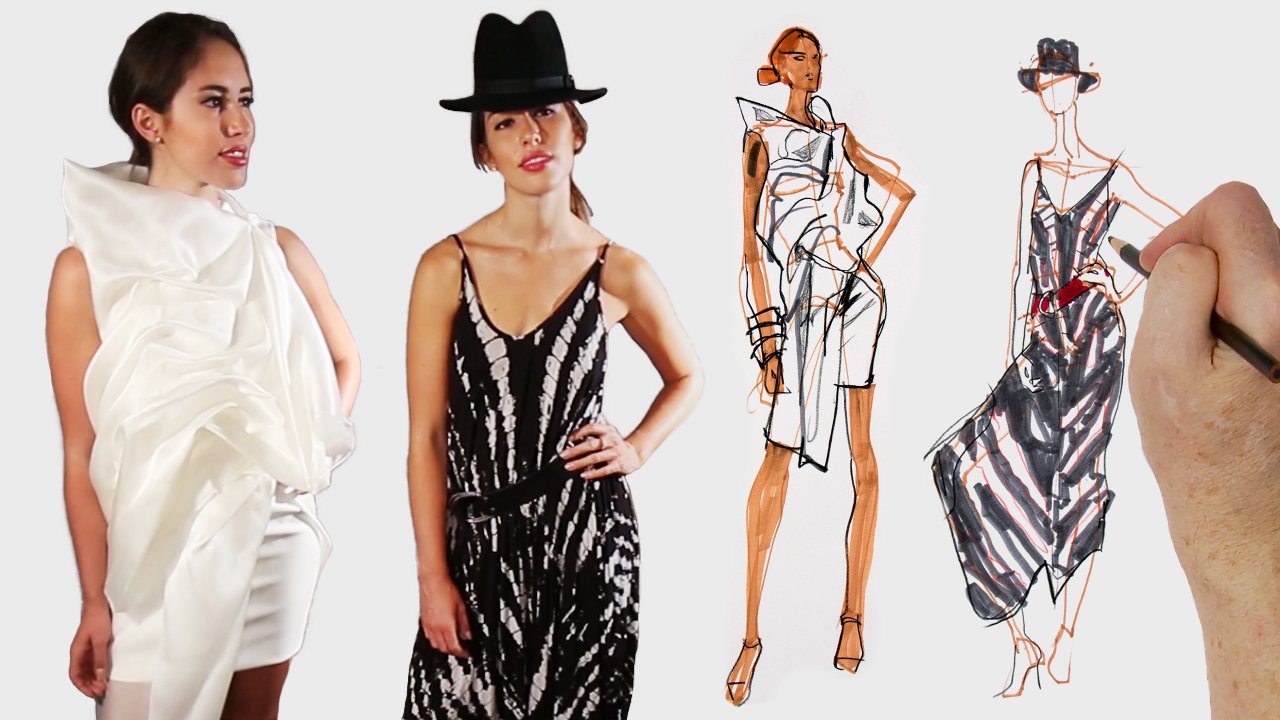
 From University of Fashion’s lesson – Model Drawing: Non-Classic Silhouettes & Poses. (Image credit: University of Fashion)
Fashion model drawing is often misunderstood as simply sketching what you see. In reality, it is a disciplined process of interpretation, structure, and intention. When working from a live model, you are not just copying a body—you are translating form, movement, and design into a visual language that communicates clothing.
Understanding Proportion Mapping the 9 ½ head fashion pose from UoF’s lesson Model Drawing: Fashion Proportion & Movement. (Image credit: University of Fashion)
 Mapping the 9 ½ head fashion pose from UoF’s lesson Model Drawing: Fashion Proportion & Movement. (Image credit: University of Fashion)
One of the first principles to understand is proportion. In fashion illustration, we commonly use the 9½-head figure, an elongated version of the human body that enhances elegance and emphasizes the garment. This is not about realism; it is about idealization. The extended proportions create space for design and movement, allowing the clothing to take center stage.
Mapping the Action Line, Center Front & Balance Line Mapping the action line, center front and balance line from UoF’s lesson Model Drawing: Fashion Proportion & Movement. (Image credit: University of Fashion)
 Mapping the action line, center front and balance line from UoF’s lesson Model Drawing: Fashion Proportion & Movement. (Image credit: University of Fashion)
From there, you begin with the action line—the visual spine of the pose. This line captures the energy and flow of the model and sets the tone for the entire drawing. Supporting this is the balance line, which ensures that your figure feels grounded, even in dynamic poses. You will also establish the center front line, a critical guide that helps you understand how the body—and therefore the garment—turns in space.
Gesture Drawing Mapping the gesture from UoF’s lesson Model Drawing: Fashion Proportion & Movement. (Image credit: University of Fashion)
 Mapping the gesture from UoF’s lesson Model Drawing: Fashion Proportion & Movement. (Image credit: University of Fashion)
Gesture drawing becomes your foundation. It is fast, expressive, and focused on movement rather than detail. A strong gesture captures life in just a few lines. Without it, even the most detailed rendering will feel stiff.
Cylindrical Perspective Mapping the cylindrical perspective from UoF’s lesson Model Drawing: Fashion Proportion & Movement. (Image credit: University of Fashion)
 Mapping the cylindrical perspective from UoF’s lesson Model Drawing: Fashion Proportion & Movement. (Image credit: University of Fashion)
Another essential concept is cylindrical perspective. The human body is not flat; it exists in three dimensions. Limbs, the torso, and even the neck should be understood as forms wrapping around an axis. Thinking in cylinders allows you to correctly place contours, seams, and shadows, giving your drawing depth and realism.
Pose vs Garment Silhouette Understanding pose choice based on garment silhouette from UoF’s lesson Model Drawing: Various Poses for Different Silhouettes. (Image credit: University of Fashion)
 Understanding pose choice based on garment silhouette from UoF’s lesson Model Drawing: Various Poses for Different Silhouettes. (Image credit: University of Fashion)
Equally important is the silhouette. The shape of the clothing—whether it clings tightly to the body or drapes loosely—dictates how the figure should be posed. This is where many beginners make a critical mistake: they choose a pose first, often inspired by a magazine image, and then try to fit their design into it. This approach rarely works.
In fashion drawing, the design must come first. The pose is not arbitrary—it is a tool to showcase the garment.
The Form-Fitting Pose For a form-fitting silhouette the pose should support and reveal the contours of the body. From UoF’s lesson Model Drawing: Various Poses for Different Silhouettes. (Image credit: University of Fashion)
 For a form-fitting silhouette the pose should support and reveal the contours of the body. From UoF’s lesson Model Drawing: Various Poses for Different Silhouettes. (Image credit: University of Fashion)
For example, if you are designing a form-fitting outfit, the pose should support and reveal the contours of the body. A stance where the legs form a wide triangle would disrupt the line and obscure the garment’s shape.
 From UoF’s lesson Model Drawing: Pant Poses. (Image credit: University of Fashion)
On the other hand, if you are designing wide-leg pants, that same triangular stance could enhance the volume and movement of the fabric, creating a casual and relaxed effect.
Evening Wear & Tailored Silhouette PosesFrom UoF’s lesson Model Drawing: Evening & Tailored Garments (Image credit: University of Fashion)
 From UoF’s lesson Model Drawing: Evening & Tailored Garments (Image credit: University of Fashion)
Every decision you make—from proportion to pose—should serve the clothing. For example, an evening wear pose should be a dramatic, exaggerated pose, with an elongated neck and perhaps a back view that features a low back neckline. The goal is not to create an interesting figure, but to create a compelling presentation of your design.
When you begin to think this way, your drawings shift from sketches into intentional fashion illustrations. You are no longer just observing—you are designing with purpose.
University of Fashion’s Model Drawing Lesson Series For more on drawing from a real-life model, view our entire Model Drawing lesson series, taught by Richard Rosenfeld. Richard has taught fashion illustration at Parsons and at FIT for 30+ years and is the Master!
[ad_2]
Source link


