
Table of Contents
Black holes are the universe’s ultimate enigmas—regions where gravity is so intense that nothing, not even light, can escape. For decades, they existed only in the equations of Einstein’s general relativity, a theoretical curiosity that seemed too bizarre to be real. Today, we have images of their shadows, detections of their gravitational waves, and a growing understanding that they are not just real, but common. In the center of the Milky Way alone, a supermassive black hole called Sagittarius A* holds the mass of about 4 million suns. Yet, for all we know, black holes remain deeply strange places where the known laws of physics break down. Let’s explore what we actually know—and what we don’t.
How Black Holes Form
Black holes are born from the death of massive stars. When a star with more than about 20 times the mass of the Sun runs out of nuclear fuel, its core collapses under its own gravity. The outer layers explode in a supernova, but the core compresses into an infinitely dense point—a singularity. The immense gravity of this singularity warps spacetime around it, creating a region from which nothing can return: the black hole.
Stellar-Mass Black Holes
These are the most common type, ranging from a few to tens of solar masses. Astronomers have detected dozens of them in binary systems where they pull matter from a companion star, heating the gas to millions of degrees and emitting X-rays. Cygnus X-1, discovered in 1964, was one of the first strong candidates.
Supermassive Black Holes
At the centers of most large galaxies, including our own, lurk supermassive black holes with masses millions to billions of times that of the Sun. How they grew so large remains an open question. They may have formed from the collapse of enormous gas clouds in the early universe, or from the merger of smaller black holes over cosmic time. The Event Horizon Telescope’s 2019 image of the black hole in M87 revealed a glowing ring of hot plasma around a dark shadow—the direct signature of a supermassive black hole.

The Anatomy of a Black Hole
A black hole isn’t a ‘hole’ in space; it’s a region of extreme gravity. Key features include:
- Singularity: The infinitely dense core where all the mass is concentrated. Spacetime curvature becomes infinite here, and our equations fail.
- Event Horizon: The boundary around the singularity. Once crossed, nothing—not even light—can escape. It’s not a physical surface but a point of no return.
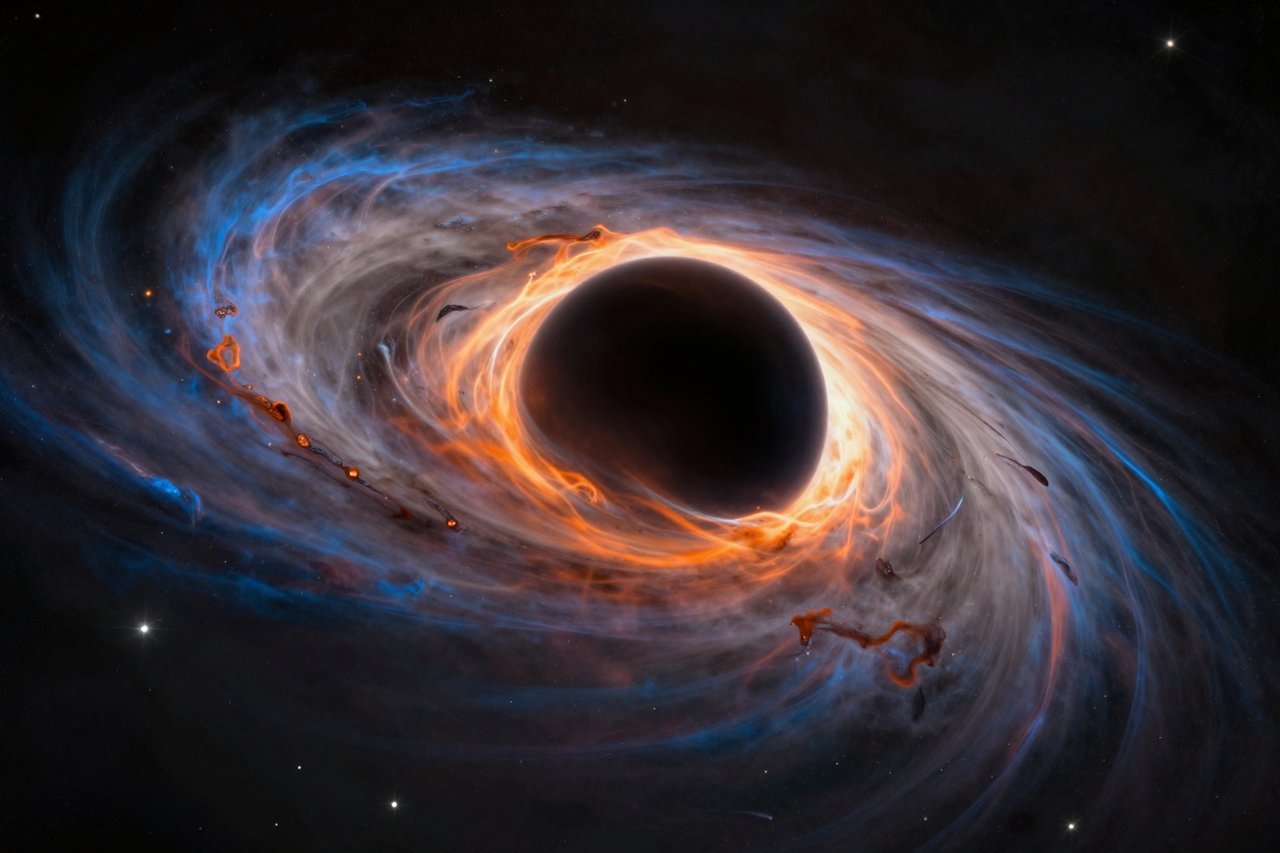
- Photon Sphere: A region just outside the event horizon where gravity is so strong that photons orbit the black hole. This creates the ‘shadow’ seen in images.
- Accretion Disk: A swirling disk of gas and dust heated to extreme temperatures as it falls inward, emitting X-rays and visible light.
What Happens When You Fall In?
If you were to fall into a black hole, the experience would be both terrifying and bizarre. As you approach the event horizon, time dilation becomes extreme. An observer far away would see you slow down, eventually freezing at the horizon, your image red-shifting to invisibility. From your perspective, however, you’d cross the horizon uneventfully—unless the black hole is small. For a stellar-mass black hole, tidal forces would stretch you into a thin strand of atoms—a process called spaghettification—long before you reach the horizon. For a supermassive black hole, you’d cross the horizon intact, then be slowly pulled toward the singularity.
Once inside, the concept of ‘direction’ changes. The singularity is not a point in space but a moment in the future—you cannot avoid it. As you fall, spacetime becomes so curved that all paths lead to the singularity. There, the laws of physics as we know them cease to apply.
Black Holes and the Limits of Physics
Singularities are a problem. In a singularity, general relativity predicts infinite density and curvature, a breakdown of predictability. This suggests that Einstein’s theory is incomplete—it doesn’t account for quantum mechanics. Physicists believe that a theory of quantum gravity, like string theory or loop quantum gravity, would replace the singularity with something else, perhaps a ‘quantum bounce’ or a fuzzball structure. But we don’t have that theory yet.
The Information Paradox
Stephen Hawking famously showed that black holes emit radiation and slowly evaporate. This raises a puzzle: if a black hole forms from matter that contains information, and then evaporates into random radiation, does the information disappear? That would violate quantum mechanics. The debate rages on, with solutions ranging from ‘hair’ on black holes to holographic principles.
Gravitational Waves: A New Window
In 2015, LIGO detected gravitational waves from two black holes merging. This confirmed a key prediction of general relativity and opened a new way to study black holes. Since then, dozens of mergers have been observed, revealing black holes of unexpected masses. For example, GW190521 involved two black holes of 85 and 66 solar masses, forming a 142-solar-mass black hole—the first direct evidence of an intermediate-mass black hole.
Black Holes as Cosmic Laboratories
Black holes are not just destructive; they are engines of creation. The jets they produce can trigger star formation in surrounding galaxies. Their immense gravity can lens light from distant objects, acting as natural telescopes. And they may hold clues to the nature of dark matter and the early universe. Some theories suggest that primordial black holes, formed in the first moments after the Big Bang, could be a component of dark matter.
In the coming years, the James Webb Space Telescope and next-generation gravitational wave observatories will push our knowledge further. We may finally see the first stars being swallowed by black holes, or detect the faint ripples from the Big Bang itself.
Black holes are not just cosmic vacuum cleaners; they are the most extreme environments in the universe, where gravity reigns supreme and our deepest theories are put to the test. They remind us that the universe is far stranger and more wonderful than we can imagine.


