
Table of Contents
Around 3200 BCE, a scribe in the Mesopotamian city of Uruk pressed a cut reed into wet clay and recorded a delivery of barley. It’s one of the oldest pieces of writing anyone has found, and it reads like an invoice. Not a poem. Not a prayer. A receipt for grain.
That detail says a lot about the oldest civilizations in human history. They were built by people who needed to track food, labour and water, and the machinery they invented to do it, including writing, calendars, laws and tax rolls, is what we eventually bundled together and called civilization.
The rankings themselves are messier than school textbooks suggest. Change the definition and the leaderboard reshuffles.
What has to be true before we call something a civilization
Archaeologists look for a cluster of features rather than one magic ingredient: cities big enough that residents didn’t all know each other, specialised trades, food surpluses stored somewhere central, monumental construction, and some system of administration. Writing helps a great deal, but it isn’t mandatory.

The Indus Valley had grid-planned cities and covered drains but no readable script. Caral, in Peru, had pyramids and apparently no pottery. Neither was less sophisticated. They just organised themselves differently, and that difference is exactly what makes the list so arguable.
Mesopotamia: the answer most historians give first
The land between the Tigris and Euphrates is where the pieces came together earliest and most visibly. By 3500 BCE, Uruk was a real city, and it kept swelling. Estimates for its peak population run between 40,000 and 80,000 people, protected by a mud-brick wall with a circuit of roughly 9.5 kilometres. Later storytellers credited that wall to Gilgamesh, who may or may not have been a historical king of the city.
Uruk, Ur, Lagash and Nippur were all functioning urban centres with temples, workshops and bureaucrats before most of the world had permanent villages. The regional arc, from the first Sumerian city-states through the Akkadian, Babylonian and Assyrian empires, is traced in this history of the Middle East as the cradle of civilizations.
Writing that began as inventory
Cuneiform started as pictographs for quantities of barley, beer and livestock. Within a few centuries it was recording myths, treaties and legal codes. The Code of Ur-Nammu, carved around 2100 BCE, is the oldest surviving law code, and it sets fines for assault and rules on divorce.
My favourite artefact from the whole period is a clay tablet from about 1750 BCE in which a customer named Nanni complains that the copper ingots he paid for never arrived. The merchant, Ea-nasir, appears to have kept the complaint filed away with others like it. People have been people for four thousand years.
Ancient Egypt: a river, a calendar, and an unreasonable amount of stone
Egypt unified around 3100 BCE, and its writing system appeared at almost the same moment, with hieroglyphic labels found in royal tombs at Abydos dated to roughly 3250 BCE. The Nile made the whole thing possible. Its flood was annual, gentle and predictable, laying down fresh silt on fields that never needed fallow years.
Compare that to Mesopotamia, where floods arrived violently and without warning. You can see the difference in the religion. Egyptian gods mostly upheld order; Mesopotamian gods had to be negotiated with, bribed and occasionally tricked.
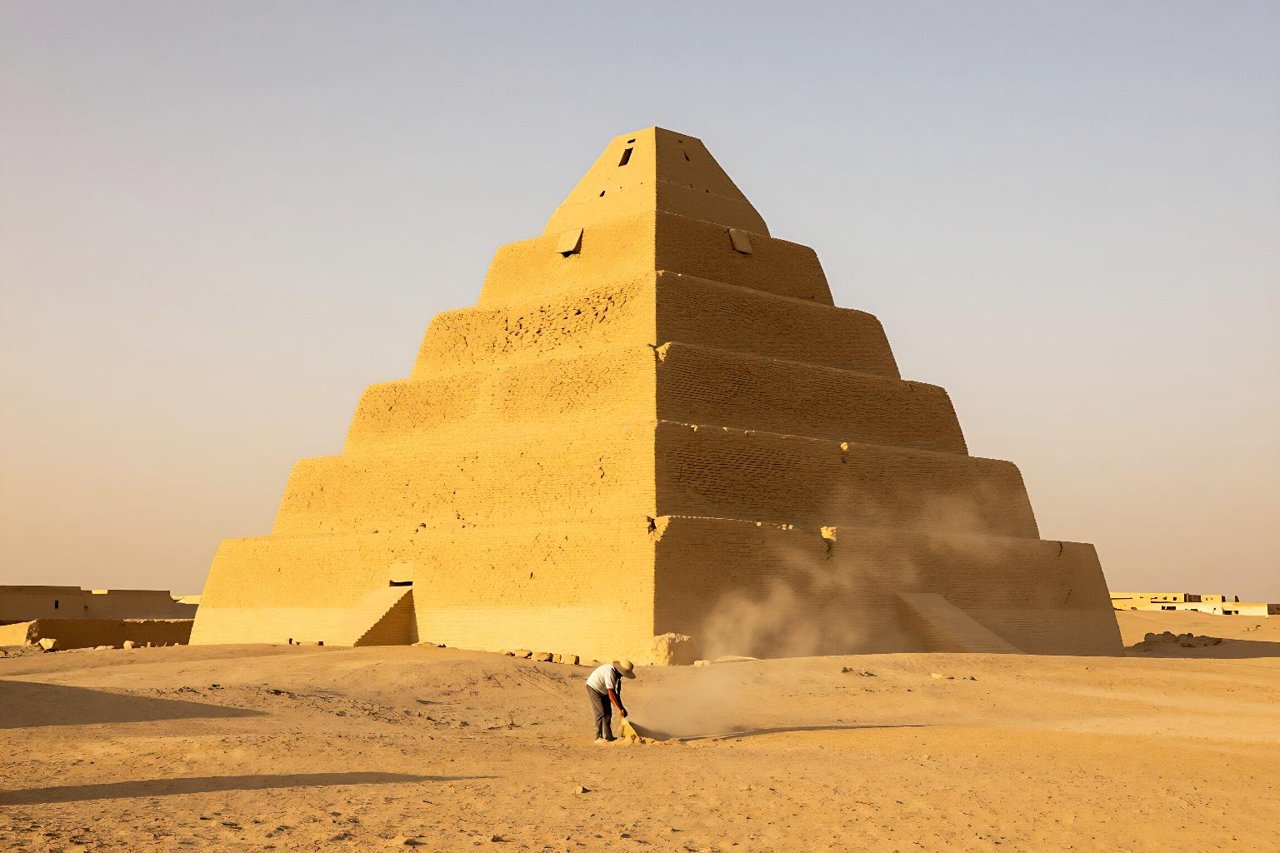
The Great Pyramid at Giza went up around 2560 BCE using roughly 2.3 million blocks. It stood as the tallest structure on Earth for nearly 3,800 years, which is a record no modern building has come close to touching.
The Indus Valley: a million square kilometres and no obvious king
The Harappan civilization covered more ground than Egypt and Mesopotamia combined, spreading across what is now Pakistan and northwestern India. Its mature phase ran from about 2600 to 1900 BCE, though farming communities at places like Mehrgarh go back to 7000 BCE.
What confuses archaeologists is how little pomp there is. Mohenjo-daro and Harappa have streets laid out on a grid, houses with private wells and bathrooms, and a sewage system that carried waste away from the buildings. Bricks were fired to a standard ratio of 1:2:4 across the entire territory. Excavators have found no vast royal tombs, no obvious palaces and no monument glorifying a single ruler.
- Around 4,000 inscribed seals survive, and the script remains undeciphered.
- Standardised weights and measuring sticks appear in nearly every excavated town.
- Lothal had what looks like a tidal dockyard for coastal trade with Mesopotamia.
- The decline coincides with rivers shifting course and monsoon rains weakening over centuries.
Caral-Supe: the surprise in the Peruvian desert
For decades the Americas were assumed to lag behind the Old World by thousands of years. Then work at the Supe Valley site of Caral, about 200 kilometres north of Lima, dated occupation to roughly 3000 BCE, putting it in the same bracket as Egypt’s unification.
The Norte Chico region holds more than 30 sites from the same culture. Caral alone has six platform mounds arranged around a plaza, including a pyramid about 28 metres tall, all built by people who had no pottery and no writing. They fed the workforce on anchovies netted from the coast and cotton grown in the valley, and they apparently traded cotton cloth inland for fish. In 2005, researchers found knotted cords at Caral, an early form of the record-keeping system later used by the Inca.
China and the Yellow River question
China’s earliest urban centres cluster along the middle Yellow River. Erlitou, occupied between roughly 1900 and 1500 BCE, had bronze foundries, a palace complex and roads, and many Chinese archaeologists link it to the Xia dynasty. The trouble is that the Xia are described in texts written many centuries later, and no inscription at Erlitou names them.
The Shang dynasty, from about 1600 BCE, is beyond dispute. Oracle bones inscribed with divination questions give us the earliest large body of Chinese writing, and the questions on them are wonderfully mundane: will the harvest hold, does the king’s toothache mean something, should we attack the neighbouring state.
Africa’s other old powers
Egypt tends to hog the continent’s ancient spotlight, but Kerma in Nubia, in what is now Sudan, was building a monumental mud-brick temple and burying rulers with thousands of retainers around 2500 BCE. The kingdom of Kush went on to rule Egypt itself for nearly a century, and Meroë later became a major iron-producing centre. The wider story, including the empires of Ghana, Mali and Great Zimbabwe, sits in this history of Africa from humanity’s cradle to independence.
Why the starting dates keep sliding backwards
Part of the confusion around the oldest civilizations is that archaeologists keep finding older material. Göbekli Tepe in Turkey pushed monumental stone architecture back to 9500 BCE, thousands of years before farming took hold nearby. Jericho had a stone wall and tower around 8000 BCE. Çatalhöyük housed thousands of people in mud-brick homes entered through the roof.
Those were settlements, not civilizations, and the distinction matters, but the line between them gets blurrier every decade. A running list of the earliest known towns is here: the oldest human settlements ever found. Meanwhile, aerial laser scanning and satellite imagery are turning up entire landscapes of canals and platforms that nobody had mapped, which is exactly how lasers, drones and droughts are rewriting the human story.
What brought almost all of them down
Three pressures show up again and again. The first is water management gone wrong. Irrigating the same fields for centuries raises the salt table, and Mesopotamian records show wheat yields collapsing as barley, which tolerates salinity better, took over. Scribes even had a term for salt crusting the soil.
The second is a shift in the rivers themselves. The Indus cities lost their water as the Ghaggar-Hakra system changed course and the monsoon weakened. The third is political fracture, often following a climate shock that a centralised state couldn’t absorb.
None of these places ended overnight. Uruk was still inhabited after Alexander the Great passed through, thousands of years after its glory days. Egypt survived invasion, occupation and dynastic collapse and kept re-forming. The pattern of rise, overreach and disappearance is the subject of how the first great powers rose, ruled and lost everything, and it’s less a moral fable than a study in institutional flexibility.
What strikes me most is how mundane the foundations were. Every one of these civilizations started with a group of people who figured out how to store a surplus, keep a record of it, and share the water that grew it. The temples and pyramids came later, and the receipts came first.


