
Table of Contents
Most holidays follow a familiar shape: a coastal town, a shortlist of restaurants, a few slow days working through the best things to do in Marmaris or wherever the cheap flights pointed. Nothing wrong with that. But every so often a hotel comes along that makes the destination almost irrelevant, because the building itself is the reason you booked.
The places below range from a salt-brick lodge on a Bolivian salt flat to a floating bedroom four metres beneath the Indian Ocean. Some cost less than a mid-range city hotel. Others cost more than a small car. All of them are genuinely strange, and all of them are bookable.
1. Palacio de Sal, Bolivia: a hotel made of salt
The Salar de Uyuni is the largest salt flat on earth, roughly 10,500 square kilometres of blinding white crust at about 3,650 metres above sea level. Sitting at its edge is a hotel where the walls, floors, ceilings, chairs, tables and bed frames are cut from salt blocks harvested straight from the ground.
The original building went up in the 1990s and was replaced by a larger, smarter version in 2007. There is a strict house rule that guests are asked not to lick the walls, which tells you something about how previous visitors behaved. Nights are cold and the air is thin, so the hotel leans into comfort: a sauna, a bar, and thick walls that hold the heat surprisingly well.

What it costs
Doubles typically run from around $130 to $180 a night, which makes it one of the cheapest entries on this list. The trade-off is altitude and a long transfer from Uyuni town.
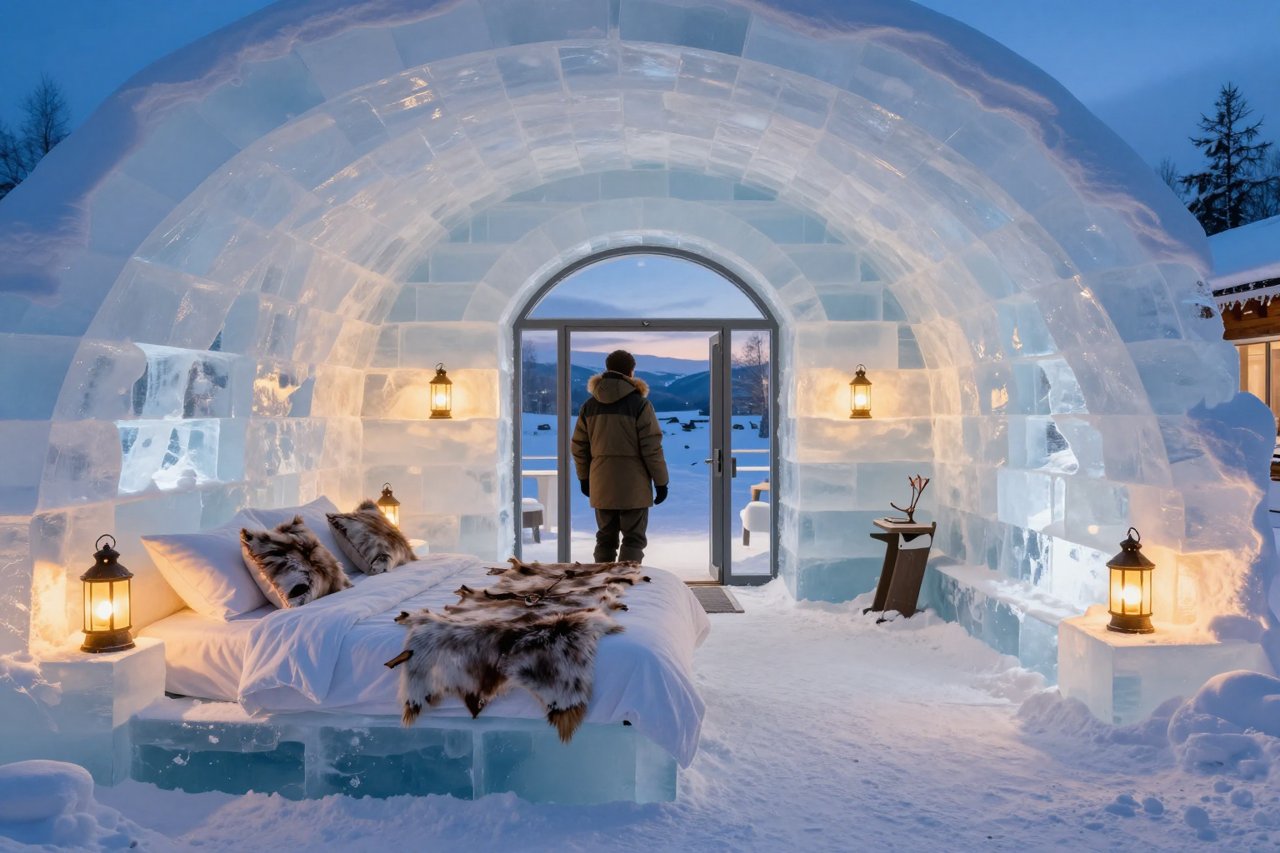
2. Icehotel, Jukkasjärvi, Sweden: rebuilt from scratch every winter
About 200 kilometres north of the Arctic Circle, the Icehotel is constructed each year from roughly 1,000 tonnes of ice pulled out of the Torne River. Artists submit designs, are selected, and spend weeks carving suites by hand. In spring, the whole thing melts back into the river and the cycle starts again.
Indoor temperatures in the cold rooms sit between about -5°C and -8°C. You sleep in a thermal sleeping bag on a bed of ice covered with reindeer hides. Staff wake you with a hot lingonberry drink in the morning, and there are warm rooms on site if one night in a freezer is enough for you. The original Icebar is here too, where the glasses are carved from ice and get quietly smashed when they start to melt.
What it costs
A cold room is usually the cheaper option, starting around $300 for the night, while the elaborate art suites climb past $1,000. Many guests book one cold night and several warm ones.
3. The Manta Resort Underwater Room, Pemba Island, Zanzibar
This one is a three-storey floating structure moored off the coast of Pemba Island. The top deck is for sunbathing, the sea level deck is for eating and doing very little, and the bedroom sits about four metres below the surface, wrapped in glass panels on all sides.
At night, spotlights attract squid and small reef fish, and you fall asleep watching them drift past your pillow. It is not a submarine and it does not move much, but the effect is close to sleeping inside an aquarium. Guests reach it by boat from the resort’s shore, and the isolation is the point.
What it costs
Rates start upwards of $1,500 a night for two, often including meals and transfers. This is the splurge entry, and it books out months ahead.
4. Free Spirit Spheres, Vancouver Island, Canada
Three wooden spheres hang in the temperate rainforest near Qualicum Beach, suspended from trees by ropes and cables like unusual fruit. Each one is roughly three metres across, with a bed, a small table, a kettle and a window that looks straight into the canopy.
The spheres sway gently when the wind picks up. That either sounds magical or slightly alarming, and the honest answer is that it depends on how well you sleep on a boat. Access is via a spiral staircase and a suspension bridge, so luggage needs to be manageable.
What it costs
Expect around $300 to $400 a night depending on the sphere and the season. There are only three of them, so availability decides your dates rather than the other way round.
5. Giraffe Manor, Nairobi, Kenya
A 1930s manor house on the edge of a forest in the Nairobi suburbs, with 12 rooms, well-kept lawns, and a herd of Rothschild’s giraffes that have worked out exactly when breakfast is served. They lean through the dining room windows and take pellets from your hand while you sit there with a coffee going cold.
It sounds like a gimmick until you learn the background. The giraffe population here was part of a breeding programme that helped bring the subspecies back from very low numbers, and the animals roam a protected sanctuary next door. The house itself is old-colonial in style, with four-poster beds and afternoon tea on the terrace.
What it costs
Rates run past $1,000 per person per night, including meals, drinks and transfers. The paperwork to get there is modest, though. Kenya now uses an electronic travel authorisation for most visitors, and honestly that is the easy end of bureaucracy compared with the situations people run into when love requires government permission before a couple can even share a surname.
6. Kakslauttanen Arctic Resort, Finland: glass igloos under the aurora
Deep in Finnish Lapland, about 250 kilometres above the Arctic Circle, Kakslauttanen offers guests small domes with thermal glass roofs. The glass stays clear at temperatures well below freezing, so you can lie in bed and watch the northern lights without getting dressed.
Aurora season runs from late August to April, with the best odds between December and March on clear nights. The resort also has traditional snow igloos, log cabins and what it claims is the largest smoke sauna in the world. Reindeer herding and husky sledding are on the doorstep, and the nearest airport is a 30-minute transfer away.
What it costs
Glass igloos generally start around $500 a night in high season, with two-person domes and larger family versions priced higher. Book early: aurora weeks sell out a year ahead.
7. Propeller Island City Lodge, Berlin
Artist Lars Stroschen turned a Berlin apartment building into somewhere between a hotel and an installation. Each of the roughly 30 rooms follows its own strange logic. One has all the furniture bolted to the ceiling. Another has beds shaped like coffins. Another is padded entirely in white. A few have beds that hang from the walls on chains.
It is not luxurious in any conventional sense. Bathrooms are shared on some floors, sound travels, and the whole place feels like a squatted art project that never quite ended. That is precisely why people book it, and why it is still running decades after opening.
What it costs
Rooms sit somewhere between about €100 and €200 a night, which makes it the most affordable strange night out on the list. Berlin being Berlin, you are a short walk from the city’s late-night bars if the coffin bed is too much.
How to book a strange hotel without wrecking your budget
Unusual hotels are a specific kind of expense: high per night, often short stay, and usually far from an airport. A few things help before you commit.
- Check the transfer cost first. A $150 salt hotel in Bolivia can involve a flight, a bus and a four-hour drive. That is often the real price.
- Read the practical notes, not just the photos. Shared bathrooms, no wifi, cold rooms, fixed meal times. These are features, not faults, but you should know in advance.
- Book one night of novelty, not five. A freezer or a hanging sphere is magic for a night and tiring for a week.
- Balance it against cheap travel elsewhere. One splurge night sits much better in a trip built on cheap vacations that don’t feel cheap.
- Watch the season. Ice hotels only exist in winter, aurora domes only pay off on clear nights, and salt flats flood briefly each year.
There is one more option worth knowing about if this list has not gone far enough: the Null Stern concept in the Swiss Alps, where the “room” is a bed on an open concrete platform in a field with no walls, no ceiling and a butler on call. It is weather-dependent, booked per night, and yes, people really do it.
Whichever one you pick, go for the story rather than the thread count. A hotel made of salt is remembered for decades. A perfectly fine business hotel is forgotten by Tuesday.


